Every year on 4 November, the Catholic Church celebrates Saint Charles Borromeo, Archbishop of Milan, a great reformer of the Church and an exceptional figure of Christian charity. This man of faith, who lived in the 16th century, devoted his life to prayer, religious teaching, the training of priests and helping the poorest of the poor.
Born into a noble family and destined for a brilliant career, Charles Borromeo chose to devote his responsibilities and privileges to the service of God. His life story is that of a man who, despite honours and difficulties, constantly sought to follow the example of Jesus Christ.
His dedication to caring for the sick during the terrible plague of Milan, his devotion to the Eucharist and his desire to renew the spiritual life of the faithful have left a profound mark on the history of the Church.
Even today, Saint Charles Borromeo remains an example of humility, courage, fidelity and love for one’s neighbour. His life invites us to reflect on our own way of living out our faith and on the place we give to others in our daily lives.
The origins of Saint Charles Borromeo: a childhood marked by faith
Charles Borromeo was born on 2 October 1538 at Arona Castle, near Lake Maggiore, in northern Italy. He belonged to the powerful Borromeo family, a family of the Italian nobility with close ties to the major political and religious authorities of his time.
His father, Gilbert Borromeo, was Count of Arona, whilst his mother, Margaret de’ Medici, came from an influential family. Charles thus grew up in a privileged environment, where there were numerous opportunities to attain high office.
However, from childhood onwards, he showed a particular interest in religious life. He received the tonsure at a young age and pursued studies that prepared him to take on responsibilities within the Church.
In particular, he studied civil and canon law at the University of Pavia, where he obtained his doctorate in 1559.
This solid intellectual grounding would play a vital role in his future work. Charles Borromeo realised very early on that knowledge, when placed at the service of the faith, can help guide people towards God.
His life story reminds us that talents, knowledge and responsibilities only take on their true meaning when they are used to do good.
A rapid rise in the service of the Church
In 1559, a decisive event turned the young Charles’s life on its head: his maternal uncle, Giovanni Angelo de’ Medici, became Pope under the name Pius IV.
The new Supreme Pontiff summoned his nephew to Rome and quickly entrusted him with important administrative and religious responsibilities.
In 1560, when he was just 21 years old, Charles Borromeo was created a cardinal. He was also appointed administrator of the Archdiocese of Milan, although he was not yet able to personally carry out all the duties of a bishop there.
At that time, it was common for the popes’ close associates to be appointed to important posts. However, Charles Borromeo gradually distinguished himself through his seriousness, his rigour and his deep desire to serve the Church.
He played an active part in the affairs of the Holy See and contributed to the resumption and subsequent completion of the Council of Trent.
Despite his young age, he demonstrated a great capacity for work and remarkable determination.
But his spiritual life also underwent a profound transformation.
The death of his elder brother, Frederick, in 1562, had a profound effect on him. This event reminded him of the fragility of human existence and the importance of dedicating his life to that which is eternal.
Whilst some members of his family envisaged a different future for him, Charles chose to pursue his religious vocation wholeheartedly.
He was ordained a priest in 1563, then consecrated a bishop in the same year.
This decision demonstrated his determination not to regard ecclesiastical offices merely as positions of honour, but as a genuine spiritual mission.
Saint Charles Borromeo and the Council of Trent: renewing the Church from within
The 16th century was a particularly difficult period for the Catholic Church.
The Protestant Reformation profoundly shook Western Christendom. Numerous questions arose concerning the training of priests, ecclesiastical discipline, the teaching of the faith and the spiritual life of the faithful.
To address these challenges, the Church convened the Council of Trent, which took place in several sessions between 1545 and 1563.
Charles Borromeo played an important role in the work of the council’s final phase, particularly through his responsibilities under Pope Pius IV.
After the council concluded, he became one of the key figures in implementing its decisions.
He was convinced that genuine reform could not be limited to texts or administrative decisions.
To renew the Church, one must first renew hearts.
This conviction guided all his actions.
He encouraged bishops to reside in their dioceses, to visit parishes regularly and to care for the faithful entrusted to them.
He emphasises the need to train priests capable of clearly teaching the Catholic faith, of celebrating the sacraments with dignity and of providing spiritual guidance to their communities.
He also attaches great importance to catechesis, so that both children and adults may better understand the foundations of their faith.
For Saint Charles Borromeo, the reform of the Church begins with the personal conversion of those who serve it.
His teaching remains particularly relevant today: no spiritual responsibility can be fully fulfilled without humility, consistency and fidelity to the Gospel.
The Archbishop of Milan: a shepherd close to his people
In 1565, Charles Borromeo settled permanently in Milan, where he was now Archbishop.
He discovered a vast diocese in need of numerous reforms. Some parishes lacked proper leadership, religious education was sometimes inadequate, and pastoral practices needed to be improved.
Rather than governing solely from his episcopal palace, Charles Borromeo decided to go out and meet the faithful.
He undertook numerous pastoral visits, travelling through the towns, villages and mountainous regions of his diocese.
These journeys were sometimes long and arduous, but he wished to understand the needs of the Christian communities first-hand.
He met with priests, visited churches, took an interest in the living conditions of the inhabitants and ensured the quality of religious education.
He also organised diocesan synods and provincial councils aimed at improving the life of the local Church.
His aim was simple: to enable every member of the faithful to find genuine spiritual guidance within the Church.
He pays particular attention to children, families on modest incomes and those who have drifted away from religious practice.
For him, being a bishop does not simply mean exercising authority. Above all, it means becoming a servant of the people of God.
This understanding of the pastoral mission is directly in line with Christ’s teaching:
‘The Son of Man did not come to be served, but to serve. ” (Mark 10:45)
The establishment of seminaries and the importance of priestly formation
One of Saint Charles Borromeo’s great contributions to the history of the Church concerns the formation of the clergy.
In his day, the standards of preparation for the priesthood were very uneven. Some priests had a solid theological education, whilst others struggled to teach Christian doctrine or to guide the faithful.
Charles Borromeo regarded this situation as a major obstacle to the spiritual life of the communities.
He therefore promoted the establishment of seminaries, in accordance with the guidelines of the Council of Trent.
In Milan, he founded institutions designed to train future priests, both intellectually and spiritually.
He wanted seminarians to learn not only theology, the Scriptures and the liturgy, but also prayer, personal discipline and a sense of service.
In his view, a priest must be a man of faith before being a man of office.
He must know how to listen, advise, teach and accompany people through the various stages of their lives.
St Charles Borromeo’s influence on priestly formation was to be enduring. His work helped to make the seminary an essential institution of the Catholic Church.
It is notably for this reason that he is today recognised as one of the patron saints of seminarians.
The plague of Milan in 1576: the extraordinary courage of Saint Charles Borromeo
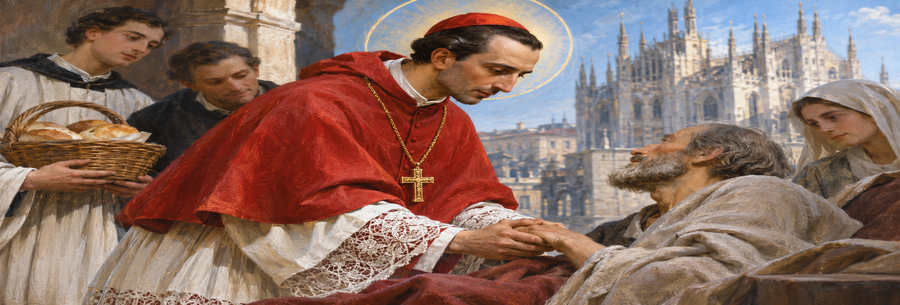
The most famous episode in the life of Saint Charles Borromeo took place during the terrible plague epidemic that struck Milan in 1576.
The disease spread rapidly and caused deep anxiety amongst the population.
The inhabitants lived in fear of contagion. Many families were struck down by the disease, whilst the authorities sought to limit the spread of the epidemic.
Faced with the danger, several officials and wealthy residents left the city.
Charles Borromeo, however, chose to stay.
He believed that a bishop could not abandon his people at a time when they needed support the most.
He therefore organised a large-scale relief effort to help the victims.
Relief supplies were distributed to poor families. Food and clothing were provided to those in need. The sick received both material and spiritual support.
Charles Borromeo used the Church’s resources and also contributed his own personal wealth to fund the relief efforts.
He ensured that isolated individuals were not forgotten and encouraged priests to continue their ministry amongst the faithful, despite the risks.
The archbishop himself took part in providing spiritual guidance to the population.
When gatherings in churches became dangerous, he promoted forms of prayer that allowed residents to participate from their homes.
In particular, altars were set up at certain crossroads so that the faithful could follow the services from a distance.
This episode reveals the full depth of his faith.
He does not merely invite others to practise charity: he personally sets an example.
His attitude echoes the words of Jesus:
‘There is no greater love than to lay down one’s life for those one loves.’ (John 15:13)
Charles Borromeo’s devotion during this epidemic made a profound impression on the people of Milan.
The crisis would long be associated with his name, to the extent that it was sometimes referred to as the Plague of Saint Charles.
His conduct remains an example for all those who care for the sick, the elderly, families in difficulty and the most vulnerable members of our society.
A life of prayer, penance and simplicity
Despite his many responsibilities, Saint Charles Borromeo gave prayer a central place in his life.
He was convinced that no truly Christian work could bear lasting fruit without a deep relationship with God.
His daily life was marked by the celebration of Mass, meditation on the Scriptures and long periods of contemplation.
He also practised rigorous self-discipline, notably through fasting and penance.
Although he came from a noble family and held one of the most important positions in the Italian Church, he gradually chose an austere way of life.
He reduced his personal expenditure in order to devote more resources to charitable works.
For him, this simplicity was not a rejection of his responsibilities, but a way of fulfilling them with greater inner freedom.
He knew that wealth, honours and power can distract a person from what is essential when they become ends in themselves.
His life teaches us that true Christian wealth is found in communion with God and in love for one’s neighbour.
The Eucharist and the sacraments at the heart of his mission
Saint Charles Borromeo showed a profound devotion to the Eucharist.
He regarded the Mass as the centre of Christian life and encouraged the faithful to participate in liturgical celebrations with faith and respect.
He paid particular attention to the dignity of churches, the formation of celebrants and the proper administration of the sacraments.
For him, the sacraments were not merely religious traditions.
They constituted encounters with Christ and sources of grace intended to nourish the spiritual life.
He thus encouraged the faithful to prepare earnestly for confession and communion.
He also emphasises the importance of Baptism, Christian marriage and the care of the sick.
His pastoral concern is to enable everyone to discover God’s presence both in times of joy and in times of trial.
This focus on sacramental life helps to explain the important place he occupies in the history of Catholic spirituality.
The difficulties and opposition faced by Saint Charles Borromeo
Charles Borromeo’s reform efforts did not always meet with approval.
His decisions disrupted certain deeply ingrained customs and provoked resistance.
Members of the clergy contested his demands for discipline, whilst certain civil authorities viewed his interventions in religious life with disfavour.
In 1569, he even narrowly escaped an assassination attempt.
A member of a religious group opposed to his reforms shot at him whilst he was at prayer. Charles Borromeo survived the attack.
This event could have led him to abandon his efforts.
Yet he continued his mission with determination.
He remained convinced that difficulties should not deter a Christian from what he considered to be right and necessary.
His courage did not stem from a lack of fear, but from his trust in God.
Through the opposition he faced, Saint Charles Borromeo teaches us that fidelity to the Gospel sometimes requires patience, perseverance and great inner strength.
The final years and death of Saint Charles Borromeo
Charles Borromeo’s final years were marked by intense pastoral activity.
He continued to visit parishes, support religious works and oversee the training of priests.
However, the considerable strain he placed on his body eventually took its toll on his health.
In the autumn of 1584, following a period of retreat and prayer at Sacro Monte di Varallo, he fell seriously ill.
He returned to Milan, where his condition deteriorated rapidly.
Saint Charles Borromeo died during the night of 3 to 4 November 1584, aged 46.
His death caused deep sorrow amongst the faithful, who remembered him as an archbishop wholly devoted to his people.
He was buried in Milan Cathedral, where his relics are still venerated today.
His reputation for holiness grew rapidly after his death.
In 1610, Pope Paul V officially canonised him, thereby recognising the exceptional value of his Christian witness.
The Catholic Church set his liturgical feast day as 4 November.
Why is Saint Charles Borromeo regarded as a great saint?
Saint Charles Borromeo occupies a special place amongst the saints of the Catholic Church, as he succeeded in uniting several essential dimensions of Christian life.
He was at once a man of prayer, a caring pastor, a determined reformer and a servant of the poorest.
His work was not limited to the organisation of the Church. It was deeply inspired by his desire to lead souls to God.
He understood that holiness does not consist solely in performing great, visible deeds.
It is also manifested in daily efforts, faithfulness to one’s commitments, respect for others and perseverance in the face of difficulties.
His example reminds us that every Christian can help to transform the world around them.
A gesture of compassion, a visit to someone who is isolated, help given to a family or a word of comfort can become true acts of charity.
The life of Saint Charles Borromeo shows that the Christian faith finds its full expression when it is translated into concrete love.
Saint Charles Borromeo, patron saint of seminarians and catechists
Owing to his commitment to religious education and the formation of future priests, Saint Charles Borromeo is particularly invoked as the patron saint of seminarians and catechists.
His intercession is also sought by bishops, priests and those involved in passing on the faith.
His example can inspire all those who carry out an educational or spiritual mission.
Teaching the faith is not merely a matter of passing on knowledge.
It also involves helping others to discover God’s love, to develop their inner life and to understand the meaning of the Gospel.
Saint Charles Borromeo thus reminds us of the importance of personal witness.
Words carry greater weight when accompanied by a consistent and generous life.
Why invoke Saint Charles Borromeo in times of difficulty?
The courage shown by Saint Charles Borromeo during the plague of Milan makes him a particularly inspiring figure for those facing illness, anxiety or suffering.
The faithful may ask for his intercession for the sick, their families and healthcare professionals.
He may also be invoked to obtain the strength to persevere in a difficult responsibility, to overcome discouragement or to rediscover the courage to help others.
His example urges us not to allow ourselves to be held captive by fear.
In the face of trials, he encourages us to seek God’s presence and to remain attentive to the needs of our neighbour.
To pray to Saint Charles Borromeo is to ask for his intercession with the Lord so that we may grow in faith, hope and charity.
What does Saint Charles Borromeo teach us for our Christian life today?
More than four centuries after his death, Saint Charles Borromeo’s message remains remarkably relevant.
Our own age, too, is marked by anxieties, divisions, social difficulties and situations of profound loneliness.
Against this backdrop, his example invites us to rediscover several essential values.
Humility in the exercise of responsibility
Saint Charles Borromeo held a high social position and exercised considerable authority. Yet he understood that every responsibility must be lived out as a service.
His example encourages us to fulfil our own family, professional or religious responsibilities with justice and kindness.
Charity towards the most vulnerable
During the plague in Milan, he chose to stand by those who were suffering.
Today, this attitude can inspire us to visit the sick, accompany those who are lonely, support families in difficulty, or devote time to those in need.
Faithfulness to prayer
Despite his many obligations, Saint Charles Borromeo did not neglect his relationship with God.
He reminds us that prayer is not a secondary aspect of Christian life, but a source of strength and discernment.
Courage in the face of trials
Opposition, threats and difficulties did not prevent him from continuing his mission.
His perseverance encourages us to remain confident when we encounter obstacles.
The importance of passing on the faith
By developing catechesis and religious education, he showed just how essential it is to help new generations discover the message of Christ.
This teaching is particularly relevant to parents, grandparents, teachers and all those who accompany children on their spiritual journey.
How can we celebrate the feast of Saint Charles Borromeo on 4 November?
The feast of Saint Charles Borromeo is a wonderful opportunity to take a moment to deepen one’s faith.
The faithful can attend Mass, meditate on a passage from the Gospel or set aside time in prayer for the sick and the most disadvantaged.
This day can also be an opportunity to perform a concrete act of charity.
Visiting someone who is isolated, helping someone in need or taking the time to listen to someone going through a difficult time are all ways of honouring the memory of this great saint.
We can also pray for priests, seminarians and catechists, that they may fulfil their mission with faith, wisdom and generosity.
Ultimately, the best way to celebrate Saint Charles Borromeo is to seek to imitate his love for Christ and his care for others.
Prayer to Saint Charles Borromeo for faith, protection and the sick
O glorious Saint Charles Borromeo,
You who devoted your life to the service of the Lord,
You who guided your people with wisdom and humility,
We turn to you with confidence.
You who did not abandon the sick in their suffering,
Intercede for all those who are enduring the ordeal of illness.
Bring comfort to those who are isolated,
courage to those who are suffering,
and hope to families in distress.
Saint Charles Borromeo,
teach us to live a sincere and generous faith.
Help us to recognise the face of Christ
in the poor, the sick and the most vulnerable.
Watch over our families,
over priests and consecrated persons,
over seminarians and catechists,
and over all those who devote their lives to the service of others.
Grant us the strength to persevere in times of difficulty,
wisdom in our decisions,
humility in our responsibilities,
and charity in all our actions.
May your example draw us closer to the Lord each day,
And help us to become faithful witnesses to his love.
Saint Charles Borromeo, pray for us.
Amen.
Saint Charles Borromeo: a spiritual legacy that lives on
The legacy of Saint Charles Borromeo extends far beyond the borders of Milan and Italy.
His work helped to bring about lasting changes to the training of priests, the organisation of dioceses and the teaching of the Catholic faith.
But perhaps his most precious legacy is that of his charity.
In an era marked by religious conflicts and epidemics, he chose to respond to adversity through prayer, courage and service.
He showed that faith cannot be separated from love for one’s neighbour and that the highest responsibilities must always be exercised in a spirit of humility.
Even today, his life invites every Christian to ask themselves: how can I serve others better? How can I deepen my relationship with God? How can I bring more peace, compassion and hope to those around me?
These questions give full force to the witness of Saint Charles Borromeo.
On this 4 November, his feast day, let us remember that holiness is built through the simplest of actions, through faithfulness to prayer and through love offered without expecting any reward.
Following the example of Saint Charles Borromeo, may we make our lives a journey of faith, generosity and trust in God.