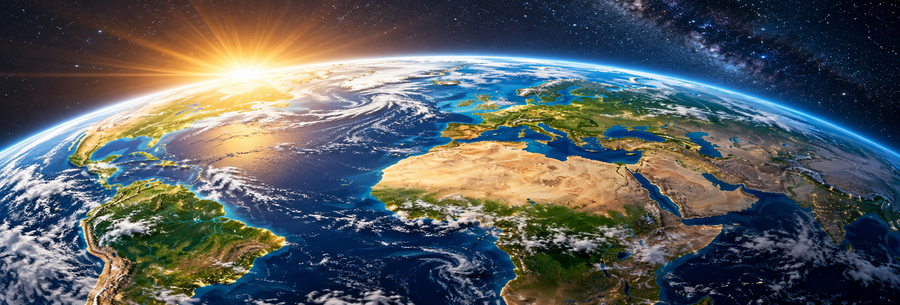
Since time immemorial, human beings have gazed at the sky, the stars, the oceans, the mountains and the vastness of the universe, asking themselves a fundamental question: Why did God create the Earth and everything that exists?
Why is there something rather than nothing? Why did life come into being? Why did God choose to create humankind and offer them a world of extraordinary richness?
These questions have spanned the centuries and touch upon the very heart of the Christian faith. The Bible teaches us that Creation is neither a meaningless accident nor the result of a divine whim. It is the expression of infinite love, a desire to give life, and a plan that transcends our human understanding.
For Christians, understanding why God created the Earth also means discovering why we exist, what our place is in the universe, and what mission has been entrusted to us.
God created the world out of love, not out of necessity
The first fundamental truth of the Christian faith is that God did not need to create the world.
God is eternal, perfect and fully happy in himself. He lacks nothing. He needed neither the Earth, nor the stars, nor human beings to complete his existence.
So why did he create all this?
Because true love seeks to give of itself and to share itself.
In the Christian tradition, Creation is understood as a free and gratuitous act of God. He does not create to fill a void or satisfy a need, but to enable other beings to exist and share in his goodness.
The Catechism of the Catholic Church teaches that God freely created the world to manifest and communicate his glory, his goodness and his perfection.
This means that every element of Creation possesses a value that has its origin in God’s love.
Sunlight, trees, animals, the oceans and human life are not merely objects that came into being without spiritual significance. They form part of a whole that is willed and loved by the Creator.
This truth profoundly transforms our view of existence: we are not merely living beings amongst others; we are creatures called to discover the love of the One who gave us life.
What does the Bible teach us about the creation of the Earth?
The first book of the Bible, Genesis, opens with a fundamental statement:
‘In the beginning, God created the heavens and the earth. ” (Genesis 1:1)
These few words form the foundation of the biblical understanding of the world.
They affirm that the universe is not eternal in and of itself and that all existence has its ultimate origin in God.
The account in Genesis then describes Creation over six days, followed by a seventh day set aside for divine rest.
God brings forth light, separates the waters, causes the dry land to emerge, brings forth vegetation, the heavenly bodies, animals and, finally, human beings.
On several occasions, the biblical text emphasises the goodness of what has just been created.
This repetition has a profound meaning: the world is fundamentally good because it comes from God.
It is important to understand that the main purpose of the Genesis account is not to provide a scientific description of the stages in the formation of the universe.
Its teaching is, above all, spiritual and theological.
It answers questions that science, on its own, cannot resolve: what is the ultimate origin of existence? Why does the world have value? What is the relationship between God and his creatures?
The biblical account thus reveals to us an ordered universe, imbued with meaning and entrusted to human stewardship.
Why did God create humankind on Earth?
Among all the creatures mentioned in the Bible, humankind occupies a special place.
The Book of Genesis states:
‘God created humankind in his own image, in the image of God he created them; male and female he created them. ” (Genesis 1:27)
This statement constitutes one of the most important teachings of the Christian faith.
Being created in the image of God does not mean that God has a body similar to ours.
It means that human beings are endowed with a special dignity, intelligence, freedom and capacity for love, which enable them to enter into a relationship with their Creator.
Human beings can contemplate the world, seek the truth, distinguish between good and evil, and freely choose to love.
They are also capable of praying, forgiving, showing compassion and turning to God.
God therefore created humankind not to make them servants without freedom, but to invite them into a relationship of love.
From a Christian perspective, the ultimate vocation of the human being is to know God, to love him and to live in communion with him.
The Earth thus becomes the place where this relationship can begin and grow.
It is in the midst of daily life, encounters, joys and trials that humankind gradually learns to respond to divine love.
Is the Earth a gift entrusted to humankind?
The Bible presents the Earth as a precious gift.
In the second chapter of Genesis, God places humankind in the Garden of Eden to cultivate and care for it.
These two verbs are essential.
To cultivate means to work, to develop, to make fruitful and to share in the richness of Creation.
To keep means to protect, preserve and respect what has been entrusted to us.
Human beings therefore have a special responsibility towards nature.
They do not own the Earth as an absolute master who could dispose of it without limit. Rather, they are its stewards, charged with looking after a treasure that ultimately belongs to God.
This responsibility extends to animals, forests, natural resources, landscapes and the balance of our environment.
It also extends to other human beings, particularly the poorest amongst us and future generations.
In his encyclical Laudato si’, Pope Francis reminds us that the protection of our common home is inseparable from our moral and spiritual responsibility.
Caring for the Earth is therefore not merely an ecological commitment.
For a Christian, it can become a concrete way of thanking God for the wonders of his Creation.
Respecting nature, avoiding waste, protecting life and sharing resources fairly are all actions that can express our gratitude to the Creator.
Why did God create a world where suffering and evil exist?
This is probably one of the most difficult questions of the Christian faith.
If God is good and all-powerful, why does the world experience wars, diseases, natural disasters, violence and death?
Why did God not create an Earth where everyone could live forever in peace and happiness?
The Bible states that God created a good world. It does not present evil as something the Creator willed for its own sake.
Christian tradition, however, distinguishes between moral evil—linked in particular to the misuse of human freedom—and the suffering that may arise from the limitations and processes of the natural world.
Freedom is an essential element of human dignity.
God willed beings capable of truly loving. Yet love presupposes freedom, and this freedom entails the possibility of rejecting the good.
The story of Adam and Eve expresses, through symbolic and theological language, the breakdown of trust between humanity and God.
Sin introduces a wound into man’s relationship with his Creator, with others and with himself.
However, not all suffering can be explained by human failings.
Illnesses, earthquakes and other natural disasters raise questions to which no simple explanation can provide a complete answer.
The Christian faith does not claim to dispel the mystery of suffering. It affirms that God does not abandon humanity in the midst of its trials.
It is precisely in this world marked by fragility that Jesus Christ comes to share our human condition.
Through his life, his Passion, his death and his Resurrection, he reveals a God who is not indifferent to the suffering of his creatures.
The Cross thus becomes the sign of a love capable of overcoming evil and death, whilst the Resurrection heralds the definitive victory of life.
Does God continue to care for the Earth today?
When we think of Creation, we sometimes imagine an event from extremely ancient times, as if God had brought the universe into being before leaving it to function on its own.
But this view does not correspond to Christian teaching.
The Catholic faith affirms that God is not content merely to be the origin of the world.
He continues to sustain the whole of Creation.
This is what theology calls divine preservation and Providence.
In other words, God remains present in his work, even if his presence is not always perceptible to our senses.
He acts without abolishing the laws of nature or human freedom.
Divine Providence does not mean that every painful event is directly willed by God, or that everything unfolds according to a script whose meaning we can easily understand.
It expresses the confidence that the history of the world remains open to God’s action and to the fulfilment of his plan of love.
Jesus himself invites his disciples to contemplate the birds of the air and the flowers of the field to discover the Father’s care.
These simple images remind us that Creation is not forgotten by its Creator.
For the believer, this divine presence becomes a source of hope, particularly when the future seems uncertain.
Can science and faith together explain the origin of the Earth?
The question of Creation naturally raises that of scientific discoveries.
Today, scientists believe that the universe evolved from an extremely dense and hot initial state some 13.8 billion years ago.
The Earth, for its part, formed around 4.54 billion years ago.
This knowledge comes from astronomy, physics, geology and many other disciplines.
Should we consider that they contradict the Bible?
The Catholic Church teaches that genuine scientific research and faith are not necessarily at odds, as they often address different dimensions of reality.
Science seeks to understand how the universe came into being, how matter is organised and how life developed.
Faith explores the ultimate reason for existence, its meaning and its relationship with God.
These approaches are not interchangeable, but they can engage in dialogue.
An interesting historical example is that of Georges Lemaître, a Belgian Catholic priest and physicist, who played a major role in the development of the first scientific theories of the expansion of the universe.
His work illustrates the possibility of rigorous scientific research being carried out by a man of faith.
It would, however, be incorrect to present the Big Bang as scientific proof of God’s existence.
Science does not directly demonstrate the divine act of creation, nor does it, on its own, settle the metaphysical question of God’s existence.
For Christians, believing in Creation means recognising that the universe is ultimately dependent on God, whatever the physical stages of its development may be.
Why did God create such a beautiful and diverse Earth?
The richness of the natural world can inspire profound wonder.
Mountain landscapes, the depths of the oceans, the diversity of flowers, the colours of birds, forests and the starry sky reveal a beauty that human beings have never ceased to admire.
In the Christian tradition, this beauty can become a path to God.
It does not constitute automatic proof of his existence, but it invites contemplation and gratitude.
St Francis of Assisi expressed this attitude in his famous Canticle of the Creatures, in which he praised God through the sun, the moon, water, fire and the earth.
He recognised in nature a community of creatures united by their common origin.
This spirituality reminds us that the beauty of the world is not limited to its material utility.
A flower does not need to serve humankind directly in order to have value.
An animal does not exist solely to meet our needs.
Every creature possesses its own goodness within the whole of Creation.
Learning to contemplate the world can thus become a form of prayer.
A sunrise, the silence of a forest or the immensity of the sea can help us rediscover a sense of humility.
Faced with the grandeur of the universe, humankind discovers that it is not the absolute centre of all things.
But they also discover that they have a place and a responsibility within this vast Creation.
Was the Earth created to last for ever?
The Bible presents the history of the world as a reality that has a beginning, a development and a fulfilment.
The Christian faith does not regard our earthly existence as an end in itself.
It proclaims eternal life and the ultimate transformation of Creation.
In the Book of Revelation, Saint John speaks of a new heaven and a new earth.
This promise expresses the hope of a world definitively reconciled with God, where evil, suffering and death will no longer have the final say.
This is not a scientific description of our planet’s future.
It is a spiritual and prophetic vision of the fulfilment of God’s plan.
Christian hope, therefore, does not consist merely in one day leaving the Earth to be with God.
It also heralds the resurrection of the dead and the renewal of all Creation.
This perspective lends a special depth to our present existence.
Our acts of love, justice, solidarity and faithfulness are not insignificant.
In a mysterious way, they are already contributing to the preparation of the Kingdom of God.
The hope of eternal life must not, therefore, distract us from our earthly responsibilities.
On the contrary, it invites us to build a more fraternal world, starting today.
What is the true meaning of our life on Earth?
The question ‘Why did God create the Earth?’ ultimately leads to an even more personal question:
Why has God given me life?
According to the Christian faith, every person is willed and loved by God.
Our existence is not merely a succession of biological, professional or material events.
We are called to discover a vocation that goes beyond the pursuit of comfort and personal success.
This vocation consists in learning to love.
To love God, to love one’s neighbour, to care for the most vulnerable, to seek the truth, to forgive and to build peace.
Jesus sums up the essence of the Law in the double commandment to love God and one’s neighbour.
This teaching gives a concrete direction to our lives.
It reminds us that the greatness of a life is not measured solely by accumulated wealth, honours received or successes achieved.
It is also manifested in the quiet acts of everyday life.
A person who accompanies someone who is ill, a parent who cares for their child, a volunteer who helps the poorest, or someone who chooses to forgive is part of this vocation of love.
Holiness itself does not necessarily consist in performing extraordinary deeds.
It can be built up through faithfulness to the little things, through patience, generosity and trust in God.
The Earth then becomes the place of our spiritual learning, the place where we are invited to nurture the gifts we have received.
How can we thank God for the gift of Creation?
Recognising that the Earth is a gift from God naturally invites us to cultivate an attitude of gratitude.
In the Christian life, this gratitude can take various forms.
Prayer is one of the simplest ways.
Thanking God for a new day, for our family, for the food we have received or for the beauty of a landscape helps us to become aware of what has been given to us.
Taking part in the Eucharist also plays a central role.
The word ‘Eucharist’ literally means ‘thanksgiving’.
Through the celebration of Mass, Christians give thanks to God for his blessings and, above all, for the gift of Jesus Christ.
Gratitude can also be expressed through concrete actions.
Caring for someone who is isolated, protecting nature, sharing one’s possessions or passing on the faith to future generations are ways of responding to the Creator’s love.
It is not enough to recognise intellectually that God created the world.
This conviction is meant to transform the way we live.
Every day can become an opportunity to show greater respect for life, to foster peace and to recognise God’s presence in the simplest of things.
Why does Creation invite us to hope?
Our world is facing many trials.
Conflicts, injustices, environmental concerns and human suffering can sometimes lead us to feel discouraged.
Yet the Christian message of Creation remains a profound source of hope.
It affirms that existence is not devoid of meaning.
The world was not brought into being by an evil will, and humanity is not left to fend for itself.
God willed life and continues to call his creatures into communion with him.
This hope finds its deepest expression in the person of Jesus Christ.
In the prologue to his Gospel, Saint John presents the Word of God as the one through whom all things were made.
That same Word became flesh and dwelt amongst us.
Thus, in the Christian faith, Creation and the Incarnation are intimately linked.
The God who brought the universe into being is also the One who came to join humanity in Jesus Christ.
This truth reveals the full depth of divine love.
God is not content merely to create a world and watch it from afar.
He enters our history, shares in our frailty and opens a path for us towards eternal life.
This is why Christians can contemplate the Earth with gratitude, live in the present with responsibility and look to the future with confidence.
Conclusion: God created the Earth to share his love and lead us to him
Why did God create the Earth?
The Christian answer is both simple and infinitely profound: God created the world of His own free will, out of goodness and love, to communicate life and invite His creatures to share in His glory.
The Earth is a place of life, encounter, discovery and responsibility.
It offers us the opportunity to love, to grow, to contemplate the beauty of Creation and to seek the One who is its source.
Even though many questions remain a mystery, the Christian faith invites us to recognise existence as a precious gift.
We do not know all the reasons behind the events that unfold in our lives, but we can choose to respond to this gift with gratitude, trust and love.
Gazing at a star, admiring a flower, welcoming a child or reaching out to someone in need can then take on a whole new meaning.
For behind the question of the world’s origin lies a deeper invitation: to discover that our lives possess dignity, a calling and a purpose.
God has given us life so that we may learn to love and, of our own free will, respond to his love.