For centuries, angels and demons have played an important role in religious beliefs, biblical narratives and the collective imagination. Often depicted as mysterious beings existing between heaven and Earth, they inspire as much fascination as they do questions.
Do angels really exist? Do we all have a guardian angel? Is the devil a real spiritual being or merely a representation of evil?
These questions touch on one of the most mysterious aspects of the Christian faith: the existence of an invisible world, which is beyond the reach of our senses but whose reality is affirmed by the Bible.
For the Catholic Church, angels are not merely symbols intended to reassure believers. They are part of God’s Creation and fulfil a specific mission amongst humanity.
Demons, for their part, are presented as angels who have freely rejected God and his love.
But what do we really know about these spiritual beings? How can we distinguish the Church’s teaching from legends and superstitions? And above all, what place should they occupy in our lives as Christians?
Do angels exist according to the Bible and the Catholic Church?
The Christian faith affirms that God created not only the visible world, but also an invisible spiritual reality.
When Christians recite the Creed, they proclaim their faith in God, the creator of the visible and invisible universe.
This affirmation includes, in particular, the existence of angels.
The Catechism of the Catholic Church, in paragraph 328, teaches that the existence of spiritual beings called angels is a truth of faith.
It is therefore not a secondary belief invented over the centuries, but a teaching deeply rooted in the Holy Scriptures and in Christian Tradition.
Angels appear on numerous occasions in both the Old and New Testaments.
They convey divine messages, accompany humankind, announce important events and play a part in the fulfilment of God’s plan.
However, their existence is a matter of faith and Revelation. Science has no evidence to confirm their presence as spiritual beings.
This distinction is essential: believing in angels does not mean claiming to have scientific proof of their existence.
For Christians, the reality of angels rests above all on trust in the Word of God.
Who are angels really, and what is their nature?
Contrary to popular depictions, angels are not human beings with wings.
In Catholic theology, they are purely spiritual creatures, by nature devoid of a material body.
They possess their own intelligence and will.
This means that they are neither mere impersonal forces nor mysterious energies circulating throughout the universe.
They are personal beings, created by God, capable of knowing and willing.
The word ‘angel’ comes from the Greek angelos, which means ‘messenger’.
This origin reveals their fundamental mission: to serve God and to participate in the fulfilment of his will.
St Augustine explained that the term ‘angel’ refers more to a function than to a nature.
In other words, an angel is a spirit by what he is and a messenger by what he does.
In the Bible, angels may appear in human form in order to communicate with people.
The wings often depicted in paintings and sculptures symbolically express their belonging to the heavenly realm and their readiness to swiftly carry out the divine will.
They do not constitute an anatomical description of their nature.
Nor should angels be confused with the souls of the deceased.
According to Christian teaching, a human being does not become an angel after death.
Humans and angels belong to two different orders of Creation.
Why did God create angels?
God did not need angels to carry out his will.
As with the whole of Creation, their existence has its origin in his goodness and love.
Angels were created to share in divine glory, to contemplate God and to serve him.
In this way, they reveal a dimension of the richness of Creation that transcends the material world.
The Bible presents them as servants of God, but also as messengers sent to humankind.
Their mission is never independent of that of the Creator.
They do not act as secondary deities possessing their own absolute powers.
Their entire mission is directed towards God.
In the Christian tradition, angels remind us that reality is not limited to what we can see, measure or touch.
They bear witness to a Creation vaster than our human perception.
Their existence also invites us to humility: humankind is not the only creature endowed with intelligence as willed by God.
Who are the three archangels mentioned in the Bible?
Their existence also invites us to humility: humankind is not the only creature endowed with intelligence as willed by God.
Who are the three archangels mentioned in the Bible?
Among the angels mentioned in the Holy Scriptures, three hold a special place in Catholic tradition: Saint Michael, Saint Gabriel and Saint Raphael.
Their names are associated with distinct and complementary missions.
Saint Michael the Archangel: the defender of God’s people
The name Michael means ‘Who is like God?’.
It expresses the incomparable greatness of the Creator and reminds us that no creature can stand on a par with Him.
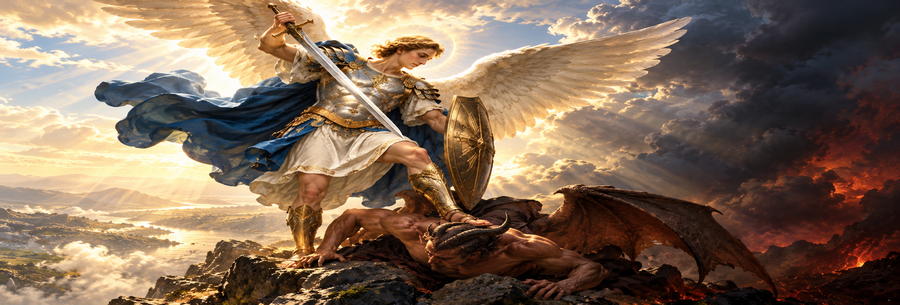
In the Book of Revelation, Saint Michael appears at the head of the angels fighting the dragon, a figure representing Satan.
He is traditionally invoked to seek divine protection against evil and to remain faithful to God in times of trial.
Saint Michael thus represents the strength of faith, spiritual courage and fidelity to the Lord.
Saint Gabriel the Archangel: the messenger of the Annunciation
Gabriel occupies a central place in the history of salvation.
In the Gospel according to Saint Luke, he is sent to the Virgin Mary to announce that she will give birth to Jesus.
This encounter is one of the most important events in Christianity.
Gabriel also announces the birth of John the Baptist to Zechariah.
He thus appears as a messenger of God’s great promises.
His mission reminds us of the importance of listening, trusting and accepting the divine will.
Saint Raphael the Archangel: companion and guide
Raphael appears in the Book of Tobit.
He accompanies the young Tobit on his journey and plays a part in a story marked by healing, protection and trust in God.
His name means ‘God heals’.
He is particularly associated with guiding travellers and with healing.
Through these three archangels, the Bible reveals different aspects of divine assistance: protection, the proclamation of the Good News and guidance.
Do we all have a guardian angel?
Belief in guardian angels plays an important role in Catholic spirituality.
According to Christian tradition, God watches over human beings and may grant them the assistance of his angels.
In the Gospel according to Saint Matthew, Jesus speaks of the angels of little ones who behold the face of the heavenly Father (Matthew 18:10).
This passage forms one of the biblical foundations of devotion to guardian angels.
The Catechism of the Catholic Church, in paragraph 336, teaches that human life benefits from the protection and intercession of angels, from childhood until death.
Catholic tradition thus speaks of a guardian angel charged with accompanying every person.
However, this protection must not be understood as a guarantee against all accidents, all illnesses or all suffering.
The presence of a guardian angel does not mean that a believer will systematically be spared the difficulties of life.
His role is, above all, spiritual.
He accompanies us on our journey towards God and invites us to remain attentive to what is good.
Devotion to the guardian angel therefore expresses trust in God’s care, rather than a promise of absolute material security.
How can angels act in our daily lives?
The Bible recounts several instances of angelic intervention.
One angel accompanies the people of Israel, whilst others announce births, protect certain servants of God or convey important messages.
In the New Testament, angels are present at several key moments in the life of Jesus.
An angel announces the birth of the Saviour to Mary.
Angels proclaim the glory of God at the Nativity.
After the temptations in the desert, they serve Jesus.
On Easter morning, heavenly messengers announce his Resurrection.
These accounts emphasise that their mission remains linked to the history of salvation.
But what about today?
Christian tradition affirms that angels continue to serve God and to accompany humankind in mysterious ways.
However, it is impossible to state with certainty that a particular event, an unexpected encounter or a personal intuition comes directly from an angel.
We must therefore exercise discernment.
Faith does not require us to constantly seek extraordinary signs.
Rather, it invites us to live in trust, prayer and fidelity to the Gospel.
A Christian may ask for the intercession of their guardian angel without seeking to provoke supernatural manifestations.
Do demons really exist according to the Christian faith?
The question of demons often arouses more fear than that of angels.
Films, novels and popular tales have gone a long way towards developing spectacular depictions of the demonic world.
But what does the Church actually say?
According to Catholic doctrine, demons are angels who have freely rejected God.
They were not created evil.
Originally, they were part of God’s good Creation.
The Catechism teaches that their evil condition stems from their own choice to turn radically away from the Creator.
It is therefore important to understand that Christianity does not present evil as an eternal power that exists independently of God.
The devil is not a second god opposed to the Creator.
He remains a creature, whose power is limited.
This fundamental distinction sets the Christian faith apart from dualistic views in which good and evil are seen as two equivalent forces eternally contending for the universe.
For the Church, God alone is all-powerful.
Satan, Lucifer and the devil: who are we talking about?
Several names are traditionally associated with the figure of the devil.
The word ‘Satan’ comes from Hebrew and means, amongst other things, ‘adversary’ or ‘accuser’.
The term ‘devil’ comes from the Greek diabolos, which refers to one who slanders, accuses or divides.
In the Gospels, Satan appears notably as the tempter who seeks to divert Jesus from his mission.
The name ‘Lucifer’ has a more complex history.
It literally means ‘bringer of light’ and derives from a Latin expression used in the translation of a passage from the Book of Isaiah.
In its original context, this passage refers to the fall of a proud ruler.
Christian tradition subsequently developed a spiritual interpretation linking this image to the fall of Satan.
It is therefore important to distinguish between the original meaning of the biblical text and the theological interpretations that have emerged over the course of history.
The Bible does not provide a detailed biography of Satan.
It places greater emphasis on his opposition to God, on temptation and on the danger of lies.
The devil is thus presented as the one who seeks to turn people away from the truth, from love and from communion with God.
Why did some angels rebel against God?
If God created the angels good, how could some of them have become evil?
Christian theology answers by emphasising their freedom.
Angels are intelligent creatures endowed with free will.
They are therefore free to choose to follow God.
According to Catholic teaching, some made the radical choice to reject His sovereignty.
This rebellion is traditionally associated with pride, that is to say, the desire to place oneself above one’s status as a creature.
The account of the fall of the angels must not, however, be turned into a fictional story filled with details not provided by the Bible.
The precise circumstances of this decision remain a mystery.
The Church teaches that the choice made by the fallen angels is irrevocable.
This definitive rejection of God forms the basis of their separation from him.
It also reveals an important truth about freedom: that it can be used to embrace love or to reject it.
How does Jesus speak of the devil and demons?
In the Gospels, Jesus repeatedly encounters people described as being tormented by evil spirits.
He casts out demons and demonstrates his authority over the forces of evil.
These accounts play a significant role in his ministry.
They show that his mission is not merely to teach morality or to proclaim fine words.
Jesus came to free humanity from whatever separates it from God.
In the wilderness, he also faced temptation.
The devil offered him the chance to use his power to satisfy his needs, gain earthly dominion and divert his mission.
Jesus rejects these proposals by remaining faithful to the Word of God.
This episode reveals that temptation can take the form of an invitation to choose the easy way out, pride or power rather than trust in and obedience to God.
However, it would be incorrect to regard every moral difficulty as a direct intervention by the devil.
The Bible also acknowledges personal responsibility, human desires, bad habits and social influences.
Spiritual warfare never exempts a person from examining their own choices.
Can demons influence human beings?
According to Christian tradition, evil can exert a spiritual influence on human beings, particularly through temptation.
This influence does not mean that demons automatically control our thoughts or actions.
Human freedom remains essential.
A temptation is not in itself a sin.
It becomes morally significant when the person freely consents to it.
In everyday life, temptations may relate to pride, jealousy, anger, lying, selfishness or the desire for domination.
These realities also have psychological, educational and social dimensions.
We should therefore not seek a demonic explanation behind every negative thought, every conflict or every difficulty.
The Church calls for discernment and prudence.
Systematically attributing one’s problems to the devil risks causing us to overlook personal responsibility and the concrete causes of the situations we face.
Above all, Christians are called to develop their inner freedom, to form their conscience and to choose what is good.
What is the difference between temptation, possession and illness?
Accounts of demonic possession have had a profound impact on the popular imagination.
However, Catholic doctrine calls for a careful distinction to be made between spiritual phenomena and medical and psychological disorders.
A person suffering from anxiety, depression, hallucinations or unusual behaviour should not be regarded as possessed.
These manifestations may stem from medical or psychological causes requiring appropriate care.
Illness is neither a sign of moral failing nor evidence of demonic intervention.
The Church itself recommends great caution before considering the possibility of an extraordinary phenomenon.
A solemn exorcism is a specific rite, reserved for a priest who has received authorisation from the competent bishop.
It must not be confused with ordinary prayers for deliverance or protection.
Catholic tradition also emphasises the need to rule out natural and medical causes before making a spiritual judgement.
This caution protects vulnerable people from hasty interpretations and dangerous practices.
The Christian faith must never lead to the neglect of necessary medical or psychological care.
Are angels and demons engaged in an invisible battle?
The image of a battle between angels and demons appears notably in the Book of Revelation.
In it, Saint Michael and his angels confront the dragon.
This scene has a strong symbolic and spiritual dimension.
It expresses the opposition between loyalty to God and rebellion against him.
However, the Christian faith does not present the universe as the theatre of a war between two equal powers.
God does not fight against Satan as if He were in danger of losing His sovereignty.
Evil remains limited and cannot destroy the divine plan.
From a Christian perspective, the decisive victory over sin and death was achieved by Jesus Christ through his Passion and Resurrection.
The believer’s spiritual struggle therefore consists in remaining faithful to Christ.
This is manifested in very concrete choices: rejecting falsehood, practising charity, resisting hatred, forgiving and seeking justice.
This struggle must not fuel a constant fear of the unseen world.
On the contrary, it must strengthen our trust in the power of God’s love.
Why are angels depicted with wings and demons with horns?
Traditional images of angels and demons stem largely from the history of religious art.
Painters and sculptors have sought to make visible spiritual realities which, by their very nature, elude human perception.
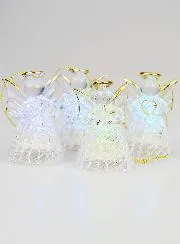
The angels’ wings evoke their heavenly mission, their freedom of movement and their closeness to God.
The light surrounding them symbolises purity and divine glory.
Conversely, depictions of demons often feature animal forms, dark colours or disturbing features.
These visual elements express the distortion of goodness, disorder and a rupture with God.
However, these depictions should not be taken literally.
The Bible does not consistently describe angels as beautiful winged figures, nor demons as creatures with horns and tails.
Religious art employs a symbolic language intended to convey a spiritual teaching.
Understanding this aspect enables us to appreciate Christian works of art without confusing their message with a physical description of the invisible world.
Can we pray to angels and ask for their protection?
In Catholic spirituality, the faithful may ask for the intercession of angels.
This practice is based on the belief that angels serve God and participate in his plan of salvation.
It is, however, essential to distinguish between the prayer of adoration, reserved for God alone, and requests for intercession addressed to angels and saints.
When a Christian invokes Saint Michael or their guardian angel, they do not regard them as independent deities.
They ask them to accompany them and to pray for them before God.
Devotion to Saint Michael is particularly widespread within the Church.
Believers seek his intercession to remain steadfast in the faith and to resist evil.
Prayer to one’s guardian angel, for its part, expresses trust in the spiritual guidance offered by God.
These practices must always lead to Christ.
The Church warns against attempts to attribute secret names to angels, to communicate with them through esoteric techniques, or to obtain supernatural powers.
True Christian devotion is based on faith, humility and trust, not on the pursuit of extraordinary phenomena.
How can we recognise what comes from God?
Given the many beliefs concerning the spiritual world, discernment plays an essential role.
Not every surprising event is necessarily a divine sign.
Not every intuition is a message from an angel.
Not every difficulty is a demonic attack.
Christian tradition encourages us to examine the spiritual fruits of an experience.
An approach that leads to greater charity, humility, inner peace, truth and fidelity to the Gospel may be welcomed with gratitude, whilst maintaining a prudent judgement.
Conversely, experiences that foster excessive fear, encourage hatred or prompt one to abandon one’s responsibilities should give rise to particular vigilance.
Discernment may be accompanied by prayer, reading the Bible, the sacraments and the guidance of a priest or a competent spiritual director.
The essential point is not to seek out a multitude of mysterious experiences.
It is to grow in an authentic relationship with God.
The Christian faith does not require us to constantly seek the extraordinary, but to recognise God’s presence in ordinary life.
Why should we not be afraid of the devil?
Christian teachings on demons are sometimes presented in an alarmist manner.
However, the central message of the Gospel is not fear of Satan.
It is the proclamation of the salvation offered by Jesus Christ.
In the Catholic faith, evil does not have the final say.
Christ’s Resurrection manifests the victory of life over death and opens up a path of hope for humanity.
This does not mean that evil has disappeared from the world.
Injustice, violence and temptation remain realities with which people are confronted.
But the believer is not called to live in a state of obsession with evil forces.
They are invited to place their trust in God.
Prayer, the sacraments, charity and fidelity to the Gospel form the ordinary foundations of the Christian spiritual life.
A balanced faith does not consist in seeing the devil everywhere.
It consists in freely choosing what is good, acknowledging one’s mistakes, asking for forgiveness and moving forward with confidence.
Christians must not centre their lives on the supposed power of evil, but on God’s love and mercy.
What do the angels teach us about our own vocation?
The presence of angels in the Bible invites us to reflect on our relationship with God.
Angels are presented as beings who contemplate the Lord, welcome his will and participate in his work.
In this way, they remind us of several essential dimensions of the Christian life.
The first is listening.
Like Mary at the Annunciation, we are invited to welcome the Word of God and to respond to it freely.
The second is service.
Angels do not seek to draw attention to themselves. Their mission is to serve the divine plan.
This attitude can inspire the way we help others without constantly seeking recognition.
The third is faithfulness.
Saint Michael symbolises this faithfulness to God in the face of pride and evil.
Finally, the angels remind us that our earthly existence is part of a broader spiritual reality.
The Christian faith calls us to a communion with God that transcends the limits of our present life.
Thus, contemplating the angelic world must not distract us from our human responsibilities.
It must encourage us to live more fully in love, truth and generosity.
Do angels and demons exist: what, ultimately, should we take away from this?
For the Catholic Church, angels and demons truly exist as spiritual creatures, even though their existence cannot be proven by current scientific methods.
Angels are beings created good by God, who serve Him and share in His plan of love.
Demons are, according to Christian doctrine, angels who have freely rejected God.
But these two realities do not possess equal power.
God remains the sole Creator and the sole Almighty.
Angels remind us of his care and guidance.
The existence of demons, as understood by the Christian faith, reminds us of the gravity of freedom and the possibility of rejecting love.
However, the essence of Christianity does not lie in knowledge of the invisible world.
It lies in the encounter with Jesus Christ.
Faith invites us not to allow ourselves to be dominated by fear, superstition or a fascination with extraordinary phenomena.
It calls us to live in trust, to seek the good and to open ourselves more and more each day to God’s love.
For the most important message of the Gospel is not that evil exists, but that God’s love is stronger than evil and that Christ opens the way to eternal life for us.