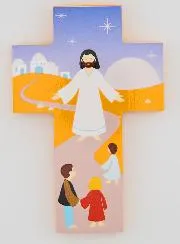
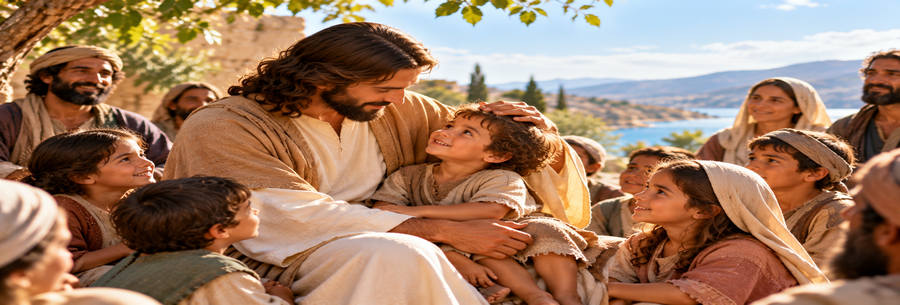
Among the most tender and profound teachings of Jesus Christ, the one recorded in the Gospel according to Saint Mark, chapter 10, verses 13 to 16, holds a special place. In this moving scene, parents bring their children to Jesus so that He may bless them. But the disciples try to send them away, prompting an unexpected reaction from the Lord.
Jesus said to them: ‘Let the little children come to me; do not hinder them, for the kingdom of God belongs to such as these. ’ (Mark 10:14)
Through these few words, Christ reveals an essential truth to us: to enter the Kingdom of God, it is not enough to accumulate religious knowledge, to perform great deeds or to hold an important position in society. We must learn to welcome God with a humble, trusting and open heart.
But why does Jesus hold up children as an example? What does it mean to become like a child in the Christian faith? And how can we rediscover this simplicity of heart as adults, faced with the worries, responsibilities and trials of life?
Let us explore together the spiritual richness of this Gospel passage, its historical context and the lessons it still imparts to us today.
1. The account of Jesus and the children in the Gospel of Mark
The episode in Mark 10:13–16 takes place whilst Jesus is continuing to teach the crowds and his disciples.
People approach Him carrying young children so that He may touch them and bestow His blessing upon them.
This gesture bears witness to the trust these families place in Jesus.
In biblical tradition, a blessing is a sign of divine favour. The parents wish for their children to benefit from God’s presence and protection.
But the disciples intervene to turn away those who are bringing the children forward.
Saint Mark writes:
‘People were bringing children to Jesus so that he might lay his hands on them; but the disciples rebuked them sharply. ” (Mark 10:13)
Why did the disciples act in this way?
The Gospel does not specify their motives. Perhaps they thought they were protecting Jesus from too many requests, or felt that the children should not interrupt his teaching.
In ancient society, children did not enjoy the same social status as adults. Their dependence and lack of authority could relegate them to the background.
But Jesus rejects this way of viewing the little ones.
On the contrary, he shows them special attention.
The account emphasises that Jesus was indignant at the disciples’ attitude.
This reaction is significant: Christ does not merely tolerate the presence of children. He stands up for them and affirms that they have a rightful place with Him.
2. ‘Let the children come to me’: a call never to stand in the way of faith
Jesus’ words are both simple and profoundly demanding:
‘Let the children come to me; do not hinder them. ” (Mark 10:14)
In addressing his disciples in this way, Jesus reminds them that no one should be considered too small or too insignificant to receive God’s love.
Children are not believers of lesser importance.
They possess a dignity that deserves to be recognised and respected.
These words have had a profound impact on Christian tradition and on the Church’s focus on the religious education of the very young.
They remind parents, catechists and the entire Christian community of their responsibility in passing on the faith.
Guiding a child towards Jesus is not merely a matter of teaching them prayers or imparting religious knowledge.
It also involves helping them to discover, through example, that God is love, that prayer is an encounter, and that faith can become a source of joy and trust.
A child often discovers God’s goodness through the patience, tenderness and faithfulness of the adults around them.
Conversely, a harsh, unfair or contemptuous attitude can make it harder for them to understand divine love.
Jesus’ teaching therefore invites us to reflect on how we pass on the faith.
To lead a child to Christ is, first and foremost, to show them, through our own lives, the beauty of Christian love.
3. Why does Jesus present children as a model for entering the Kingdom of God?
Jesus continues his teaching with a surprising statement:
‘Amen, I say to you: whoever does not receive the Kingdom of God like a child will not enter it. ’ (Mark 10:15)
These words overturn the usual criteria of human greatness.
In our society, we often value independence, success, experience and the ability to take control of our lives.
A child, on the other hand, depends on adults to live, grow and be protected.
They must receive what they cannot yet provide for themselves.
It is precisely this attitude of openness and dependence that sheds light on Jesus’ teaching.
The Kingdom of God is not a reward that a person could attain solely through their own efforts.
It is, above all, a gift from God.
To receive it, we must recognise that we need His grace.
The child thus becomes an image of trust and inner openness.
This does not mean that all children are naturally perfect or free from faults.
Jesus does not present childhood as a total absence of sin or weakness.
He invites us to recognise certain spiritual dispositions that enable us to welcome God: humility, trust, simplicity and the capacity to receive.
The true disciple learns not to regard their relationship with God as a personal achievement.
They discover that they are, first and foremost, a child loved by their heavenly Father.
4. Regaining a child’s heart: trust at the heart of the Christian life
One of the great lessons of this Gospel concerns trust.
A young child can surrender themselves with peace of mind into the arms of a loving parent.
They do not always understand the difficulties of the world, but they find security in the presence of the one who cares for them.
In the spiritual life, Jesus invites us to develop a similar trust in God.
This trust does not mean that we should ignore dangers, stop thinking for ourselves, or passively wait for all our problems to disappear.
It consists in recognising that our lives remain in the hands of a Father who loves us.
Adults often have many worries: health, family responsibilities, work, their children’s future or financial difficulties.
These concerns can overwhelm our minds and make prayer more difficult.
Jesus’ teaching reminds us that we can bring our worries to God without needing to have everything under control.
Christian trust does not necessarily remove trials.
It enables us to get through them, knowing that we are not alone.
Praying with a child’s heart sometimes simply means saying:
‘Lord, I do not understand everything, but I want to trust You. Guide me and teach me to walk with You.’
This humble prayer can be the beginning of a profound inner transformation.
5. Humility: recognising that we need God
Becoming like a child also means learning humility.
In daily life, we often seek to show off our abilities, our achievements and our independence.
We may be tempted to believe that we need no one.
But the spiritual life teaches us another truth.
Before God, we remain creatures who receive life, love and grace.
Christian humility does not mean despising oneself or denying one’s qualities.
It means truthfully acknowledging who we are, with our talents, our limitations and our dependence on God.
A humble heart is willing to ask for forgiveness, to accept help and to acknowledge its mistakes.
It does not seek to place itself above others.
Jesus Himself sets us an example of this humility.
Although He is the Son of God, He chose to come amongst mankind in the simplicity of a birth in Bethlehem.
He grew up in a modest family and led a quiet life in Nazareth for many years.
Throughout his ministry, he drew close to the poor, the sick and those who were rejected.
By holding up children as a model, Jesus invites us to cast aside the pride that closes our hearts to grace.
Humility does not take away our dignity: it enables us to discover that our true greatness comes from God’s love.
6. Simplicity of heart: an often-forgotten spiritual treasure
Children often possess a spontaneous capacity to marvel at the simplest things.
A flower, a smile, a gesture of affection or a word of encouragement can become a source of joy for them.
As we grow up, we risk losing this capacity for wonder.
Habits, responsibilities and disappointments can gradually make our outlook more anxious or harsher.
Gospel simplicity invites us to rediscover a renewed appreciation for God’s gifts.
This does not mean being naïve or incapable of understanding the complexity of the world.
It consists of living with a heart less burdened by pride, jealousy and excessive ambition.
A simple person knows how to give thanks.
They recognise the value of modest gestures.
They do not need to constantly seek the admiration of others.
In prayer, this simplicity is particularly precious.
It is not necessary to recite long prayers to be heard by God.
A sincere prayer, even a very short one, can express deep love.
A simple ‘Thank you, Lord’, spoken with faith, possesses true spiritual value.
Jesus thus teaches us that our relationship with God does not depend on the complexity of our words, but on the sincerity of our hearts.
7. Jesus takes the children into his arms: God’s tenderness revealed
Saint Mark’s account ends with a particularly moving gesture:
‘He embraced them and blessed them, laying his hands on them. ’ (Mark 10:16)
After correcting the disciples’ attitude, Jesus personally welcomes the children.
He does not merely deliver a teaching on their dignity.
He shows his love through a concrete gesture.
He takes them into his arms and blesses them.
This scene reveals to us the tenderness of Christ.
Jesus is not a distant, inaccessible teacher, nor is he indifferent to the little ones.
He is close to those who come to Him.
He takes the time to welcome them and show them His affection.
In the Christian tradition, this image has become a symbol of divine goodness.
It reminds us that God does not look only at humanity as a whole.
He loves each person with a personal love.
Every child has a unique value in his eyes.
But this tenderness is not reserved solely for the youngest among us.
Adults, too, are invited to recognise themselves as children of God.
Even as we grow older, even when we face trials or have made mistakes, we remain called to welcome his love.
Christ invites us to come to Him with confidence, like a child who knows they will be welcomed.
8. What is the difference between having a child’s heart and being childish?
Jesus’ teaching can sometimes be misunderstood.
Becoming like a child does not mean refusing to grow up, abandoning one’s responsibilities or giving up one’s intelligence.
The Christian faith does not ask us to remain immature.
On the contrary, it invites us to develop our judgement, our moral conscience and our capacity to love.
There is a fundamental difference between the spirit of childhood and childishness.
Childish behaviour consists of shirking one’s responsibilities, seeking excessive dependence or rejecting the demands of adult life.
The evangelical childlike spirit, on the other hand, is based on a free and conscious trust in God.
A spiritually mature person may possess great intelligence, hold positions of significant responsibility and demonstrate discernment, whilst retaining a humble and trusting heart.
They know that their strength does not come solely from themselves.
They recognise that they need God.
True Christian maturity therefore combines the responsibility of an adult with the trust of a child.
This combination enables one to live a deep, balanced and authentic faith.
9. Saint Thérèse of Lisieux and the ‘Little Way’ of spiritual childhood
Jesus’ teaching on children found a particularly luminous expression in the spirituality of Saint Thérèse of the Child Jesus.
This young French Carmelite, born in 1873 and who died in 1897, became one of the great spiritual figures of the Catholic Church.
She developed what is known as the ‘little way’ of spiritual childhood.
Saint Thérèse understood that holiness did not necessarily depend on extraordinary deeds.
It could be lived out in the simplest of actions, performed with great love.
Aware of her limitations, she chose to rely on God’s mercy rather than on her own strength alone.
Her spirituality is based on a deep trust in the Father’s love.
She teaches us that we do not need to be powerful, famous or remarkable to progress towards holiness.
All we need to do is welcome God’s grace and seek to love in the ordinary circumstances of our lives.
This ‘little way’ is not an easy or superficial form of spirituality.
It requires great faithfulness, sincere humility and persevering trust.
It is deeply in keeping with the words of Jesus:
‘ ‘Whoever does not receive the kingdom of God like a child will not enter it.’
Saint Thérèse shows us that spiritual childhood can become a path to great Christian maturity.
10. How can we pass on the love of Jesus to children?
The Gospel of Mark 10:13–16 is of particular importance for Christian families.
Parents are the first witnesses of the faith to their children.
This transmission does not rely solely on religious teachings.
It begins in everyday life.
A child learns to know God’s love through the love they receive.
The patience, attentiveness, forgiveness and kindness shown by adults can help them understand the goodness of the Heavenly Father.
Family prayer is also a valuable way of passing on the faith.
A few moments of prayer in the morning or evening can gradually introduce a child to a personal relationship with God.
Reading the Gospels, adapted to their age, can help them discover the life of Jesus.
Major Christian festivals, such as Christmas, Easter or Pentecost, also offer wonderful opportunities to explain the foundations of the faith.
But it is essential to respect each child’s own pace and questions.
Faith must not be presented solely as a series of prohibitions or obligations.
It must be discovered as a living relationship with a God who loves.
The example set by parents often leaves a deeper impression than long speeches.
A child who sees their parents praying, forgiving and helping others discovers in a tangible way what it means to live out the Gospel.
11. Why did the disciples want to prevent the children from approaching Jesus?
The disciples’ reaction may surprise us.
How could those who were with Jesus seek to keep the children away when they had come to receive his blessing?
The text does not give us a precise explanation.
However, their attitude reveals a failure to understand Christ’s mission.
They seem to want to decide who is worthy of approaching the Master.
Yet Jesus rejects this logic of exclusion.
He reminds us that the Kingdom of God does not operate according to society’s usual criteria.
Those considered weak or insignificant are no less important in the Lord’s eyes.
This episode also serves as a warning to Christian communities.
We must take care not to erect unnecessary barriers between people and Christ.
A cold attitude, hasty judgement or a lack of welcome can drive away those who are seeking God.
Conversely, a caring, compassionate and open community can become a place where everyone discovers the joy of the Gospel.
Children, in particular, need to feel welcomed into the life of the Church.
Their presence, their questions and their spontaneity must not be seen as obstacles to spiritual life.
On the contrary, they can remind adults of the importance of simplicity and trust.
12. How can we rediscover a childlike heart in our daily lives?
Jesus’ teaching is not just about how we view children.
He invites us to transform our own inner lives.
Regaining a childlike heart begins with learning to trust.
We can get into the habit of entrusting our concerns to the Lord every day.
This does not mean denying our difficulties, but refusing to face them without Him.
Humility is another important step.
Acknowledging our mistakes, asking for forgiveness and accepting advice can help us to grow spiritually.
Gratitude also enables us to rediscover simplicity of heart.
Thanking God for life’s little joys teaches us to recognise His presence in our daily lives.
Forgiveness also plays a vital role.
Wounds and grudges can gradually close our hearts.
By asking for the grace to forgive, we learn to free ourselves from what prevents us from loving.
Finally, prayer helps us to maintain a living relationship with God.
We can speak to Him with simplicity, without trying to use complicated words.
Just as a child speaks to their father, we can share our joys, our sorrows, our doubts and our hopes with the Lord.
To have a child’s heart is to learn to live before God with trust, truth and love.
13. Is the Kingdom of God reserved for children?
When Jesus says that the Kingdom of God belongs to those who are like children, He does not mean that only young children can enter it.
His teaching is addressed specifically to the adults who are listening to Him.
He invites them to adopt a particular inner disposition.
The Kingdom of God is not reserved for any particular age group, social class or level of knowledge.
It is offered to those who welcome divine grace with faith.
Children serve as a model because, in this passage, they represent an attitude of receptiveness and dependence.
Adults who recognise their need for God can thus welcome the Kingdom with a child’s heart.
These words also remind us that no one can claim to deserve salvation by their own merit alone.
Eternal life is a gift from God.
We are invited to respond to it freely through faith, love and fidelity to the Gospel.
Spiritual childhood is therefore not a stage reserved for the beginning of the Christian life.
It can accompany the believer right to the end of their life.
The further we progress in the faith, the more we discover how much we need divine mercy.
14. Frequently asked questions on Mark 10:13–16 and spiritual childhood
What does ‘Let the children come to me’ mean?
These words of Jesus mean that children have a rightful place with God. Christ asks his disciples not to stand in the way of their encounter with him and reminds them of their dignity.
Why does Jesus say that we must become like a child?
Jesus invites believers to welcome the Kingdom of God with humility, trust and simplicity. He is not asking us to become immature, but to recognise our dependence on divine grace.
What is the main message of Mark 10:13–16?
The passage teaches that the Kingdom of God must be received as a gift. Jesus holds up children as an example and shows his tenderness by embracing and blessing them.
What is spiritual childhood in the Catholic faith?
Spiritual childhood is an attitude of trust, humility and surrender to God. It consists in recognising that we are his children and that we need his love and grace.
What is the connection between Saint Thérèse of Lisieux and this Gospel passage?
Saint Thérèse of the Child Jesus developed a spirituality known as the ‘little way’, based on trust in God, humility and love lived out in small, everyday actions.
How can we learn to pray like a child?
Praying like a child means addressing God with sincerity and simplicity. We can entrust our joys, difficulties and needs to Him without resorting to complicated phrases.
How can we help a child discover Jesus?
Parents and educators can pass on the faith through their example, family prayer, reading the Gospels, participation in the life of the Church, and an attitude of patience and love.
15. Prayer to rediscover a child’s heart with Jesus
Lord Jesus,
You who welcomed children with such tenderness, teach me to come to You with a simple and trusting heart.
Over the years, life’s worries, responsibilities and wounds have at times made my heart less open to Your love.
I have sought to understand everything, to control my future and to find the answers to my difficulties on my own.
But today, Lord, I long to rediscover that deep trust which enables me to surrender myself into God’s hands.
Teach me to recognise my limitations without becoming discouraged.
Deliver me from the pride that prevents me from asking for help, and from the fear that weakens my faith.
Give me a humble heart, capable of receiving Your grace with gratitude.
When trials come, remind me that You remain by my side.
When I doubt, strengthen my trust.
When I fall, help me to get back up.
When I am tempted to close myself off from others, open my heart to charity.
Lord Jesus, You who took children into Your arms to bless them, welcome me into Your mercy.
May I go forward each day with the certainty that I am loved by my heavenly Father.
Teach me to pray with simplicity, to forgive with sincerity and to love without seeking reward.
May my heart find the peace of one who knows they are never forsaken.
Jesus, give me a child’s heart to love You, follow You and welcome Your Kingdom.
Amen.
Conclusion: becoming like a child to fully welcome God’s love
The Gospel of Mark 10:13–16 offers us a teaching of great spiritual depth.
Through a simple and moving scene, Jesus overturns the usual criteria of human greatness.
Whilst the disciples seek to send the children away, Christ welcomes them, embraces them and blesses them.
In doing so, he reveals that the Kingdom of God belongs to those who know how to receive it with humility and trust.
Becoming like a child does not mean giving up our maturity or our responsibilities.
It means rediscovering simplicity of heart, recognising our need for God and learning to surrender to his love.
In a world where we often seek to control everything, this teaching invites us to rediscover the beauty of trust.
We do not need to be perfect to draw near to Jesus.
We are invited to come to Him just as we are, with our strengths, our frailties and our sincere desire to grow in faith.
Christ, who welcomed children along the roads of Galilee, continues to call each one of us today.
He invites us to lay aside our worries, to set aside our pride and to open our hearts to grace.
For the true path to the Kingdom of God begins when we learn to recognise ourselves, with trust and humility, as the beloved children of our heavenly Father.