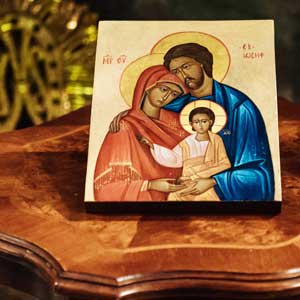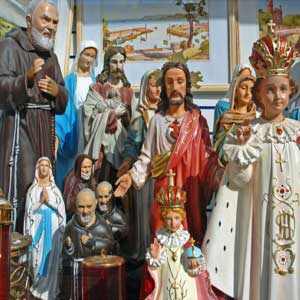
The month of May is traditionally dedicated to the Virgin Mary in the Catholic Church. It is a month of devotion, prayer and celebrations, when the faithful turn their gaze more especially to the Mother of Christ. Among the concrete expressions of this Marian piety are several important liturgical feasts, rooted in the tradition and theology of the Church. These feasts are not there simply to honour Mary, but to help Christians enter more fully into the mystery of salvation, through her who was its humble handmaid.
The month of Mary: a time of grace
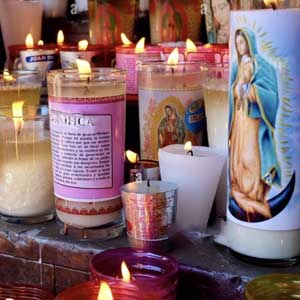
Before going into detail about the liturgical Marian feasts celebrated in May, it is important to understand the spiritual context of this month. Since the 18th century, the Church has encouraged the faithful to dedicate the month of May to Mary. This is a popular tradition that originated in Jesuit circles and then spread widely thanks to popular piety and the support of several popes. The month of May then became a time of prayer, wreaths of flowers, rosaries, novenas, processions and consecrations.
Within this Marian month, certain specific liturgical feasts punctuate the calendar, strengthening the bond between Mary and the faithful.
1. 13 May: Our Lady of Fatima
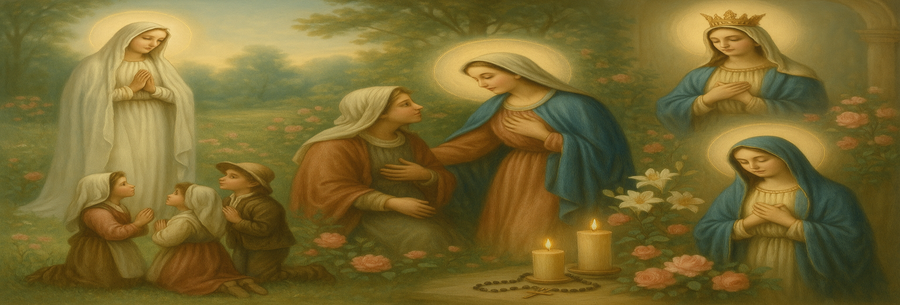
The feast of Our Lady of Fatima is one of the most significant of the month of May. It commemorates the first Marian apparition that occurred on 13 May 1917 to three young Portuguese shepherds: Lucia, Francisco and Jacinta, in the countryside around Fatima.
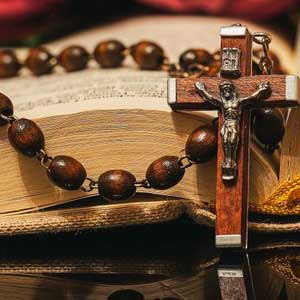
The Virgin appeared to them several times between May and October of the same year, delivering a message of prayer, conversion and penance. She insisted on reciting the rosary to obtain peace in the world, particularly during the First World War, which was raging at the time. She also shared prophetic messages about Russia, the Christian faith, and the Church.
The recognition of these apparitions by the Church, as well as the worldwide impact of Fatima (pilgrimages, papal messages, Marian consecrations) make this feast a major Marian moment, celebrated with fervour in many countries.
2. 24 May: Mary, Help of Christians
The feast of Mary, Help of Christians (or Mary Help of Christians) is celebrated on 24 May. It was officially instituted by Pope Pius VII in 1815, in thanksgiving for his release after years of captivity under Napoleon. He attributed this release to the intercession of the Virgin Mary.
This feast highlights Mary's role as protector of the Church and help in times of trial. It is particularly dear to the faithful of the Salesian family, founded by St John Bosco, who had great confidence in this Marian figure. In fact, Don Bosco had the Basilica of Mary Help of Christians built in Turin, a major place of pilgrimage.
This feast invites us to entrust ourselves to the Virgin as a powerful and benevolent Mother, always ready to support her children in the spiritual struggles and difficulties of the world.
3. The Saturday after Ascension: Our Lady of the Cenacle
The Saturday before Pentecost is sometimes marked by the memory of Mary in the Cenacle. Although not included in the universal liturgical calendar as an obligatory feast, this spiritual tradition recalls Mary's presence at the heart of the nascent Church, praying with the apostles, awaiting the Holy Spirit.
It underlines Mary's role as a figure of the Church, a model of faith and docility to the Spirit. On this eve of Pentecost, Mary appears as Mother of the Church, gathering her children together in hope.
4. The last day of May: the Visitation of the Virgin Mary
On 31 May, the Church celebrates the feast of the Visitation of the Virgin Mary, one of the major events in her life recounted in the Gospel of Luke (1:39-56). After the Annunciation, Mary went "in haste" to visit her cousin Elizabeth, who was pregnant with John the Baptist. This encounter gives rise to a moment of intense joy, spiritual exultation, and the singing of the Magnificat.
This feast highlights Mary's active charity, her faith in action, her deep joy in God's plan. It invites the faithful to imitate Mary in her generosity, her availability, and her ability to transmit the presence of Christ.
The feast of the Visitation thus concludes the month of Mary as a spiritual summit, a call to become, like her, bearers of light and hope for the world.
Other local celebrations and traditions
In addition to these liturgical feasts, many local or particular Marian feasts may be celebrated during the month of May, depending on the diocese or country. These include:
The crowning of the Virgin, where Marian statues are crowned with flowers by children or the faithful.
Marian processions, often organised in villages or shrines.
Novenas to Mary, particularly before Fatima or the Visitation.
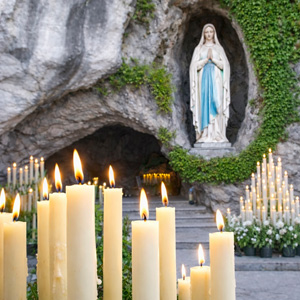
Pilgrimages, such as those to Lourdes, Pontmain, La Salette or other Marian shrines in Europe and around the world.
Conclusion
The Marian feasts in May remind us that Mary is not a figure from the past, but a living presence in the lives of Christians. Each feast reveals a particular face of the Mother of God: the one who appears to call for prayer and peace, the one who protects her own, the one who gathers the Church in prayer, the one who visits and consoles.
By celebrating them, we deepen our relationship with Mary and, through her, with Jesus. These feasts are so many opportunities to meditate, pray, sing, convert and love, in the joy of the spiritual springtime that the Church is offering us through this month of Mary.