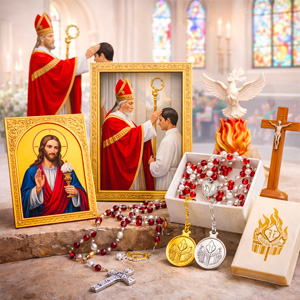

In the Catholic faith, religious objects are not decorative accessories or mere cultural symbols. They are concrete supports for nourishing prayer, expressing a personal relationship with God, and accompanying a spiritual journey. When it comes to Marian devotion, these objects take on a very special significance, as they express the filial tenderness of the faithful towards the Virgin Mary, Mother of Christ and Mother of the Church. These objects help to anchor faith in everyday life, to open up a sacred space in the home, and to enter more deeply into a life of prayer.
The rosary: the Marian instrument par excellence
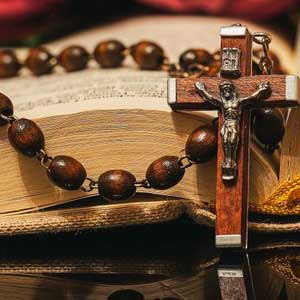
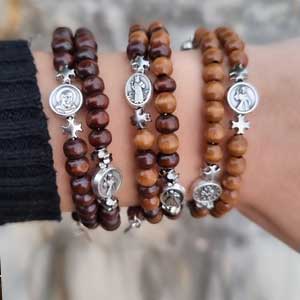
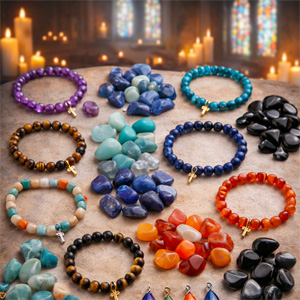
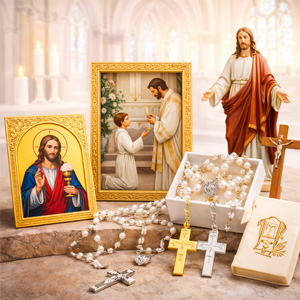
The rosary is undoubtedly the most emblematic object of Marian devotion. It is a cord or necklace made up of beads, intended to guide the meditative prayer of the rosary. Each bead corresponds to a prayer: mainly the "Hail Mary", but also the "Our Father", the "Glory be to the Father" and meditations on the mysteries of Christ's life.
Used since the Middle Ages, the rosary is a path of contemplation, a means of uniting the prayer of the heart with the rhythm of the breath, and entrusting each day to the Virgin Mary. Today, there is a wide variety of rosaries: traditional, made of wood or metal, luminous, scented, for children or the sick. Some are blessed and thus become sacramentals, carriers of special graces.
Marian medals: carrying Mary on your person
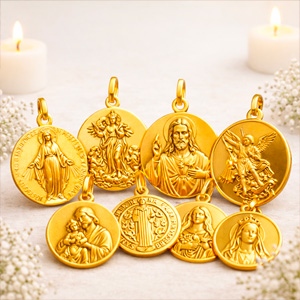
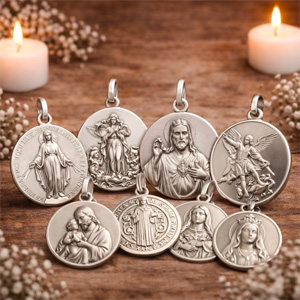
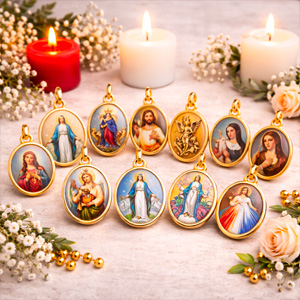
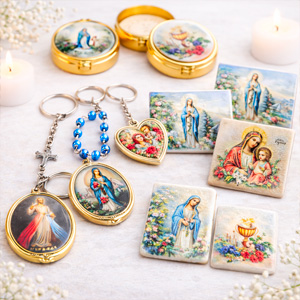
Medals represent another form of personal link with Mary. Worn around the neck, in a pocket or hanging from a bag, they are a reminder of the Virgin's presence and the protection she offers her children. The best known is the Miraculous Medal, given by the Virgin to Saint Catherine Labouré in Paris in 1830, with this promise: "Those who wear it with confidence will receive great graces."
Medals may represent the Immaculate Conception, Our Lady of Lourdes, Our Lady of Fatima, or other Marian titles. They are often offered on the occasion of a baptism, first communion, confirmation or pilgrimage. They become a sign of faith and hope, and an ever-present silent prayer.
Statues and icons: a presence in the home
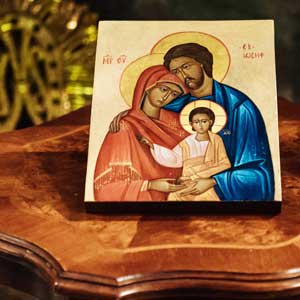
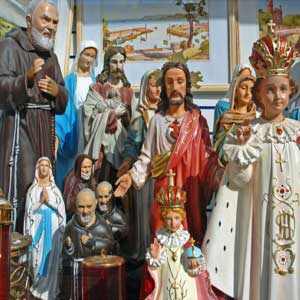
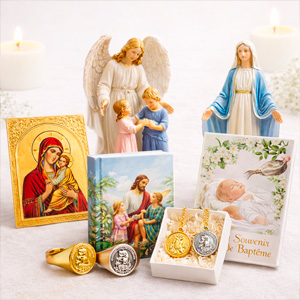
Installing a statue or icon of the Virgin Mary in the home is a deeply spiritual act. It's not just an ornament: it's an invitation to Mary to remain in our daily lives, to watch over the home, to accompany us in our joys and sorrows.
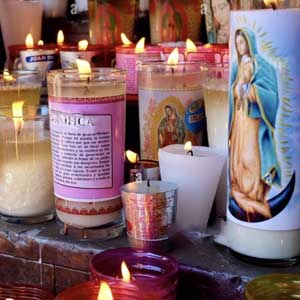
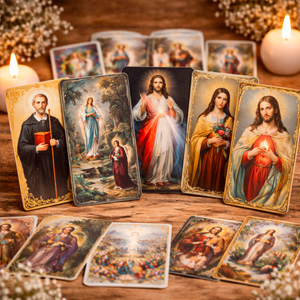
Whether it's a representation of Our Lady of Lourdes, the Virgin of Fatima, Mary who unties knots, or an icon of oriental tenderness, each image speaks to the heart. They help us to pray, to entrust our intentions and to keep our eyes turned towards Heaven. Christian families often choose to place a statue in a prayer corner, and light a candle or place a flower on it during the month of May or on the occasion of a Marian feast.
Scapulars: a commitment of faith
The Mount Carmel scapular is a small piece of blessed cloth, worn around the neck, and linked to a promise the Virgin made to Saint Simon Stock in the 13th century. It is the sign of a personal commitment to follow Christ under the protection of Mary. Wearing the scapular means entering into a relationship of trust and fidelity, and becoming part of a rich spiritual tradition.
There are other types of scapular, sometimes in the form of medals, always linked to a strong spiritual undertaking. They are often accompanied by a solemn blessing and a specific prayer.
Water and candles from Lourdes: the devotion of pilgrims
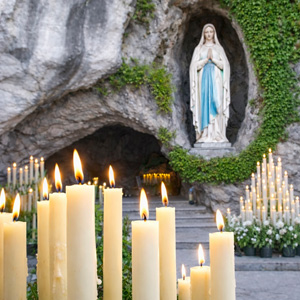
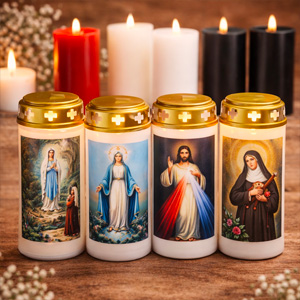
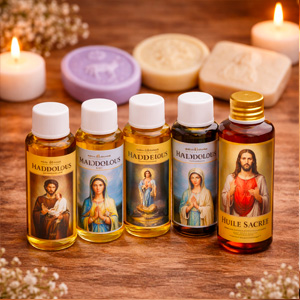
Among Marian religious objects, those from shrines are particularly precious to the faithful. At Lourdes, pilgrims often leave with a bottle of holy water from the spring, a candle lit at the Grotto, or a small statue of the Virgin.
These objects carry the memory of the pilgrimage, but also the faith lived in the heart of a place of graces. They are used to pray for the sick, to ask for healing, or to rekindle hope. They are not magic, but they support prayer with strength and simplicity.
Prayer books and novenas
Finally, the objects that accompany personal prayer play a fundamental role. Prayer books to Mary, novenas, guided rosaries or rosary meditations help to structure spiritual time. They are companions for vigils, moments of solitude and times of trial. They reveal the richness of popular piety, but also the theological depth of Marian devotion.
Conclusion: objects that connect with the invisible
Marian religious objects are bridges between the visible and the invisible. They are neither talismans nor objects of superstition, but concrete aids to nourish a living spiritual life. They remind us of Mary's maternal presence, they encourage us to pray, they express the love of a heart for her who watches over us constantly.
By using them with faith, respect and love, believers become rooted in an ancient, living and deeply human tradition. They discover that faith is lived not only in spirit, but also through hands, eyes, and everyday life. And through each rosary, each image, each flame lit, it is Mary herself who guides us towards her Son.