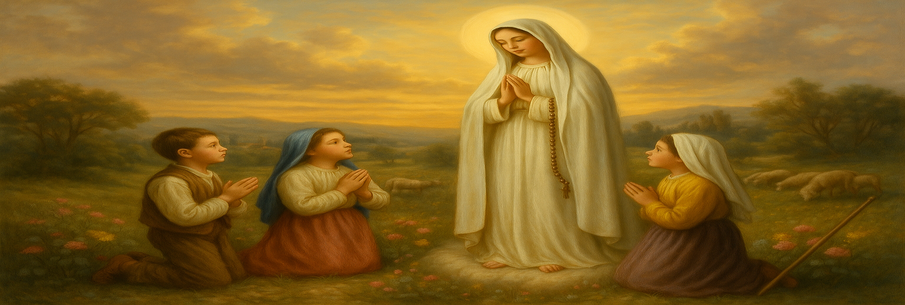
In 1917, in the heart of Portugal, a small village was to become one of the most famous places of Marian devotion in the world: Fatima. It was there, in the countryside of the Cova da Iria, that the Virgin Mary appeared to three young shepherds, delivering a message of peace, prayer, penance and conversion. The story of these apparitions, now officially recognised by the Church, continues to fascinate, move and challenge millions of believers.
Historical and spiritual context
Portugal, in 1917, was going through a difficult period. The monarchy had been overthrown in 1910 and an anti-clerical republic had been installed. The Church was persecuted, religious congregations were dissolved, and priests had to work underground or in fear. At the same time, the First World War was ravaging Europe and causing untold suffering. The climate was one of anxiety, despair and the shaking of landmarks.
It was against this troubled backdrop that heaven was to lean over the earth.
The visionaries: Lucia, Francisco and Jacinta
The Fatima apparitions were received by three children from very modest peasant families:
Lucie dos Santos, aged 10,
Francis Marto, her cousin, aged 9,
Jacinta Marto, Francisco's sister, aged 7.
The three children were used to tending the flocks in the hills around their village. They were pious, simple and extremely humble. Their lives change in 1916, when they receive a visit from an angel, who teaches them to pray and announces the coming of the Virgin.
The Angel of Peace (1916)
Even before the apparitions of Mary, the children receive three visits from an angel, who introduces himself as the Angel of Peace, then as the Angel of Portugal. He teaches them two profound prayers, invites them to adoration and reparation for offences against God.
At the third apparition, he gives them communion, prefiguring the importance of the Eucharist in the message of Fatima.
These apparitions of the angel prepare the children for the coming of the Virgin and introduce them to a life of offering, prayer and sacrifice.
The six apparitions of the Virgin Mary (13 May - 13 October 1917)
The apparitions of Our Lady took place every 13th of the month, between May and October 1917, in the small valley of the Cova da Iria.
13 May 1917
The Virgin appears for the first time, dressed in white, radiant with light. She asks the children to return every 13th of the month for six months. She entrusts them with a mission: to pray the Rosary every day for peace in the world and an end to the war.
Lucie asks if she will go to heaven with her cousins. The Virgin assures her that she will, but that Francisco will have to pray many rosaries. To Jacinta too, the promise of heaven is given.
13 June 1917
Mary teaches the children a new prayer and invites them to consecrate themselves to her Immaculate Heart. She tells them that Francisco and Jacinta will soon go to heaven, but that Lucia will stay on earth longer to make her mission known.
13 July 1917
This apparition is the most striking. Mary shows the children a vision of hell, with the souls of the damned. She then confides to them what will later be known as the three secrets of Fatima:
The vision of hell.
The announcement of a future war (the Second World War) if humanity does not convert.
The message related to the persecution of the Church, the martyrdom of believers, and the role of Russia.
She still insists: "To save souls, God wishes to establish in the world devotion to my Immaculate Heart."
August 19, 1917 (exceptionally delayed)
With the children imprisoned by the civil authorities, the apparition takes place a few days later in Valinhos. Mary exhorts them to prayer and fidelity despite the suffering.
13 September 1917
Around 30,000 people attend this apparition. Mary repeated her calls to recite the rosary and promised a great miracle for the following month.
13 October 1917 - The miracle of the sun
This was the apotheosis of the apparitions. Around 70,000 people gather in the rain. After the apparition, the sun begins to dance in the sky, turning on itself, projecting multicoloured lights, seeming to come dangerously close to the earth, before returning to its place.
This phenomenon is seen by the entire crowd, believers and non-believers alike, journalists and sceptics alike. It was quickly dubbed "the miracle of the sun".
Marie revealed her identity: "I am Our Lady of the Rosary", and renewed her calls for conversion.
After the apparitions
The fate of the visionaries
François died in 1919, aged 11, a victim of Spanish flu.
Jacinthe died in 1920, aged 10, after a long illness offered for the conversion of sinners.
Lucie entered religion and became a Carmelite nun. She lived until 2005, continuing the mission entrusted to her by the Virgin.
François and Jacinthe were canonised by Pope Francis in 2017. Lucia is in the process of being beatified.
The shrine of Fatima
As soon as the apparitions were recognised by the Church (1930), the place became a major Marian shrine, to which millions of pilgrims come every year. The Basilica of Our Lady of the Rosary, the Chapel of the Apparitions and the esplanade made it a place of intense prayer and conversion.
Successive popes would visit: Paul VI, John Paul II (very attached to Fatima), Benedict XVI and Francis.
The message of Fatima: still relevant today
The message of Our Lady of Fatima is centred on prayer, the Rosary, conversion of heart, penance, peace and trust in Mary.
She calls humanity to turn to God, to repair the offences done to her Immaculate Heart and that of her Son. She promises the final victory of good: "In the end, my Immaculate Heart will triumph."
In a world still marked by war, sin, indifference or doubt, the call of Fatima remains a cry of love and hope.