A light that speaks to the soul
Since the origins of the Christian faith, candles have held an essential place in prayer, liturgy and gestures of the heart. To light a candle is to make a prayer visible, to offer silence, to invoke the light of Christ in the shadow of the world. Each flame evokes the presence of God, a discreet but living fire that enlightens without forcing, that warms without burning.
In Catholic tradition, certain candles have become powerful symbols, each carrying its own meaning and a particular use. Here are the 5 most important Catholic candles to know.
1. The paschal candle
This is the most solemn candle of the liturgical year. Lit on Easter night, the paschal candle represents the risen Christ, victorious light over the darkness of death.
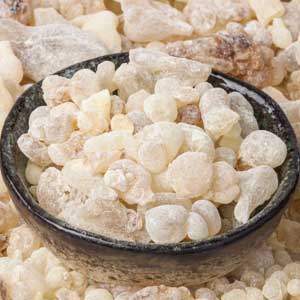
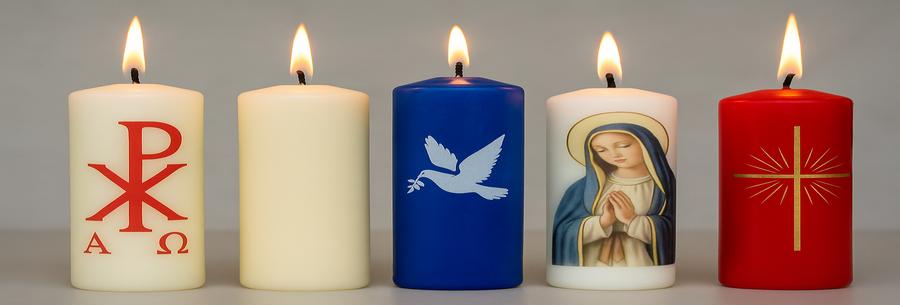
Embossed with alpha and omega (the first and last letters of the Greek alphabet), it is also marked with the current year and five grains of incense inserted in the shape of a cross. The fire of the Paschal candle opens the Easter night, illuminates baptism, accompanies funerals.
It is kept lit until Pentecost, then used at baptisms and funerals throughout the year, a sign that the light of Christ illuminates our beginnings as well as our passages.
2. Altar candles
Presented on or near the altar, these candles are signs of Christ's presence in the Eucharist. Their number may vary according to the solemnity of the Mass, but they are always there to say that the Lord's table is a place of light and sacrifice.
They also recall the words of Jesus: "I am the light of the world; he who follows me will not walk in darkness, but will have the light of life." (John 8:12)
Their use is codified in the liturgy, but their symbolism remains profound: to serve the Mass is to serve the light.
3. Novena candles
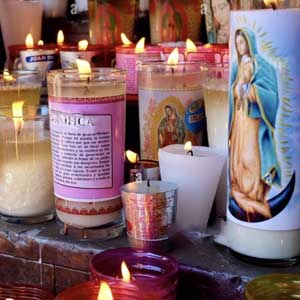
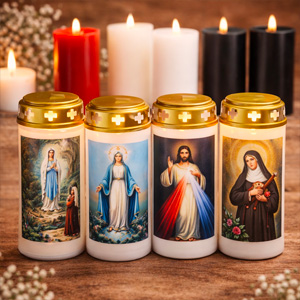
More popular, these are often used to accompany prolonged prayer, for 9 days (hence the name "novena"). They usually bear the image of a saint, Jesus or Mary, and are lit to ask for a grace, entrust an intention, or give thanks after an answered prayer.
They can be found in shrines, churches, but also at home. Their peaceful light carries prayer in silence, day and night.
These are the candles most associated with personal devotion, discreet, persevering, trusting.
4. Votive candles
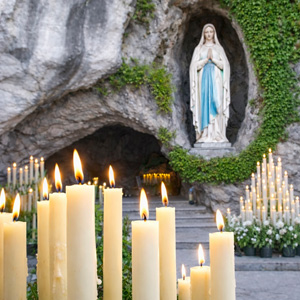
Small and numerous, they are the most visible in shrines such as Lourdes, Lisieux, or Montmartre. Lit by pilgrims, they are a simple but powerful way of saying to God, Mary, or a saint, "I'm thinking of you, I offer you this."
The word "votive" comes from votum, the vow, the promise. Lighting a votive candle links a prayer to a visible act, a commitment: "I pray for someone, I offer myself, I ask."
These are candles of passage, of crowds, but their meaning remains intimate: each one speaks for someone.
5. Processional candles
Used for major liturgical celebrations such as Candlemas, Palm Sunday, the Marian procession or funerals, these candles are carried by hand. They symbolise the Church on the move, led by the light of Christ.
On the feast of the Presentation of the Lord (Candlemas), the faithful receive a blessed candle and light it to signify that their lives should be light.
At funerals, they are sometimes carried to the cemetery. They are a reminder that even in the night, faith carries a fragile but invincible flame.
The candle, a silent prayer
There is no one way to light a candle. Whether in a cathedral or on your bedroom table, it's the intention of the heart that gives the flame its meaning. The light of the candle does not speak: it listens, watches, connects.
Offering a candle means entrusting your life to God, acknowledging your littleness, hoping in silence, loving without noise. It's a way of inhabiting time through light, and letting God illuminate our inner night.