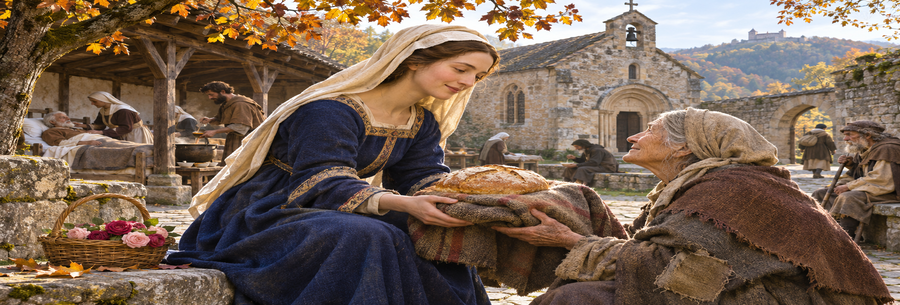
Discover Saint Margaret of Scotland, an 11th-century Christian queen, mother, reformer of the Church and servant of the poor, whose feast day is 16 November.
Saint Margaret of Scotland, a queen in the service of God and the poor
On 16 November, the Catholic Church observes the optional memorial of Saint Margaret of Scotland, alongside Saint Gertrude the Great. On this Monday of the 33rd week in Ordinary Time, her witness resonates with astonishing relevance with the Gospel’s call: to ask the Lord to see more clearly, to recognise his presence and to follow in his footsteps.
Saint Margaret of Scotland was a queen, a wife, a mother and a woman of prayer. Her life reminds us that holiness is not confined to cloisters or great, visible deeds: it can be lived out through family responsibilities, the governance of a country, care for the most vulnerable, and daily fidelity to Christ.
An exiled princess who became Queen of Scotland
Margaret was born around 1045 into an Anglo-Saxon royal family. She was the granddaughter of King Edmund II of England. Her childhood was marked by the political upheavals that shook her country following the Norman conquest of England. Along with her family, she experienced exile and uncertainty.
Just as she was perhaps about to leave the British Isles to head for the continent, her ship ran aground on the Scottish coast. This event, which might have seemed merely an accident, marked the beginning of a new chapter in her life. She was welcomed to Scotland by King Malcolm III, also known as Malcolm Canmore.
The king was moved by this young woman’s faith, intelligence and gentleness. Their marriage united two very different personalities: Malcolm was a man of war, energetic and courageous; Margaret was cultured, a devout Christian, devoted to prayer and attentive to the needs of others. Far from withdrawing from the realities of the kingdom, she illuminated them through the Gospel.
She became Queen of Scotland and gave birth to eight children. Several of them would go on to play an important role in their country’s history. Margaret never separated her love for her family from her love for God. She understood that her home was the primary place where faith was lived out, through education, patience, forgiveness and example.
A faith lived out in prayer and daily life
Saint Margaret is known for her deep spiritual life. She began her days with prayer and made a point of attending the liturgy. Her devotion to God did not distance her from earthly realities; on the contrary, it made her deeply available to others.
At a time when travel was difficult and poor families often suffered from hunger, illness or isolation, she made charity a priority. She did not regard the destitute as a burden or as a problem to be solved from afar. She welcomed them, listened to them and sought to help them in practical ways.
Tradition has it that before eating her own meal, she would ensure that the poor were fed. She also took in orphans and cared for abandoned children. In these simple acts, the full strength of her faith is revealed: for Marguerite, serving the poor meant welcoming Christ himself.
Her generosity was not limited to a passing emotion. It became a way of life, a deep-seated orientation of her heart. She knew that wealth and honours only take on their true meaning when they become a means of fostering justice, peace and brotherhood.
A queen who gently reformed the Church
Eleventh-century Scotland already had a long Christian tradition. However, certain local liturgical and disciplinary practices had drifted away from the customs of the universal Church. Margaret, with the help of bishops and religious, encouraged a respectful and patient reform.
In particular, she promoted a more meaningful celebration of Sunday, the day consecrated to the Lord. She encouraged the faithful to attend Mass, to rest from unnecessary work, and to restore to this day its true meaning of praise, family fellowship and charity.
She also worked to ensure that the liturgy was more closely aligned with that of Rome. For her, this was not a matter of imposing external rigidity, but of reminding people that the Church is one great family gathered around Christ. Communal prayer, the sacraments and fidelity to the faith received are sources of peace and unity.
Her influence on King Malcolm was decisive. He deeply respected his wife’s faith and supported her initiatives. Their marriage thus became a sign of hope: it showed that married life can become a path towards God, when each partner helps the other to grow in truth, goodness and service.
A mother attentive to the Christian upbringing of her children
Saint Margaret did not entrust Scotland’s future solely to political decisions; she also laid the foundations for it through the upbringing of her children. She saw to their human, intellectual and spiritual formation. She wishes to instil in them a love of prayer, a love for the poor, respect for the Church and a sense of responsibility.
This aspect of her life speaks particularly to today’s parents and grandparents. Educating in the faith is not merely a matter of teaching prayers or reminding children of rules. Above all, it is about helping children discover that God loves them, that the Gospel guides their choices, and that charity can transform everyday life.
Marguerite knows that her children are growing up in an uncertain world. She cannot shield them from every trial, but she gives them a solid foundation: a home filled with prayer, care for others and trust in God.
Her example invites every family to make their home a place of peace. A word of forgiveness, a shared meal, an intention entrusted to the Lord, or discreet help given to someone who is alone can all become genuine acts of faith.
Charity, the treasure of a Christian kingdom
A saying attributed to Saint Margaret beautifully expresses her view of the poor: the hand of those in need becomes the safest place in which to deposit the treasures God has entrusted to us. This conviction sums up her entire life.
She does not despise material realities; she places them in their proper context. Bread, money, clothing, power and time are gifts that can become instruments of goodness. They are never an end in themselves.
In a society often tempted to measure success by possessions, Saint Margaret of Scotland shows us another way. She teaches us that true wealth is that which circulates, nourishes, uplifts and comforts. A hand extended with respect can become a sign of God’s tenderness.
Her charity is also characterised by great sensitivity. She does not seek to dominate those she helps, nor to seek admiration for herself. She wishes to honour their dignity. This attitude remains essential: every Christian act of solidarity must be imbued with respect, a willingness to listen and brotherhood.
A trying end to her life, yet filled with hope
Saint Margaret’s life came to an end amidst trials. Her husband Malcolm III and one of their sons died during a conflict. Severely weakened by illness, Margaret learnt this terrible news shortly before her own death on 16 November 1093.
This immense grief did not destroy her trust in God. Right up to the very end, she remained faithful to prayer and entrusted her life into the Lord’s hands. Her passing was that of a woman who had experienced the joys of family life, the responsibilities of power, concern for the poor and suffering, without ever ceasing to seek God.
The Church recognises her as a saint because her faith shaped her entire life. She did not live apart from the world: she carried out her responsibilities at the very heart of this world, with courage and humility.
What Saint Margaret of Scotland teaches us today
Saint Margaret is a precious companion for those who seek to reconcile their faith with a demanding family, professional or social life. She reminds us that Christ can be present in important decisions as well as in the most ordinary tasks.
She teaches us to give prayer its rightful place, not as an isolated obligation, but as a source that renews the heart. She also invites us to look out for the vulnerable: the poor, the elderly, children, the sick, families in difficulty or those who feel lonely.
Finally, her example encourages us to live out our responsibilities as a form of service. Whether as a parent, spouse, team leader, volunteer, neighbour or friend, everyone can choose to spread more peace around them.
Marguerite’s holiness is not a distant ideal. It is made up of faithfulness, listening, generosity and trust. On this 16th November, let us ask her to help us put more faith into our actions, gentleness into our words and charity into our interactions.
Prayer to Saint Margaret of Scotland
Saint Margaret of Scotland,
you who served God at the heart of your family and your kingdom,
teach us to fulfil our responsibilities with love and humility.
Grant us a heart attentive to the poor,
a faithful faith in times of joy as well as in times of trial,
and a deep peace in our homes.
Help us to make our lives a service offered to Christ
and to recognise his face in every person we meet.
Amen.