Discover the miracles attributed to the Miraculous Medal, its history since 1830, the conversion of Alphonse Ratisbonne and the true Christian meaning of this devotion.
SEO Title: Miracles of the Miraculous Medal: testimonies, conversions and spiritual significance
Meta description: Discover the miracles attributed to the Miraculous Medal, its history since 1830, the conversion of Alphonse Ratisbonne and the true Christian meaning of this devotion.
The Miracles of the Miraculous Medal: graces, conversions and hope
Since its introduction in 1832, the Miraculous Medal has been associated with countless testimonies of healings, protection, conversions and restored peace. It is precisely this abundance of accounts that has given it its popular name, the ‘Miraculous Medal’.
However, understanding the miracles of the Miraculous Medal requires us to look beyond a superficial or magical view. The medal is not a lucky charm. It does not possess any automatic power. It is a sign of faith, a call to prayer and a reminder of the maternal intercession of the Virgin Mary.
The graces attributed to the Miraculous Medal have their origin in the message entrusted to Saint Catherine Labouré during the apparitions of 1830 on Rue du Bac in Paris. Through this small object of devotion, Mary invites the faithful to turn to God with trust, perseverance and simplicity.
The origin of the Miraculous Medal
On 27 November 1830, the Virgin Mary appeared to Saint Catherine Labouré, a young novice of the Daughters of Charity. Mary appeared standing on the globe, her hands open, with luminous rays streaming from her fingers.
According to Catherine’s account, these rays symbolise the graces that Mary obtains for those who ask for them. The Virgin then asked for a medal to be struck according to the model shown during the apparition.
Surrounding Mary is the now famous invocation:
‘O Mary, conceived without sin, pray for us who have recourse to you. ”
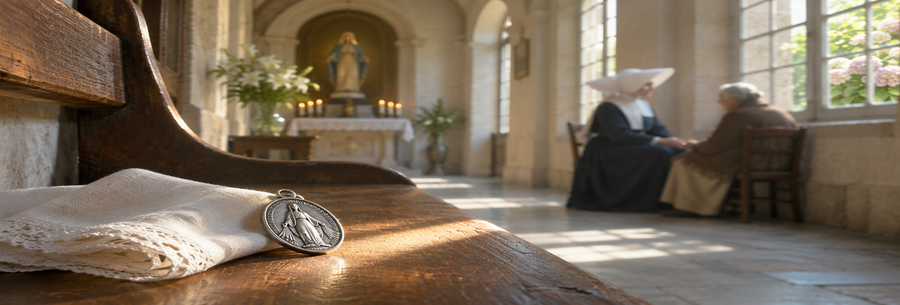
The first medals were produced in 1832. They were distributed, in particular, by the Daughters of Charity to poor families, the sick and the victims of the cholera epidemic that struck Paris.
Very soon, accounts of unexpected healings, profound conversions, reconciliations and acts of protection began to multiply. The faithful began to speak of the ‘Miraculous Medal’. This name, born of popular piety, expressed their gratitude for the graces received through Mary’s intercession.
What does the word ‘miracle’ mean in the Christian faith?
In everyday language, any happy or unexpected event is often called a miracle. In the Christian tradition, a miracle is a sign that points to God. It does not seek to impress, but to awaken or strengthen faith.
The miracles in the Gospels performed by Jesus are never mere displays of power. They reveal his compassion, his love for those who are suffering, and his desire to save all of humanity.
Similarly, when a grace is attributed to the intercession of Our Lady of the Miraculous Medal, the believer must not focus solely on the external event. A healing, protection or an improvement in one’s circumstances may be received with gratitude, but the deepest grace always remains the encounter with God.
A conversion of the heart, a renewed inner peace, the strength to forgive, the courage to endure an illness or a return to prayer can be immense graces, even when they are not visible to the world.
The first testimonies during the cholera epidemic
The first Miraculous Medals began to be distributed during a very painful period. In 1832, Paris was struck by a severe cholera epidemic. The disease caused fear, grief and great distress in working-class neighbourhoods.
The Daughters of Charity, already committed to caring for the sick and the poor, distributed the first medals, inviting people to pray with confidence. Accounts of healings, unexpected improvements and conversions then spread rapidly.
These stories must be received with faith, but also with discernment. Not all healings are subject to medical or canonical investigation. Nevertheless, they remain significant for those who recognise in them an answer from God, support received in times of trial, or a special grace.
What particularly characterised the early days of the Miraculous Medal was the surge of confidence it inspired. For many, it became a sign of hope in a time of fear and uncertainty.
The conversion of Alphonse Ratisbonne
The most famous account linked to the Miraculous Medal is that of Alphonse Ratisbonne, in Rome, on 20 January 1842.
Alphonse Ratisbonne, a young man from a Jewish family in Strasbourg, was in Rome at the time. Although he was very distant from the Christian faith and even deeply hostile to Catholicism, he nevertheless agreed, at a friend’s request, to wear a Miraculous Medal and to recite the Marian prayer.
As he entered the Church of Saint-André-des-Frattes, he had a deeply moving spiritual experience which he attributed to an apparition of the Virgin Mary. He subsequently testified to a radical change in his view of the Christian faith.
His conversion caused a considerable stir throughout Catholic Europe. An ecclesiastical inquiry was conducted in Rome. Shortly afterwards, Alphonse Ratisbonne was baptised and went on to become a priest. He subsequently devoted much of his life to education and spiritual guidance.
Beyond the extraordinary nature of this event, Alphonse Ratisbonne’s testimony reminds us that no one is forever closed off from God’s grace. Conversion is not a victory over someone; it is a personal encounter with Christ, who transforms a heart and opens it to new life.
Healings attributed to the Miraculous Medal
Since the 19th century, many people have reported receiving special help after praying to Our Lady of the Miraculous Medal. Some bear witness to an unexpected physical healing. Others speak of an improvement in their state of health, a favourable outcome in a difficult situation, or new strength to endure illness.
The Church always urges caution. Any claim of healing must be examined seriously when presented as miraculous. Medicine plays an essential role, and prayer never replaces the need to seek medical advice, receive treatment or follow a course of treatment.
But the Christian faith also affirms that God can act in any situation. He can grant a physical healing, but also an inner healing: relief from anxiety, peace after a long period of mourning, the ability to regain confidence, or the courage to face a trial.
From this perspective, the Miraculous Medal accompanies the person without promising a specific outcome. It invites them to place their life in God’s hands and to ask Mary to pray for them.
Invisible miracles: peace, forgiveness and a return to God
The most profound testimonies associated with the Miraculous Medal are not always the most spectacular. Many people recount having rediscovered a peace they had long since lost, having found the courage to ask for forgiveness, having let go of long-held anger, or having returned to the path of prayer.
In a divided family, a medal given as a gift can become a sign of a desire for reconciliation. In times of loneliness, it can serve as a reminder that God never forgets anyone. In times of illness, it can become an inner source of strength that helps one to avoid despair.
These unassuming graces are entirely in keeping with the spirit of the Gospel. God often acts in silence. He does not force hearts, but reaches out to them with patience. He does not always immediately remove the trial, but He gives the strength to endure it.
The Virgin Mary, present at the foot of the Cross, is particularly close to those who suffer. She does not promise a life without difficulties; she teaches us to remain hopeful.
Why the Miraculous Medal is not a talisman
The Church is very clear on this point: no religious object, even if blessed, should be regarded as a talisman or an amulet.
Wearing a Miraculous Medal does not work automatically. The medal does not offer protection without faith, without prayer and without the desire to live in accordance with the Gospel. To attribute magical powers to it would be to fall into superstition.
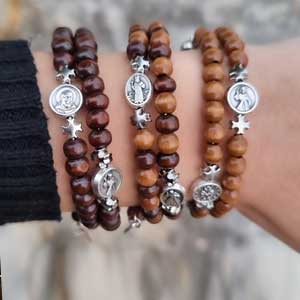
The medal is a sacramental. It is a visible sign that helps us turn towards God. It serves as a reminder of a promise of grace, but this grace calls for a response: trust, prayer, perseverance, charity and a life faithful to Christ.
The right way to wear the Miraculous Medal is therefore to regard it as a daily reminder. When we see or touch it, we can say: ‘Mary, lead me to Jesus.’
How do we ask Our Lady of the Miraculous Medal for a grace?
We can address Mary in very simple words. There is no need to use long prayers. The essential thing is to pray sincerely.
You can begin by making the sign of the cross, holding the medal in your hand and saying:
‘Our Lady of the Miraculous Medal, I entrust this intention to you. Present it to Jesus and obtain for me the grace to face this situation with faith, courage and peace.”
Then you can recite the invocation:
“O Mary, conceived without sin, pray for us who have recourse to you. ”
A nine-day novena may also be prayed. It enables one to entrust an intention to God faithfully, without seeking to impose an answer. The novena teaches us to wait, to persevere and to accept God’s will.
It is also possible to have one’s medal blessed by a priest or a deacon. The blessing invites the believer to receive this object as a sign of prayer and Christian faithfulness.
The miracles of the Miraculous Medal today
Devotion to Our Lady of the Miraculous Medal remains alive because it meets a deeply human need: the need to know that one is loved, accompanied and supported in prayer.
Even today, people entrust their intentions to Mary for their children, their marriage, their health, their work, their financial difficulties or their inner wounds. Some receive a visible answer. Others discover a peace and strength they did not expect.
The message of the Miraculous Medal remains relevant today: to ask for the graces we need, to trust in God, and never to forget that prayer bears fruit, even when that fruit is not immediately apparent.
The medal does not offer a guarantee against trials. It offers a path of trust. It reminds us that Mary intercedes for every person and that Jesus welcomes those who come to him with a humble heart.
Frequently asked questions about the miracles of the Miraculous Medal
Does the Miraculous Medal really work miracles?
Catholics attribute many graces, healings, acts of protection and conversions to the intercession of Our Lady of the Miraculous Medal. The Christian faith recognises that God can perform miracles, but it emphasises that the medal itself does not act as a magical object.
Can one wear the Miraculous Medal for protection?
Yes, it can be worn as a sign of trust and prayer. However, it should not be regarded as automatic protection. It invites one to entrust oneself to God and to seek Mary’s intercession.
Can one give a Miraculous Medal to someone?
Yes. It can be given on the occasion of a baptism, a birth, a First Communion, a Confirmation, a wedding or during a difficult time. It is a gift of faith and hope, which may be accompanied by a quiet prayer.
Can one pray to the Miraculous Medal for healing?
Yes, it is possible to ask for healing, either for oneself or for a loved one. This request must always be accompanied by trust in God, respect for the necessary medical care and a peaceful surrender to His will.
Prayer to Our Lady of the Miraculous Medal
O Mary, conceived without sin,
pray for us who have recourse to you.
Virgin Mary,
you who pour out God’s graces
upon those who turn to you,
I entrust to you my needs, my sorrows and my hopes.
Support the sick,
comfort those who are suffering,
bring back to Jesus those who have strayed
and grant peace to wounded hearts.
Teach us to pray with confidence,
to accept God’s will
and to live each day in faith and charity.
Our Lady of the Miraculous Medal,
pray for us.
Amen.