Discover the liturgical colours of Christmas in the Catholic Church, the significance of white and gold, as well as the purple and pink of Advent and their Christian symbolism.
The liturgical colours of Christmas: their meaning and significance in the Catholic tradition
Every year, as Christmas approaches, churches gradually change their appearance. The purple vestments of Advent give way to the white or gold vestments of the Nativity celebrations. The altars are decorated, candles illuminate the sanctuaries and the priests don their finest vestments to celebrate the birth of Jesus Christ.
These changes are not merely decorative choices. In the Catholic Church, liturgical colours have a specific spiritual significance. They mark the different seasons of the year and help the faithful to better understand the mystery being celebrated.
At Christmas, white is the principal liturgical colour. It expresses the joy, light, purity and glory of Christ. Gold, often used in the most solemn vestments, also evokes divine majesty and the splendour of this great Christian feast.
But why do priests wear purple during Advent? What is the significance of the pink worn on the third Sunday of Advent? Why does white replace purple at Christmas? And how do these colours help us to experience the Saviour’s birth more deeply?
Let us discover the history and significance of the liturgical colours of Christmas, their place in Catholic tradition and their importance for the spiritual preparation of the faithful.
1. What are liturgical colours in the Catholic Church?
Liturgical colours are the colours used for the vestments of ordained ministers and certain ornaments during religious celebrations.
They vary according to the seasons of the liturgical year and the feasts being celebrated.
In the Roman Rite, the main colours are white, red, green and purple. Pink may also be used on certain special occasions. Black is still used in certain funeral contexts.
Each colour has a symbolic meaning.
White primarily expresses joy and glory.
Red evokes, in particular, the blood of the martyrs, fire and the Holy Spirit.
Green is used during Ordinary Time and traditionally symbolises hope and spiritual growth.
Violet is associated with preparation, penance and conversion.
Pink signifies a particular joy at the heart of certain periods of preparation.
Why does the Church use different colours?
The Catholic liturgy makes use of many visible signs.
Gestures, hymns, lighting, vestments and sacred objects all help to express spiritual realities.
Colours enable us to recognise the character of a celebration immediately.
They follow the rhythm of the Christian year.
They also serve as a reminder that the life of faith comprises different stages: anticipation, conversion, joy, celebration and hope.
Are liturgical colours compulsory?
In the Roman Rite Catholic Church, the use of liturgical colours is governed by the rules of the liturgy.
Vestments must normally correspond to the season or the celebration.
However, certain adaptations are permitted, particularly for especially solemn vestments and in accordance with legitimate customs.
These rules apply primarily to liturgical vestments and sacred ornaments. They do not constitute a mandatory colour code for home decorations or the clothing of the faithful.
2. White: the main liturgical colour of Christmas
White is the colour traditionally used to celebrate the birth of Jesus Christ.
At Christmas, priests therefore normally wear a white chasuble.
Other liturgical vestments may also feature this colour.
White is associated with light, joy, glory and purity.
White symbolises the light of Christ
In the Gospel according to Saint John, Jesus is presented as the true light that comes into the world.
Christians thus understand the Saviour’s birth as the manifestation of divine light amongst humanity.
White expresses this reality.
It reminds us that Jesus comes to enlighten humankind and open up a path to salvation for them.
White expresses the joy of the Nativity
Christmas is one of the great feasts of the Catholic calendar.
Christians celebrate the birth of the Son of God.
This feast is marked by joy, praise and thanksgiving.
The colour white visually conveys this joy.
It distinguishes the Christmas season from the period of preparation that precedes it.
White evokes divine glory
In biblical tradition, white garments are frequently associated with heavenly glory and the presence of God.
At the Transfiguration, Jesus’ clothes became dazzlingly white.
In the Book of Revelation, white garments also appear as a symbol of victory and participation in divine life.
At Christmas, this colour serves as a reminder that the Child of Bethlehem is recognised by Christians as the eternal Son of God.
3. Why is gold also used at Christmas?
Gold features prominently in Christmas celebrations.
It can be found in the embroidery on chasubles, altar ornaments and church decorations.
It is particularly associated with major festivals.
Gold evokes divine majesty
Since ancient times, gold has been regarded as a precious metal.
Its luminous colour evokes wealth, royalty and splendour.
In a Christian context, it can symbolise the glory of God.
At Christmas, the use of gold emphasises the grandeur of the mystery being celebrated.
The Baby Jesus, born in poverty in a manger, is recognised as Christ the Lord.
Gold and the kingship of Christ
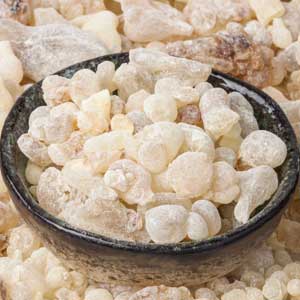
In the Gospel according to Saint Matthew, the Magi from the East offer Jesus gold, frankincense and myrrh.
Christian tradition interprets gold, in particular, as a symbol of Christ’s kingship.
This offering serves as a reminder that Jesus is recognised as the long-awaited King, even though he was born in humble circumstances.
Can one wear a gold chasuble for Christmas Mass?
Yes. In the Roman Rite, particularly precious or solemn vestments may, under the conditions laid down by liturgical rules, be used on feast days, even when they do not correspond exactly to the colour of the day.
Gold is thus frequently used for major solemnities, notably Christmas and Easter.
It should be noted, however, that white remains the liturgical colour specific to the Christmas season. Gold is associated with the use of solemn vestments, and not with a distinct principal colour prescribed for this period.
4. Purple: the colour of anticipation and preparation during Advent
Before Christmas, the Church observes the season of Advent.
This period begins four Sundays before Christmas and prepares the faithful to celebrate the birth of Jesus.
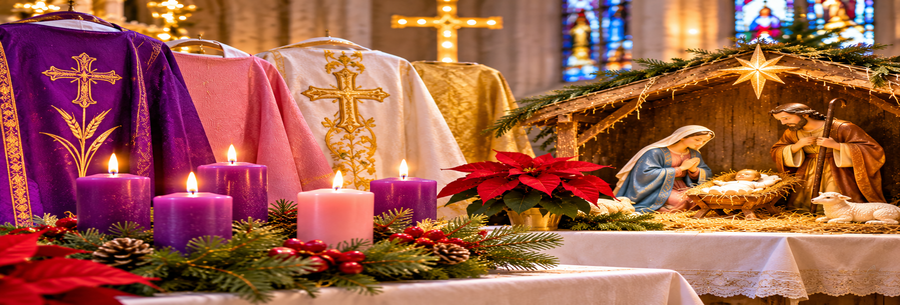
Purple is the customary liturgical colour of Advent.
Why is purple used during Advent?
Purple traditionally evokes spiritual preparation, conversion and penance.
During Advent, Christians are invited to prepare their hearts to welcome Christ.
This preparation can take various forms: prayer, forgiveness, confession, acts of charity and meditation on the Word of God.
Purple reminds us that Christmas should not be prepared for merely in a material sense.
It calls for inner preparation.
Is Advent a time of sadness?
No.
Advent is, above all, a time of hope.
Christians joyfully await the celebration of the Saviour’s birth.
Purple therefore does not mean that this period is a sad one.
Rather, it expresses the solemnity and depth of this anticipation.
It also serves as a reminder that Advent directs the faithful towards the glorious coming of Christ at the end of time.
Why does purple disappear at Christmas?
The transition from purple to white marks an important change.
During Advent, the Church prepares itself.
At Christmas, she celebrates the birth of Christ.
The liturgical anticipation gives way to the joy of the feast.
This change in colour makes visible the spiritual progression between Advent and Christmas.
5. Pink: the distinctive colour of the third Sunday of Advent
The third Sunday of Advent is traditionally known as Gaudete Sunday.
This Latin word means ‘Rejoice’.
It comes from the opening antiphon of the Mass, which invites the faithful to rejoice in the Lord.
Why is pink used?
Pink may be used instead of purple on the third Sunday of Advent.
This colour expresses a special joy at the heart of this season of preparation.
It serves as a reminder that Christmas is approaching.
The Church invites the faithful to renew their hope and to rejoice in the coming of the Saviour.
Is pink compulsory?
No.
Pink is permitted for the third Sunday of Advent, but its use is not compulsory.
If the parish does not have pink vestments, purple may be retained.
A colour that heralds the joy of Christmas
Gaudete Sunday marks an important stage.
It reminds us that Christian anticipation is focused on a promise of joy.
The birth of Christ is drawing near.
The faithful are invited to prepare their hearts with confidence.
6. The colours of the four candles on the Advent wreath
The Advent wreath is a particularly cherished Christian tradition.
It usually features four candles, which are lit one by one over the four Sundays leading up to Christmas.
Three purple candles and one pink candle
In a widespread custom, the wreath features three purple candles and one pink candle.
The purple candles symbolise the spiritual preparation of Advent.
The pink candle is associated with the third Sunday, Gaudete Sunday.
However, there is no universal liturgical rule requiring these colours for home Advent wreaths.
Some families use four red, white or other coloured candles.
The growing light
Each Sunday, an additional candle is lit.
The light gradually increases.
This gesture symbolises the approach of Christmas and recalls the coming of Christ, the light of the world.
A tradition to be enjoyed as a family
The Advent wreath can become a focus for family prayer.
Every Sunday, parents and children can gather to light a candle, read a passage from the Gospel and say a short prayer.
This tradition helps us to experience Advent in faith.
7. The transition from purple to white: a profound spiritual significance
The change in colour between Advent and Christmas is one of the most visible signs of the liturgical year.
It expresses the transition from anticipation to celebration.
During Advent, the Church keeps vigil
Purple accompanies the weeks of preparation.
The faithful meditate on the prophecies announcing the coming of the Messiah.
In particular, they listen to the texts of the prophet Isaiah and the calls of Saint John the Baptist to prepare the way of the Lord.
The Virgin Mary also plays a vital role in this period of anticipation.
At Christmas, the Church celebrates the birth of the Saviour
When the Christmas celebrations begin, white vestments replace the purple ones.
The hymns fully express the joy of the Nativity.
The Gloria, which is usually omitted at Masses on Sundays in Advent, is sung or recited once more at Christmas Masses.
The liturgy proclaims the Good News of Christ’s birth.
A visible transformation
This transition from purple to white helps the faithful, and particularly children, to understand that the Church is entering a new liturgical season.
The colours thus become a true spiritual language.
8. The liturgical colours of the various Christmas Masses
In the Roman Rite, the celebration of Christmas traditionally comprises four forms of Mass.
These are the Mass on Christmas Eve, the Midnight Mass, the Dawn Mass and the Day Mass.
Each highlights a different aspect of the mystery of the Nativity.
The Vigil Mass
This celebration marks the beginning of the Solemnity of Christmas.
It prepares the faithful to welcome the birth of the Saviour.
The liturgical colour is white.
The Midnight Mass
Often called Midnight Mass, it is particularly associated with the Christmas tradition.
The Gospel according to Saint Luke recounts the birth of Jesus in Bethlehem and the announcement made to the shepherds.
The liturgical colour is white.
Golden vestments are also frequently used.
The Dawn Mass
This celebration particularly highlights the journey of the shepherds as they make their way to Bethlehem.
It recalls the joy of the first witnesses to the Nativity.
The liturgical colour is white.
Christmas Day Mass
The Mass on Christmas Day features, in particular, the prologue to the Gospel according to Saint John.
This text proclaims the mystery of the Word made flesh.
The liturgical colour remains white.
Thus, all Masses on the Solemnity of Christmas express the same joy through the liturgical colour.
9. Liturgical colours throughout the Christmas season
The Christmas season is not limited to 25 December.
In the Roman calendar, it extends until the Feast of the Baptism of the Lord.
During this period, the Church continues to meditate on the mystery of the birth and manifestation of Christ.
The Octave of Christmas
The eight days beginning on 25 December constitute the Octave of Christmas.
This period solemnly extends the celebration of the Nativity.
White is the customary colour of the Christmas season.
However, certain feasts celebrated during the octave have their own liturgical colour.
The Feast of Saint Stephen
On 26 December, the Church celebrates Saint Stephen, the first Christian martyr.
The liturgical colour is red.
This colour recalls his witness, which led to the sacrifice of his life.
The Feast of the Holy Innocents
On 28 December, the Church commemorates the children of Bethlehem put to death on the orders of King Herod, according to the Gospel of Matthew.
The liturgical colour is red, in recognition of their martyrdom.
The Feast of the Holy Family
The feast of the Holy Family of Jesus, Mary and Joseph is celebrated during the Christmas octave, in accordance with the liturgical calendar.
The colour used is white.
It expresses the joy of contemplating the family life of Jesus.
1 January: Mary, Mother of God
On the first day of the year, the Catholic Church celebrates the Solemnity of Saint Mary, Mother of God.
The liturgical colour is white.
This feast recalls Mary’s essential role in the mystery of the Incarnation.
The Epiphany of the Lord
The Epiphany celebrates Christ’s manifestation to the nations, notably through the visit of the Magi.
The liturgical colour is white.
It expresses the glory of Christ revealed to the world.
The Baptism of the Lord
This feast marks the end of the Christmas season in the Roman calendar.
The liturgical colour is white.
It recalls the manifestation of Jesus as the beloved Son of the Father.
10. Why do some feasts during the Christmas season use the colour red?
The presence of red during the Christmas season may come as a surprise.
This colour is notably associated with the martyrs.
It recalls the blood shed in witness to the Christian faith.
Red, the colour of martyrdom
Saint Stephen is celebrated on Boxing Day.
He is recognised as the first Christian martyr.
His feast day reminds us that following Christ can require courage and faithfulness.
A different meaning for red Christmas decorations
A distinction must be made between liturgical red and the red used in popular decorations.
Red baubles, ribbons and decorative candles do not necessarily have the same significance as red liturgical vestments.
In the liturgy, each colour corresponds to a specific tradition and set of rules.
In decoration, colours are more a matter of family and cultural customs.
11. Why isn’t green used for Christmas Mass?
Green is the usual liturgical colour for Ordinary Time.
It features throughout much of the Christian year.
It traditionally evokes hope, spiritual growth and life.
Green in the liturgical calendar
During Ordinary Time, the Church reflects in particular on the public life of Jesus and his teachings.
Green symbolises the progression of the Christian life.
The green of Christmas trees
Green is, however, very prominent in Christmas decorations.
Christmas trees, wreaths and holly sprigs contribute to the festive atmosphere.
In popular tradition, evergreen plants can symbolise life and hope.
But this decorative use does not alter the liturgical colour of Christmas.
At Mass, white remains the main colour.
12. Liturgical vestments worn by priests at Christmas
Liturgical colours are particularly prominent in the vestments worn during Mass.
The chasuble
The chasuble is the liturgical vestment specific to the priest celebrating Mass.
At Christmas, it is normally white.
It may feature gold embroidery or other religious motifs.
Some chasubles depict crosses, Eucharistic symbols or motifs inspired by Christian tradition.
The stole
The stole is a liturgical garment worn by ordained ministers.
It is usually colour-coordinated with the celebration.
At Christmas, it is therefore normally white.
The dalmatic
When a deacon takes part in a solemn Mass, he may wear a dalmatic.
At Christmas, this is also white.
Altar decorations
Altar cloths are white in accordance with liturgical regulations.
Other decorative elements may help to emphasise the festive nature of Christmas.
The overall effect must, however, retain the dignity and simplicity appropriate to the Eucharistic celebration.
13. How can we explain the liturgical colours of Christmas to children?
Colours are an excellent way of introducing children to the Christian calendar.
They make the different periods of the liturgical year easier to understand.
Explaining purple
You can tell children:
‘During Advent, the priest wears purple because we are preparing our hearts to welcome Jesus. ”
This simple explanation helps to present Advent as a time of waiting.
Explaining pink
“ On the third Sunday of Advent, the priest may wear pink because Christmas is approaching and our joy is growing. ”
Pink thus becomes a sign of hope.
Explaining white
“At Christmas, the priest wears white because we are celebrating the birth of Jesus, who brings light and joy to the world. ”
Explaining gold
“Gold reminds us that Jesus is the Son of God and that Christmas is a very great feast. ”
A family activity
Parents can make a small Advent wreath with their children.
They can also observe the colours of the priest’s vestments during the various Masses.
Paying attention to these liturgical symbols helps children to better understand the celebrations.
14. Can we use the liturgical colours in our Christmas decorations at home?
Christian families may choose to take inspiration from the liturgical colours for their decorations.
However, this is not compulsory.
Purple during Advent
A wreath made up of purple candles can symbolise the season of preparation.
Some families also use purple ribbons or simple decorative elements.
Pink on the third Sunday
A pink candle can be lit on Gaudete Sunday.
It expresses the joy of Christmas drawing near.
White and gold at Christmas
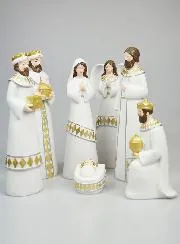
White and gold can be used around the nativity scene or in family decorations.
They evoke the light and joy of the Nativity.
The central place of the nativity scene
Decorations can help to create a warm atmosphere.
But in a Christian home, the nativity scene remains one of the most important symbols of Christmas.
It serves as a direct reminder of the birth of Jesus in Bethlehem.
Colours can complement this representation without distracting from it.
15. Liturgical colours invite us to experience Christmas inwardly
The colours used by the Church are not merely intended to embellish the celebrations.
They invite the faithful to deepen their faith.
Purple teaches us to wait
In a society where everything moves so quickly, Advent reminds us of the importance of patience.
Violet invites us to take the time to pray and prepare ourselves inwardly.
Pink teaches us to hope
Gaudete Sunday reminds us that Christian joy can be present even during times of waiting.
It invites us to remain confident.
White teaches us to welcome the light
At Christmas, white expresses the joy of the Saviour’s coming.
It reminds us that Christ came to bring hope and salvation.
Gold invites us to recognise God’s greatness
Gold highlights the glory of Christ.
But this splendour contrasts with the humility of his birth in a manger.
This contrast is one of the most profound lessons of Christmas.
The Son of God comes into the world in simplicity.
True greatness is revealed in love.
16. A prayer to live out the light of Christmas
Lord Jesus,
During this Christmas season, we contemplate the light of your birth.
You who came in the simplicity of Bethlehem, come and enlighten our hearts.
During Advent, teach us to prepare for your coming with trust and faithfulness.
May the purple of anticipation remind us of the importance of prayer and conversion.
May the pink of joy renew our hope.
May the white of Christmas remind us of your purity, your light and your love.
May the gold of the great celebrations invite us to recognise your divine glory.
Following the example of the Virgin Mary, grant us a heart open to your Word.
Following the example of Saint Joseph, teach us faithfulness and courage.
May the light of your birth bring peace to our families.
Comfort those who are alone, be with the sick, and support those going through trials.
Help us, in turn, to become witnesses to your light.
And may the joy of Christmas remain in our hearts throughout the year.
Amen.
Conclusion: the liturgical colours of Christmas: a language of faith and light
Liturgical colours play an important role in the Catholic tradition.
They accompany the faithful throughout the year and help us to better understand the mysteries being celebrated.
During Advent, purple symbolises spiritual preparation and the anticipation of the Saviour.
The pink of the third Sunday heralds the coming joy of Christmas.
When the feast of the Nativity arrives, white expresses the light, glory and joy of the birth of Jesus Christ.
Gold, often featured in solemn vestments, emphasises the divine majesty of this great celebration.
These colours are therefore not merely decorative elements.
They constitute a genuine spiritual language.
They invite us to move from anticipation to joy, from preparation to celebration, and to recognise in the Child of Bethlehem the Son of God who came to save humanity.
At Christmas, white and gold remind us that the greatest light is not that of the decorations, but that of Christ, who came to dwell amongst mankind.
By observing the colours of the liturgy, the faithful can thus rediscover the richness of the Christian calendar and experience the mystery of the Nativity more deeply.
For behind the beauty of the decorations lies an essential message: God became man, and his light continues to illuminate the world.