A Christian reflection on Jesus’ words in the face of upheaval: discerning, rejecting fear and relying on God in times of trial.
When everything seems to be falling apart: keeping faith through the Gospel
Introduction
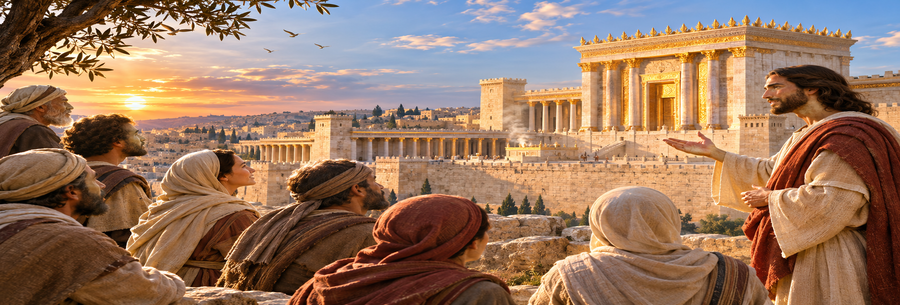
Today’s Gospel shows us Jesus standing before the Temple in Jerusalem. Some admire the beauty of its stones, the richness of its decorations and the offerings that adorn it. Then Jesus utters a puzzling statement: everything that seems so solid will one day pass away.
This announcement may be unsettling. The Temple is a sacred place, a sign of God’s presence amongst his people. Yet Jesus does not seek to discourage those listening to him. He invites them not to place their hope in what is visible, however beautiful and impressive it may be.
Through this passage from the Catholic liturgy, Christ teaches us how to navigate periods of uncertainty without giving in to fear. He calls us to vigilance, discernment and a deeper trust in God.
The Gospel: a magnificent but fragile Temple
People are gazing at the Temple and speaking of its beautiful stones. Jesus tells them that a time will come when not one stone will be left upon another. His listeners then ask him when this will happen and what signs will indicate that these events are drawing near.
Jesus does not reply by giving a timetable. He does not feed the anxious curiosity of those who seek to know the future. His first advice is clear: do not let yourselves be led astray.
The Lord knows that, when our bearings falter, many voices seek to attract attention. Some promise immediate answers; others foretell disasters or claim to hold the truth all to themselves. Jesus urges his disciples not to be drawn in by such talk.
The heart of his message is not a prophecy of destruction, but a call to remain attached to him. Buildings, wealth, habits and human securities may change. But the word of Christ endures.
Do not confuse upheaval with the end of hope
Jesus speaks of wars, unrest, disasters and great fears. These words may seem hard to hear. Yet they reflect a universal experience: our world faces crises, and every life also weather its own storms.
Illness, bereavement, separation, worry about a child, difficulties at work or prolonged loneliness can make it feel as though everything is falling apart. At such times, we naturally seek explanations and reassurance. But the Gospel does not promise us a life free from trials. It promises us a presence: Christ does not abandon us.
When Jesus tells us not to be terrified, he is not downplaying suffering. He frees us from the idea that chaos has the final say. Even at the heart of what seems incomprehensible, God continues to act, often in subtle ways, through a person who helps us, a word that lifts us up, a prayer that brings peace, or an unexpected strength to carry on.
The Christian faith does not deny difficult realities. It navigates them with a deeper light: human history is in God’s hands.
Be wary of false certainties
‘Take care not to be led astray. ’ These words are very relevant today. When we are anxious, we may be tempted to believe too readily those who claim to know everything, who exploit our fears or who offer easy solutions to complex issues.
Christian discernment consists in seeking what leads to peace, truth, charity and hope. A word that comes from God does not fuel panic, contempt or despair. It calls for conversion, faithfulness and love for one’s neighbour.
To exercise discernment, Christians can simply return to the Gospel, take time for silence, seek advice from someone they trust, and pray to the Holy Spirit. It is not a matter of understanding everything immediately, but of walking humbly with God.
Christian meditation thus teaches us to distinguish between the clamour of the world and the voice of the Lord. The clamour scatters us; the voice of Christ brings us together. The clamour increases anxiety; the voice of Christ opens a path of trust.
What remains when certainties fade
The Temple, admired by Jesus’ contemporaries, represented stability, beauty and grandeur. Yet Christ reminds us that even the most impressive realities remain fragile. These words do not ask us to despise beautiful things or to shirk our responsibilities. They help us to put every reality in its proper place.
We may rely on our work, our health, our home, our family or our plans. These things are precious, but they cannot, on their own, bear the full weight of our hope. Only God can be the ultimate foundation of our lives.
What endures is the love given and received. What endures is a word of forgiveness, an outstretched hand, a prayer said in the night, humble faithfulness. What endures is the risen Christ, present amongst his people.
The Gospel invites us to build our inner life upon that which does not pass away. A faith nourished by prayer, listening to the Word of God and participation in the Catholic liturgy becomes a solid house, even when the wind rises.
A practical meditation for times of uncertainty
When faced with a difficulty, we can begin by bringing before God what is troubling us. There is no need to hide our fears from the Lord. In prayer, we can simply say to him: ‘Jesus, I don’t understand what is happening, but I want to stay close to you.’
Next, we can choose a small act of trust. This might involve phoning someone who is lonely, asking for forgiveness, giving thanks for a blessing received, refraining from saying something hurtful, or setting aside a few minutes for prayer.
Today’s Gospel also helps us to let go of what weighs us down inwardly. We might ask ourselves: what fragile sense of security am I placing above God? Is it the judgement of others, success, money, the need to control everything, or the fear of loss?
Christ does not take away what is good. He teaches us to receive it with gratitude, without turning it into an idol. He wants to give us a peace that does not depend solely on circumstances.
The Catholic liturgy: a source of inner stability
In the Catholic liturgy, the Church gathers the faithful around the Word of God and the Eucharist. Generations come and go, situations change, but Christ continues to nourish his people.
Attending Mass, listening to the Gospel, praying with the community and receiving the sacraments remind us that we are not alone. Faith is lived out personally, but it is also shared in community. In difficult times, the Church’s prayer becomes a source of support when we are at a loss for words.
The liturgy refocuses us on what matters most: God is faithful. He is present in our history, in our frailties and in our desire to live according to the Gospel.
Prayer inspired by the Gospel
Lord Jesus,
when trials trouble my heart,
keep me from fear and discouragement.
Grant that I may recognise your voice amidst the clamour,
remain faithful in the little things
and place all my hope in you.
Amen.
FAQs on the Gospel and times of upheaval
Why does Jesus foretell the destruction of the Temple?
Jesus reminds us that visible realities, even the most marvellous ones, are not eternal. He urges his disciples to place their trust in God rather than in human assurances.
Does Jesus foretell the end of the world in this Gospel?
Jesus speaks of upheavals and calls for vigilance, but he gives no date or timetable. His main message is not to be led astray and to remain faithful to God.
How can we avoid giving in to fear in the face of bad news?
Prayer, reading the Gospel, taking part in the Catholic liturgy and concrete acts of charity help us to rediscover a deep sense of peace. Faith does not deny difficulties, but it reminds us that Christ is present at the heart of our trials.
What does ‘do not let yourselves be led astray’ mean?
These words call for discernment. Christians are called not to follow discourse that fuels fear, confusion or despair, but to seek out what leads to truth, peace and love.
What practical step can we take following this meditation?
Choose a simple act of trust: set aside some time for prayer, ask for forgiveness, help someone who is isolated, minimise sources of anxiety, or entrust a specific concern to the Lord.
Liturgical reference: The Gospel according to Saint Luke, chapter 21, verses 5 to 11.