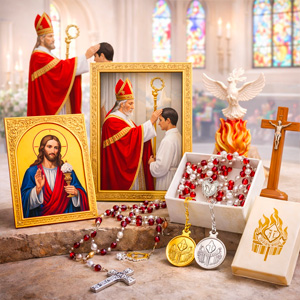

Discover Saint Clement I, one of the first bishops of Rome, his letter to the Corinthians, and his call for unity, humility and charity in the early Church.
Saint Clement I: a pastor of the early Church in the service of unity
The Catholic calendar today commemorates Saint Clement I, Pope and martyr, as an optional memorial. He is one of the great figures of the early Church, living close in time to the apostles and deeply concerned with communion amongst Christians.
His name is chiefly associated with a letter addressed to the Christian community in Corinth. This ancient text, of remarkable spiritual richness, reveals the heart of a pastor who seeks to heal divisions, lift up those who are wounded, and remind everyone that the Church can only grow through charity, humility and fidelity to Christ.
Saint Clement I, a witness to the apostolic age
Saint Clement lived in the first century, at a time when the Church was still young, fragile and often beset by trials. According to Christian tradition, he was one of the first successors of Saint Peter in Rome, following Linus and Anacletus. He thus belonged to that generation which received the legacy of the Apostles at first hand and was entrusted with the mission of passing on the faith to the new communities.
The Christians of his time lived at the heart of the Roman Empire. Many would gather discreetly in homes to listen to the Word of God, share the Eucharistic bread, pray together and support one another. Their faith set them apart in a society where the worship of the Roman gods played a significant role. They were not always understood and could be subjected to mistrust, pressure or persecution.
In this context, being a pastor meant encouraging believers, safeguarding their unity and helping them to live out the Gospel in practical ways. Saint Clement did not leave behind the image of a man seeking honour or power. Rather, he appears as a servant of communion, keen to remind people that all Christian authority must lead to peace, truth and brotherhood.
The Letter to the Corinthians: a message of peace in a divided community
The major work associated with Saint Clement is a letter addressed to the Christians of Corinth. This community, already known from the letters of Saint Paul, was experiencing fresh tensions. Divisions and rivalries had disrupted the fraternal peace. Some members were challenging the authority of recognised leaders, and community life was at risk of being damaged by pride, jealousy and personal animosities.
Saint Clement intervenes firmly, but without harshness. He does not seek to humiliate or point the finger at anyone. He invites the Christians to look once more to Christ, to remember God’s patience and to rediscover the path of humility.
His message is deeply evangelical: a Christian community is not built on competition, the pursuit of prestige or the desire to be right at all costs. It is built when everyone agrees to serve, to repent, to recognise the dignity of others and to seek the common good.
This letter is particularly valuable, as it shows that difficulties within the Christian community are nothing new. From the earliest days of the Church, Christians have had to learn to live together despite their differences in character, culture and sensibilities. Saint Clement reminds them that unity does not mean erasing people’s individuality, but welcoming everyone as a brother or sister entrusted to them by God.
Humility, the path to true unity
For Saint Clement, humility is not a weakness. It is the quiet strength of one who knows that everything comes from God. The humble person does not despise their gifts, but neither do they use them to dominate others. They understand that every talent, every responsibility and every service must contribute to the growth of the community.
This vision remains highly relevant today. In a family, a parish, a prayer group or a workplace community, hurt often arises when no one is willing to listen, when everyone seeks to impose their own point of view, or when words become harsher than they are brotherly.
Saint Clement invites us to take a step back. Before responding in anger, he teaches us to seek peace. Before judging, he calls us to look at the other person’s suffering. Before asserting our place, he reminds us that Jesus himself chose the path of service.
Christian humility does not require us to step back out of fear or to remain silent about what is right. It teaches us to speak truthfully, but also with kindness. It enables us to defend a conviction without crushing those who do not think the same way.
A Church that cares for the most vulnerable
The faith of the early Christians was also evident in their practical care for the poorest, the elderly, the sick, widows and those living in solitude. Communion was not limited to fine words: it took the form of sharing, visiting, material support and prayer.
The teaching of Saint Clement reminds us that charity lies at the heart of Christian life. It is not enough simply to take part in prayer or to know the great truths of the faith. Christians are also called to recognise Christ in those who suffer, who are hungry, who are grieving or who feel forgotten.
In a society where many people experience isolation, fear of the future or inner weariness, the memory of Saint Clement encourages us to become attentive once more. A simple word, a visit, a gesture of forgiveness or discreet help can become very concrete signs of God’s presence.
Christian charity is never a cold duty. It springs from the certainty that every person is loved by God. It teaches us not to look away from the frailties of others.
Saint Clement I and the mission of the Church of Rome
Saint Clement’s Letter to the Corinthians also holds particular significance in the history of the Church. It bears witness to the deep bond that already united the Christian communities with one another. Rome did not turn in on itself: it held the believers in other cities in its prayers and care.
Saint Clement does not intervene to impose human domination. His concern is to help a divided community restore peace. His words are rooted in the faith received from the apostles and in the conviction that all the baptised are called to form one people centred on Christ.
This mission of communion remains essential. The Church is present in many countries, languages and cultures. It brings together people from very different backgrounds. Yet it does not rest solely on an organisation or on shared customs. Its unity springs from Jesus Christ, the Gospel, prayer and lived charity.
Saint Clement reminds us that the unity of the Church is a gift to be welcomed, but also a responsibility to be safeguarded. Everyone can contribute to this by refraining from hurtful words, by praying for pastors, by fostering dialogue and by always seeking what brings us together.
The martyrdom of Saint Clement: a tradition of fidelity
Christian tradition honours Saint Clement as a martyr. Later accounts relate that he was exiled and died for his faith. The historical details of his final days remain difficult to establish with certainty, but the Church has preserved his memory as that of a faithful witness to Christ.
Martyrdom does not merely refer to a violent death. Above all, it expresses a witness given to the very end. A martyr is someone who chooses to remain faithful to God rather than renounce their faith, even when that faithfulness comes at a high price.
Although they do not face the same trials, Christians today are also called to live out a form of witness. This may involve remaining honest in a difficult situation, refusing to accept injustice, forgiving despite being hurt, protecting a vulnerable person, or remaining faithful to the Gospel in an indifferent environment.
Saint Clement teaches us that faithfulness is often lived out in simple, everyday choices. It is through patience, prayer, service and perseverance that the heart gradually becomes a true witness to Christ.
What does Saint Clement teach us for our daily lives?
The life of Saint Clement I can shed light on many very practical situations. When a family is facing a misunderstanding, he urges them to resume dialogue. When a parish is experiencing tension, he reminds us that communion is worth more than rivalries. When a person feels overwhelmed by conflict, he encourages them to return to prayer and ask for the grace of a peaceful heart.
His example also urges us not to remain mere spectators when unity is threatened. Seeking peace does not mean ignoring difficulties. It means choosing to face them with respect, asking God for the light needed to discern, listen and act justly.
Finally, Saint Clement teaches us that no community can survive for long without charity. Skills, projects and good will are valuable, but they bear fruit only when they are sustained by love for one’s neighbour.
Following his example, we can ask for the grace to become peacemakers: in our homes, in our neighbourhoods, in our parishes and wherever the Lord sends us.
Prayer to Saint Clement I
Saint Clement, shepherd of the early Church,
you called upon Christians to rediscover the path to peace and unity.
Help us to keep a humble heart,
to listen before judging,
to forgive before condemning
and to serve without seeking honours.
Teach us to love the Church,
to support those who suffer
and to foster brotherhood around us.
May our lives bear simple witness
to the love of the Risen Christ.
Amen.