Discover the Gospel of the widow and her two small coins: a Christian reflection on generosity, trust in God and giving from the heart.
The widow’s offering: the richness of a generous heart
Introduction
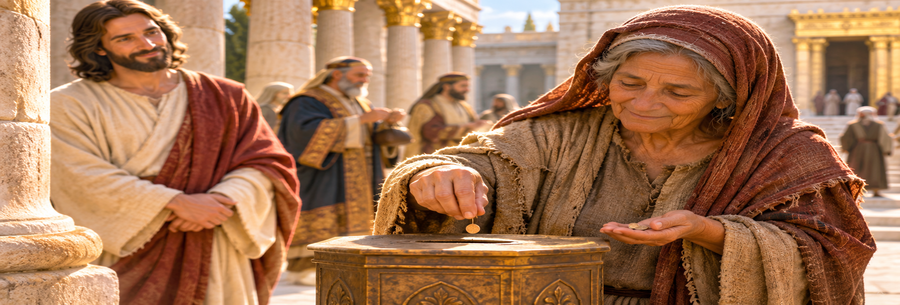
In today’s Gospel, Jesus observes the people as they place their offerings into the Temple treasury. Among the rich who give generously, he notices a poor widow who puts in two small coins. This gesture seems almost insignificant. Yet Jesus affirms that she has given more than all the others.
This passage from the Catholic liturgy invites us to look at generosity in a different light. God does not measure our gifts by their amount, their appearance or the praise they may elicit. He sees what they mean to our hearts. He knows our limitations, our worries, our hidden efforts and the love with which we choose to give.
The Gospel story of the widow is therefore a great lesson in faith. It does not ask us to compare ourselves with others, but to entrust ourselves to God, with simplicity and trust.
The Gospel: the widow’s two small coins
Jesus is in the Temple, watching the people who come to make their offerings. The rich give from their abundance. Then he sees a poor widow putting in two small coins. Jesus then declares that she has given more than all the others, for the others have given from their surplus, whilst she has offered everything she had to live on.
Jesus’ gaze falls upon a discreet person, without power or influence. She does not seek to be noticed. She expects no recognition. Her offering is small in the eyes of the world, but immense in the eyes of God.
This scene is particularly moving because it reveals the heart of Christ. Jesus sees the one whom no one else seems to notice. He knows this woman’s precarious circumstances, but also her deep trust. He receives her gesture as a true prayer.
God looks at love before looking at the gift
We often tend to measure things by what is visible: quantity, success, results, prestige or appearances. The Gospel teaches us that God sees things differently. He looks at the truth of the heart.
The widow possesses almost nothing, yet she offers what she has with great inner freedom. Her gesture expresses her trust: she places her future in God’s hands. She does not rely solely on her own resources. She believes that the Lord remains her security and her wealth.
These words must never be understood as an invitation to ignore material needs, nor as an obligation to deprive oneself of everything. Jesus does not glorify poverty. Rather, he reveals the incomparable value of a heart that loves without calculation and refuses to let fear govern its life.
Giving can take many forms. It may be a little time spent with someone who is lonely, a word of comfort, a difficult act of forgiveness, a service performed discreetly, patient listening, or a faithful prayer for someone who is suffering. In God’s eyes, none of these gestures is small when it is motivated by love.
The widow, a model of trust
The widow in the Gospel teaches us a humble faith. She does not make a speech. She does not put herself forward. Her silent gesture is enough to speak of her relationship with God.
In the Bible, the widow often represents a vulnerable person, deprived of support and exposed to uncertainty. By placing her at the centre of this scene, Jesus reminds us that God is particularly close to those who have nothing to boast about, to those who feel poor, fragile or forgotten.
There are times when we, too, feel helpless: when faced with a family crisis, illness, worries about work, inner weariness or a prayer that seems to go unanswered. We may then believe that we have nothing to offer the Lord. Yet God welcomes precisely what we bring to him in truth: our poverty, our weakness, our desire to persevere.
Christian prayer is not about appearing strong before God. It is about coming to him as we truly are. A short prayer said with faith can become a precious offering. A wounded heart that continues to hope can be a powerful testimony of trust.
Giving without seeking to appear
Jesus highlights the difference between visible giving and true giving. Some may give a great deal whilst keeping their hearts closed. Conversely, a person may offer very little materially, yet give much of themselves.
These words invite us to ask ourselves gently: what do I give of my surplus, and what do I hold back out of fear? Do I sometimes seek recognition for what I do? Do I know how to do good in silence, without expecting anything in return?
Christian reflection on this Gospel should not make us feel guilty. Rather, it leads us towards greater freedom. God does not demand great deeds. He desires our trust. He waits for us to give him our hearts, even if they are poor, weary or divided.
True generosity is not limited to money. It is a way of life. It is recognised in our willingness to help, our patience, our care for the most vulnerable, and the courage to do good when no one is watching.
A practical reflection for our lives
To welcome this Gospel into our daily lives, we can take a few moments of silence and ask ourselves: what is my small coin today?
Perhaps it is a phone call we have been putting off, a visit to pay, a reconciliation to begin, a worry to lay before God, or a few minutes set aside for prayer. Perhaps it is simply the choice to respond gently rather than impatiently.
The Lord does not ask us to have everything sorted out before coming to him. He invites us to hand over to him what we have, here and now. Our offering may seem small, but it becomes fruitful when placed in his hands.
The widow also teaches us that our worth does not depend on what we possess. We are loved by God even before we act, succeed or give. It is because we are loved that we can learn to love in turn, with a freer heart.
Living the Catholic liturgy as an offering
The Catholic liturgy draws us into the great movement of Christ’s offering. At Mass, the bread and wine are presented to God; they also represent the labour, joys, sorrows and intentions of an entire community.
As we listen to the Gospel of the widow, we can offer up to the Lord, in our hearts, whatever fills our day. We can entrust to him someone who is suffering, a decision to be made, a fear to be allayed or a desire for conversion.
Each celebration then becomes a place where our life is welcomed by God. Even what seems fragile or unfinished to us can become an offering. Christ never despises the two small coins of our existence. He receives them, blesses them and transforms them through his love.
Prayer inspired by the Gospel
Lord Jesus,
you see the hidden gestures and the hearts that hope in silence.
Teach me to give with simplicity,
without seeking to appear good or to be rewarded.
Receive my poverty, my limitations and my small efforts.
Grant me a free, trusting and generous heart,
so that my life may become an offering of love.
Amen.
FAQ on the Gospel of the Widow
What does the offering of the two small coins signify?
It shows that God does not judge the value of a gift by its quantity, but by the love, trust and personal sacrifice it expresses.
Does Jesus ask Christians to give away all their money?
This Gospel should not be understood as an obligation to put oneself in danger or to neglect one’s responsibilities. Jesus highlights the widow’s faith and invites everyone to give with freedom, truth and charity.
How can we live out this Gospel in our daily lives?
By offering, with simplicity, whatever we can: time, a listening ear, a service, forgiveness, practical help or a prayer. Small acts done with love are of great value to God.
Why does Jesus take notice of this widow?
Because she is often invisible to others, but not to God. In this way, Jesus reveals his closeness to the poor, the vulnerable and the unassuming.
What is the connection between this Gospel and prayer?
The widow teaches us to present ourselves before God without pretence. Christian prayer is an offering from the heart: in it we can lay before God our joys, our sorrows, our needs and our trust.
Liturgical reference: The Gospel according to Saint Luke, chapter 21, verses 1–4