Find out why the Advent wreath is an important Christian tradition, the origin of its four candles, the significance of its branches, and how to prepare for Christmas as a family.
Why put up an Advent wreath at home? A deeply meaningful Christian tradition to mark the run-up to Christmas
As Christmas approaches, many families put up an Advent wreath in their homes. Traditionally made of fir branches, four candles and sometimes a few natural decorations, it marks the four weeks leading up to the birth of Jesus Christ.
Much more than a mere decorative item, the Advent wreath is a symbol of hope, light and spiritual preparation. It reminds us that Christmas is not just a family celebration, but above all a celebration of the coming of the Saviour.
Every Sunday, an additional candle is lit. The light gradually grows brighter as Christians draw nearer to the feast of the Nativity.
In a society where Christmas preparations sometimes begin several weeks in advance, with presents, decorations and festive meals, the Advent wreath invites us to return to what really matters: taking the time to wait, to pray, to share and to prepare our hearts to welcome Jesus.
But why is this wreath circular in shape? Why are fir branches used? What is the origin of this tradition? And how can it help us to live out our faith more deeply?
Let’s discover the history and significance of the Advent wreath, as well as the reasons why it deserves a special place in our Christian homes.
1. What is an Advent wreath in the Christian tradition?
The Advent wreath is a floral arrangement, usually circular in shape, on which four candles are placed.
It is traditionally set up at the start of Advent, the period of preparation for Christmas which comprises the four Sundays leading up to 25 December.
The word ‘Advent’ comes from the Latin adventus, which means ‘coming’ or ‘arrival ”.
In the Christian faith, this period has a dual significance.
It prepares the faithful to celebrate the first coming of Jesus Christ, at his birth in Bethlehem.
It also invites them to await his glorious return at the end of time.
Advent is therefore a time of watchfulness, conversion, prayer and hope.
The wreath serves to make this anticipation visible in the home.
Each Sunday, the lighting of a new candle marks another step towards Christmas.
It thus becomes a true spiritual calendar, inviting families to devote time to God.
A family and religious tradition
The Advent wreath can be displayed in a church, a chapel or a home.
In Christian families, it is often placed in the centre of the table, near the nativity scene or in a space set aside for prayer.
It accompanies Sunday meals, Bible readings and moments of reflection.
Its presence serves as a discreet reminder that the weeks leading up to Christmas should not be devoted solely to material preparations.
They also constitute a special time for nurturing one’s faith.
2. What is the origin of the Advent wreath?
The Advent wreath has a relatively recent history in its current form, although some of its symbolic elements are much older.
The use of evergreen foliage and lights during winter was already part of various European traditions.
These elements evoked, in particular, life, light and hope at the heart of the cold season.
The modern Christian wreath developed mainly in Germanic regions during the 19th century.
Johann Hinrich Wichern and the first modern Advent wreath
In 1839, Johann Hinrich Wichern, a German Protestant pastor, was looking for a way to help the children in his care to wait patiently until Christmas.
In his children’s home in Hamburg, he set up a large wooden wheel decorated with candles.
The display featured candles to count down the days until Christmas, with special lights for Sundays.
This allowed the children to follow the build-up to the festival whilst discovering its religious significance.
This initiative gradually became a great success.
Over the decades, the tradition evolved into a wreath of evergreen branches bearing four candles, one for each Sunday in Advent.
A tradition gradually adopted by Catholics
Initially widespread amongst German Protestants, the Advent wreath subsequently spread to Catholic families.
It became particularly popular during the 20th century.
Today, it is found in many European countries and in Christian communities around the world.
It is not a liturgical obligation, but a tradition of popular piety that helps the faithful prepare for Christmas.
Its simplicity largely explains its success: a few branches, four candles and a moment of prayer are enough to give it its full meaning.
3. Why is the Advent wreath round?
The circular shape of the wreath has significant symbolic meaning.
A circle has neither beginning nor end.
In Christian interpretation, this shape can evoke the eternity of God and his boundless love.
The symbol of God’s eternal love
The wreath reminds us that God’s love does not depend on the circumstances of our lives.
He remains faithful, even when we are going through trials or periods of doubt.
In the Christian faith, God is eternal.
His love predates our existence and accompanies us throughout our lives.
The circular shape thus becomes an image of this faithfulness.
The circle, a symbol of communion
The wreath can also evoke family unity and communion amongst believers.
When family members gather round it to pray, they express their desire to live united in faith.
This aspect takes on particular significance during Advent.
The weeks leading up to Christmas are an opportunity to strengthen family ties, to forgive and to find peace.
A wreath that heralds the kingship of Christ
The shape of the wreath can also symbolically evoke the kingship of Jesus Christ.
However, this kingship is different from that of earthly rulers.
Jesus comes in the humility of a manger.
His Kingdom is founded on truth, justice, peace and love.
The Advent wreath can thus invite us to recognise Christ as the true Lord of our lives.
4. Why are fir branches used for the Advent wreath?
Advent wreaths are traditionally made from fir branches or other evergreen plants.
Unlike many trees that shed their leaves in autumn, conifers retain their greenery throughout the winter.
This natural characteristic has great symbolic significance.
Green, a symbol of life and hope
In the depths of winter, fir branches remain green.
They serve as a reminder that life goes on, even when nature seems to be asleep.
In the Christian tradition, this greenery can symbolise the hope of eternal life.
It evokes the promise of salvation brought by Jesus Christ.
An invitation to remain hopeful
Advent is a time of hope.
The prophets of the Old Testament announced the coming of the Messiah, even whilst the people of Israel were going through difficult times.
The evergreen foliage of the wreath serves as a reminder of this trust.
Even when our lives face trials, we are invited to believe that God remains present.
The simplicity of creation
The natural branches also remind us of the beauty of creation.
A wreath made from fir, pine cones and a few other natural elements can be a particularly beautiful object without the need for lavish decorations.
This simplicity is deeply in keeping with the spirit of Advent.
It invites us to let go of the superfluous and rediscover what is essential.
5. Why are there four candles on the Advent wreath?
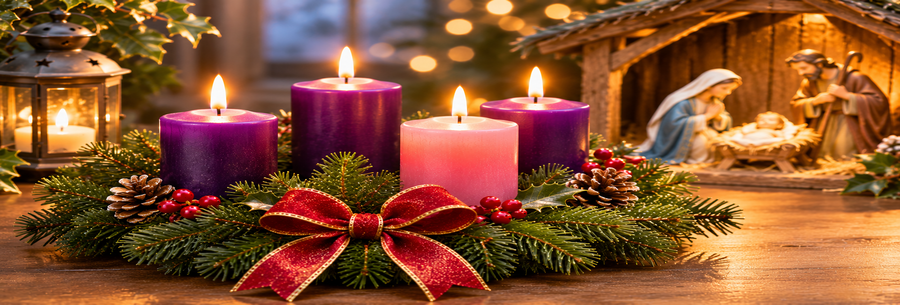
The four candles correspond to the four Sundays of Advent.
Each Sunday, an additional candle is lit.
In the first week, a single flame shines.
In the second week, two candles are lit.
In the third week, three flames light up the wreath.
Finally, on the fourth Sunday, all four candles burn together.
A light that grows gradually
This progression symbolises the approach of Christmas.
As the weeks go by, the light grows brighter.
For Christians, it symbolises the coming of Jesus Christ, the light of the world.
In the Gospel according to Saint John, Jesus declares:
‘I am the light of the world. ’ (John 8:12)
The Advent wreath thus allows us to symbolically contemplate this light that comes to illuminate humanity.
An invitation to patience
The gradual lighting of the candles also teaches patience.
We live in a society where everything seems to have to be immediate.
Advent, on the contrary, teaches us to wait.
Each week has its own value.
The joy of Christmas grows as we prepare for it inwardly.
Light stronger than darkness
Candles take on a special significance during the long December evenings.
A small flame is enough to light up the darkness.
It reminds us that the light of Christ remains stronger than the darkness.
Even in the midst of difficulties, the Christian faith invites us to hold on to hope.
6. What is the spiritual significance of the four candles?
In many Christian families, the four candles are associated with hope, peace, joy and love.
This interpretation is very widespread, but it should be noted that it does not constitute a universal and binding liturgical attribution.
Depending on traditions, other meanings may be proposed.
These four themes nevertheless offer a beautiful path of preparation for Christmas.
First candle: hope
The first candle is lit on the first Sunday of Advent.
It can symbolise hope.
It recalls the expectation of the Messiah and God’s promises announced by the prophets.
This first light invites us to place our trust in the Lord.
It encourages us not to lose heart in the face of difficulties.
Second candle: peace
The second candle can be associated with peace.
It reminds us that Jesus comes to reconcile people with God.
Peace begins in our hearts and in our relationships with others.
This week may be an opportunity to ask for forgiveness, to put an end to a dispute or to renew dialogue with someone.
Third candle: joy
The third candle corresponds to Gaudete Sunday.
The Latin word Gaudete means ‘Rejoice ’.
This Sunday marks an important milestone: Christmas is drawing near.
In the Catholic liturgy, the priest may wear pink vestments.
This is why some wreaths feature a third pink candle.
It symbolises the joy of awaiting the Saviour.
Fourth candle: love
The fourth candle can be associated with love.
It is lit on the last Sunday of Advent.
It invites us to contemplate God’s immense love, manifested in the birth of his Son.
With Christmas just a few days away, this final light reminds us that the finest gift we can offer is a heart open to love.
7. Why put up an Advent wreath in your home?
The Advent wreath is not just for churches.
It has a very special place in the family home.
It helps to integrate Christian life into everyday living.
Bringing prayer into family life
Displaying an Advent wreath is a simple way of reminding us that the home can be a place of prayer.
Every Sunday, family members can gather around it.
An adult can read a passage from the Gospel.
The children can offer up an intention.
Then a candle is lit.
Even just a few minutes are enough to give this moment real spiritual depth.
Preparing for Christmas differently
The weeks leading up to Christmas are often very busy.
Shopping, decorations and organising meals can take up a lot of time.
The Advent wreath invites us to pause amidst this hustle and bustle.
It reminds us that preparing for Christmas must also be an inner process.
We prepare our homes, but we are also called to prepare our hearts.
Creating an atmosphere of peace
The soft glow of candles encourages contemplation.
It invites us to slow down, to be still and to spend time together.
In a home, the wreath can become a symbol of peace and serenity.
It reminds us that God’s presence can be welcomed in the simplest acts of daily life.
8. The Advent wreath: a lovely way to pass on the faith to children
For children, the Advent season can seem long.
They look forward to Christmas with impatience and often associate this festival with presents and decorations.
The Advent wreath helps to gradually explain to them the true Christian significance of this period.
Understanding the passing of time
Every Sunday, an extra candle is lit.
This helps children visualise the approach of Christmas.
This gradual build-up teaches them patience.
It shows them that waiting can be a joyful experience.
Discovering Jesus as the light of the world
Parents can explain that the flames symbolise the light of Jesus.
When the first candle is lit, a small light appears.
Then it grows brighter as the weeks go by.
This image helps children understand that Christmas celebrates the coming of Jesus amongst humankind.
Learning generosity
Each Sunday can be linked to a good deed.
Children can choose to share a toy, help out at home, visit an elderly person or make a gesture of reconciliation.
The wreath thus becomes a tool for Christian education.
It teaches that preparing for Christmas is not just about waiting for presents, but also about learning to give.
Building family memories
Traditions repeated year after year leave a deep impression on children.
Memories of lit candles, prayers and shared moments can stay with them for a long time.
These simple gestures help to pass on the faith from one generation to the next.
9. Where should the Advent wreath be placed in the home?
There are no religious rules dictating a specific location.
Each family can choose the spot that suits them best.
The wreath is often placed in the centre of the family table.
It can also be placed on a piece of furniture, near the nativity scene or in a prayer corner.
Near the nativity scene
Placing the wreath near the nativity scene brings together two major Christian traditions.
The wreath symbolises the anticipation of Jesus.
The nativity scene represents his birth in Bethlehem.
Together, they mark the spiritual journey from Advent to Christmas.
In the centre of the family table
The table is a place for gathering and sharing.
Placing the wreath there makes it easy to bring the family together at prayer time.
Lighting the candles can take place before Sunday dinner.
This gesture then becomes a moment eagerly awaited by everyone.
In a prayer space
Some families have a small prayer corner with a Bible, a cross or an image of the Virgin Mary.
The Advent wreath can be placed there during the four weeks leading up to Christmas.
It serves as a reminder that this is a particularly favourable time for reflection.
In all cases, the candles must be placed on a stable, heat-resistant stand, away from dry branches and flammable materials. They must never be left burning unattended.
10. How can you make an Advent wreath as a family?
Making your own Advent wreath can be a lovely family activity.
This is a chance to get ready for Christmas whilst explaining the significance of the different elements to the children.
Choosing the branches
Fir branches are the most traditional.
You can also use pine, cypress or other evergreen plants.
Their green colour symbolises hope and life.
Shaping the wreath
The branches are arranged around a circular frame.
You can use a structure specially designed for wreaths.
The round shape symbolically represents the eternity of God.
Placing the four candles
The candles must be secured in suitable, stable and non-flammable holders.
They can be purple, pink, white, red or gold.
The traditional Catholic colours are three purple candles and one pink one, but these are not compulsory.
Add a few decorations
Pine cones, ribbons or natural elements can be used to complete the wreath.
It is best to keep the decoration simple.
The wreath must remain, above all, a spiritual symbol.
For safety reasons, plant-based decorations must never come into contact with the flames.
LED candles may also be used, particularly where young children are present.
11. Should you have your Advent wreath blessed?
It is possible to ask a priest or deacon to bless an Advent wreath.
Some parishes also offer a blessing of Advent wreaths at the start of this season.
However, this blessing is not compulsory.
A family may certainly use their wreath to accompany their prayers without it having received a specific blessing.
What is the significance of the blessing?
In the Catholic tradition, a blessing is a prayer through which the Church gives thanks to God and asks for his help.
The blessing of an Advent wreath invites us to recognise that this object is intended to support faith and prayer.
It does not transform the wreath into a magical object.
It simply serves as a reminder that Christians wish to dedicate this time of preparation to God.
A simple prayer when putting up the wreath
When the wreath is put up, the family can gather together and say a prayer.
This moment symbolically marks the start of the journey towards Christmas.
It allows us to entrust the coming weeks to the Lord.
12. What prayers should be said before the Advent wreath?
Prayer is one of the most beautiful ways of giving the wreath its full meaning.
Each Sunday can be accompanied by a short prayer.
Prayer for the first Sunday: Hope
Lord Jesus,
We light this first candle as we await your coming.
Let hope grow within us.
Teach us to trust in you in times of joy as well as in times of difficulty.
Prepare our hearts to welcome your light.
Amen.
Prayer for the second Sunday: peace
Lord Jesus,
As we light this second candle, we ask you for peace.
Help us to forgive and to be reconciled.
May our home be a place of listening, patience and love.
Guide us along the path that leads to Christmas.
Amen.
Prayer for the third Sunday: joy
Lord Jesus,
The feast of your birth is drawing near.
As we light this third candle, we thank you for the joy you bring to the world.
Teach us to share this joy with those who suffer.
May your light warm our hearts.
Amen.
Prayer for the fourth Sunday: love
Lord Jesus,
We light this fourth candle as Christmas draws near.
Thank you for your boundless love.
Help us to love with simplicity and generosity.
May our family welcome you in peace and trust.
Come and dwell in our hearts.
Amen.
13. What is the difference between an Advent wreath and a Christmas wreath?
Advent wreaths and Christmas wreaths may sometimes look alike, but they do not necessarily serve the same purpose.
The Advent wreath
The Advent wreath is associated with the four weeks leading up to Christmas.
It traditionally features four candles.
Its use accompanies a spiritual journey.
Each Sunday, the lighting of a new candle marks the approach of Christ’s birth.
The Christmas wreath
The Christmas wreath is generally used as a festive decoration.
It can be hung on a door, placed on a wall or displayed in the home.
It is often adorned with ribbons, pine cones, fir branches and other decorative elements.
It does not necessarily include candles.
Two complementary traditions
The Advent wreath prepares us for the festive season.
The Christmas wreath helps to express the joy of this festive season.
Both can naturally coexist in a Christian home.
But the Advent wreath has a special significance, as it invites us to prayer and inner preparation.
14. Does the Advent wreath help us rediscover the true meaning of Christmas?
Christmas is now a widely celebrated festival, even outside Christian communities.
Decorations, presents and family meals play an important part.
These traditions can be lovely and joyful.
However, they can sometimes risk making us forget the religious significance of Christmas.
The Advent wreath is a simple way of putting Jesus back at the centre of this season.
Remembering the Saviour’s birth
Each candle reminds us that we are drawing closer to the celebration of the Nativity.
The Baby Jesus, born in poverty in a manger in Bethlehem, is at the heart of the festival.
The wreath invites us to contemplate this birth in faith.
Learning to live more simply
Advent is a good time to reflect on our priorities.
Do we spend enough time with our loved ones?
Do we make time for prayer?
Do we know how to share with those in need?
The wreath reminds us that the true richness of Christmas is not measured by the number of presents.
It is found in love, peace and the presence of God.
Cultivating charity
The weeks of Advent can be devoted to acts of generosity.
Visiting someone who is lonely, helping a family in difficulty, taking part in a collection or giving your time to someone are all ways of preparing for Christmas.
The light of the candles then becomes a symbol of a living faith, which is expressed through actions.
15. A prayer for placing the Advent wreath in one’s home
Lord our God,
As Advent begins, we place this wreath in our home to prepare our hearts for the birth of your Son.
May its circular shape remind us of your eternal love.
May its evergreen branches be a sign of hope for us.
May the four candles, lit as the weeks go by, gradually lead us towards the light of Christmas.
Teach us to live this season in prayer, patience and charity.
Help our family to grow in peace and forgiveness.
Following the example of the Virgin Mary, grant us a heart open to your will.
Following the example of Saint Joseph, teach us faithfulness and trust.
May our home be a place of welcome, sharing and love.
And when we celebrate the birth of Jesus, grant that we may recognise in him the true light of the world.
Amen.
Conclusion: Why does the Advent wreath deserve a place in every Christian home?
Displaying an Advent wreath at home is a simple yet meaningful way to prepare for Christmas in faith.
Its circular shape evokes the eternity of God and his boundless love.
Its evergreen branches symbolise life and hope.
Its four candles symbolise the growing light that heralds the coming of Jesus Christ.
But beyond these symbols, the Advent wreath holds genuine family and spiritual value.
It brings generations together around a shared ritual.
It enables children to gradually understand the meaning of Christmas.
It invites adults to slow down, to pray and to rediscover what really matters.
Every Sunday, lighting a new candle becomes an opportunity to make room for God in our daily lives.
The Advent wreath is therefore not merely a decoration for our home: it helps us prepare our hearts to welcome Christ.
Through its light, it reminds us that God remains faithful to his promises and that the birth of Jesus brings new hope to the world.
When all four candles shine together, as Christmas draws near, they invite us to contemplate the mystery of Bethlehem.
The Son of God comes amongst mankind in the simplicity of a child.
And this birth reminds us that the true light of Christmas does not come from the decorations that light up our homes, but from the love of God who wishes to dwell in our hearts.