The Miracle of Fátima remains one of the most significant religious events of the 20th century. It took place on 13 October 1917, in the small village of Fátima, which was then still relatively unknown. On that day, a huge crowd, estimated at between 50,000 and 70,000 people, had gathered to witness a sign foretold by three young shepherds: Lúcia dos Santos, Francisco Marto and Jacinta Marto. Their testimony was to shake the whole world.
The Apparitions of the Virgin Mary
It all began a few months earlier, on 13 May 1917. On that day, the three children claimed to have seen a ‘Lady brighter than the sun’ appear above a small oak tree. This Lady, later identified as the Virgin Mary, asked them to return to the same spot on the 13th of every month.
Throughout the apparitions, the Virgin conveyed a message centred on prayer, particularly the Rosary, the conversion of hearts and peace in the world. She also spoke of future events, some of which would later be interpreted as linked to the great upheavals of the 20th century.
During the July apparition, she promised a sign visible to all so that everyone might believe.
13 October 1917: the miracle of the sun
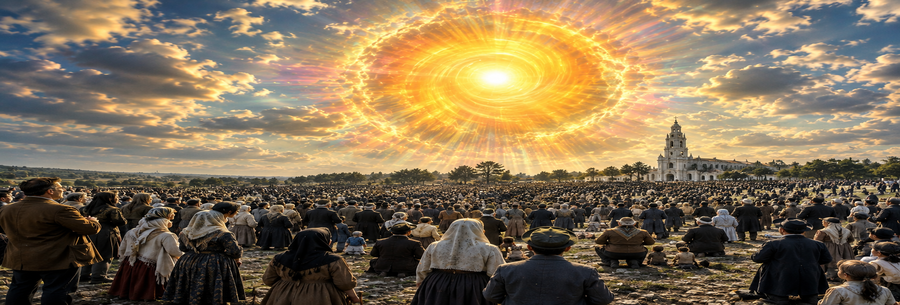
The long-awaited day finally arrives. Despite driving rain and soggy ground, thousands of people flock to Cova da Iria. Among them are devout believers, but also onlookers, journalists and sceptics.
Around midday, the rain suddenly stops. The clouds part and the sun appears. It is then that an extraordinary phenomenon occurs: the sun seems to spin on its axis, like a wheel of fire, casting lights of different colours over the crowd and the landscape.
Some witnesses report that the sun appears to be drawing closer to the earth, causing a wave of panic, with everyone thinking they are witnessing the end of the world. Then, just as suddenly as it had begun, the phenomenon ceased, and the sun resumed its normal appearance.
Equally astonishing was the fact that the soaked clothes of those present reportedly dried in a matter of moments.
Eyewitness accounts and repercussions
The miracle of the sun was reported by numerous witnesses, including in the press of the time. Portuguese newspapers, some of which were not particularly favourable towards religion, also described the phenomenon observed.
This point is crucial, as it gives the account a significance that goes beyond the mere realm of faith. Even sceptical observers acknowledged having witnessed something inexplicable.
However, not everyone perceived exactly the same thing, which still leaves room for varied interpretations today.
Recognition by the Church
Following a thorough investigation, the Catholic Church officially recognised the apparitions of Fátima in 1930. The miracle of the sun was then regarded as a sign authenticating the children’s visions.
Since then, Fátima has become one of the world’s greatest places of pilgrimage. Every year, millions of the faithful visit to pray and reflect.
The message of Fátima
Beyond the spectacular phenomenon, the heart of Fátima lies in its spiritual message. The Virgin Mary calls for:
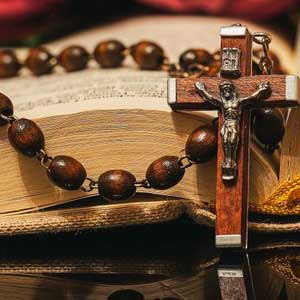
daily prayer, particularly the Rosary
personal conversion and a return to God
penance and reparation for sins
peace among nations
These calls, simple yet profound, continue to resonate today in a world often marked by conflict and uncertainty.
A mystery that lives on
More than a century after the events, the miracle of Fatima continues to fascinate and raise questions. For believers, it is a powerful sign of God’s presence and the Virgin Mary’s love for humanity. For others, it remains a mysterious phenomenon, difficult to explain scientifically.
Whatever the case, Fatima remains a place of faith, hope and prayer, where millions of people find comfort and light.
The miracle of the sun is not merely an event of the past: for many, it is an invitation to look up to the heavens and open one’s heart to a message of peace and conversion.