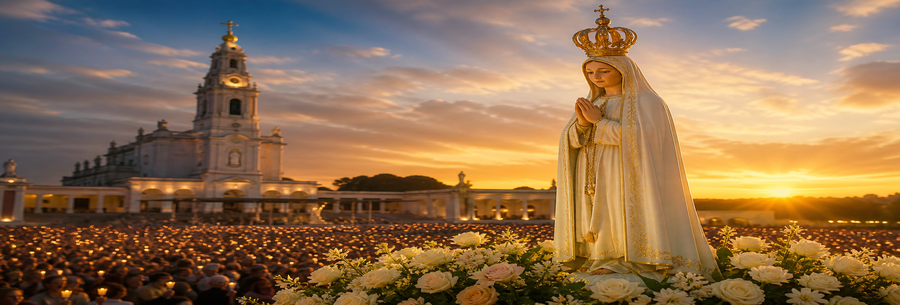
Every year on 13 May, millions of the faithful around the world celebrate the feast of Our Lady of Fatima, one of the most significant Marian apparitions of the 20th century. This event, deeply rooted in Catholic spirituality, draws pilgrims from all walks of life to the Shrine of Our Lady of Fatima in Portugal. But beyond the location itself, this feast carries a universal message of peace, conversion and hope.
The apparitions of 1917: a significant historical context
The story of Fátima begins against a backdrop of turmoil. In 1917, Europe was in the midst of the First World War, and Portugal itself was experiencing significant political and social tensions. It was in this climate of uncertainty that three young shepherds, Lucia dos Santos and her cousins Francisco Marto and Jacinta Marto, claimed to have seen a ‘Lady brighter than the sun’.
13 May 1917 marked the first apparition at Cova da Iria, near Fatima. The Virgin Mary appeared to them on six occasions, always on the 13th of the month, until October. During these encounters, she entrusted them with spiritual and prophetic messages, calling for prayer, penance and the conversion of hearts.
The message of Fatima: prayer, conversion and peace
The heart of the message of Fatima rests on three essential pillars:
1. Prayer, in particular the Rosary
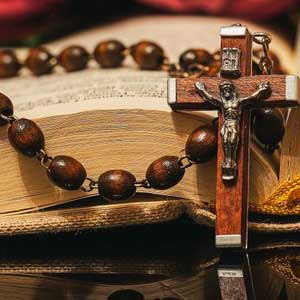
The Virgin Mary urges the daily recitation of the Rosary to obtain peace in the world and an end to the war. This emphasis on simple and accessible prayer highlights a spirituality open to all.
2. Personal conversion
The apparitions call on everyone to turn away from sin and return to God. The notion of conversion is not only individual but also collective, inviting societies to rediscover spiritual values.
3. Devotion to the Immaculate Heart of Mary
Another central aspect is consecration to the Immaculate Heart of Mary, seen as a spiritual refuge and a path to God.
The ‘Miracle of the Sun’: a landmark event
On 13 October 1917, during the final apparition, an extraordinary phenomenon was witnessed by tens of thousands of people: the sun appeared to spin, change colour and draw closer to the earth. This event, known as the ‘Miracle of the Sun’, significantly bolstered the credibility of the apparitions and attracted international attention.
Recognition by the Church
Following a thorough investigation, the Catholic Church officially recognised the apparitions of Fátima in 1930. Since then, the shrine has become one of the world’s greatest pilgrimage sites, comparable to the Sanctuary of Lourdes.
Several popes have shown great devotion to Our Lady of Fatima, notably John Paul II, who attributed his survival following the assassination attempt on 13 May 1981 to the intercession of the Virgin of Fatima.
The celebration of 13 May today
13 May is a particularly solemn feast day in Fatima. The celebrations include:
International open-air Masses
Impressive torchlight processions
The recitation of the Rosary in different languages
Moments of silence and contemplation
Pilgrims sometimes come on foot, travelling hundreds of kilometres as a sign of faith and devotion.
In many parishes around the world, this date is also marked by special prayers, novenas and acts of consecration.
A universal and contemporary significance
More than a century after the apparitions, the message of Fatima remains surprisingly relevant. In a world marked by conflict, social crises and uncertainty, the call for peace, prayer and conversion remains as relevant as ever.
Fatima is not merely a historical event or a religious tradition. It is a constant invitation to reflect on the meaning of life, to cultivate inner peace and to work towards a more just world.
Conclusion
The feast of Our Lady of Fatima, celebrated on 13 May, is much more than a mere remembrance of past apparitions. It embodies a profound, spiritual and universal message that transcends generations. Whether one is a believer or simply curious, Fatima invites us to pause, to reflect, and perhaps to experience an inner renewal.