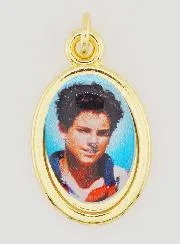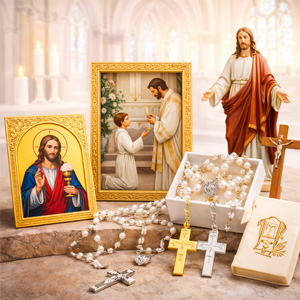
Carlo Acutis was born on 3 May 1991 in London, into a wealthy Italian family. Shortly after his birth, his parents moved to Milan, where he grew up. From an early age, Carlo showed an uncommon spiritual sensitivity. Although his parents were not practising believers, it was he who, at the age of just seven, expressed the desire to make his First Communion. That day, he wrote in his diary: "To be united with Jesus, that is my life plan.
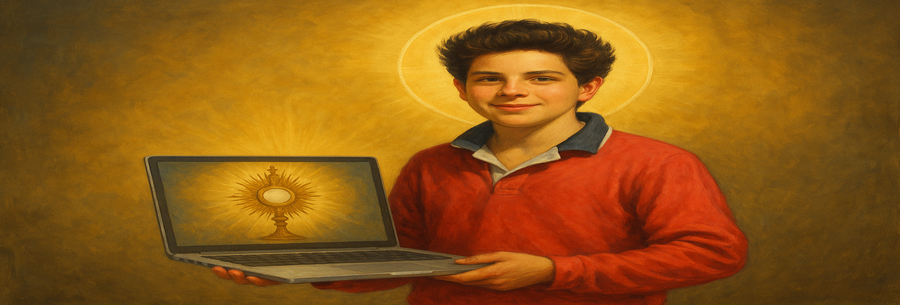
This boy, passionate about computers and video games, also loves sport, animals and his friends. But at the heart of this ordinary teenager's life burns a fire: love of the Eucharist. Carlo goes to Mass every day, spends long periods in prayer before the Blessed Sacrament, and recites the rosary every day. For him, communion is his "road to heaven", and he likes to say: "The Eucharist is my motorway to heaven."
A short but luminous life
Despite his youth, Carlo understood very early on that life only has meaning when lived in love and giving. He put his computer skills at the service of evangelisation by creating a website devoted to Eucharistic miracles around the world. This impressive, rigorous and passionate work reveals just how much he wanted everyone to be able to rediscover the real presence of Christ in the Eucharist.
Carlo doesn't just talk about God: he lives him. He helps the poor, defends his mocked classmates and doesn't hesitate to talk about his faith with simplicity and conviction. Those around him testify to a boy who is joyful, well-balanced, generous and deeply interested in others.
In 2006, aged just 15, Carlo fell seriously ill. The doctors diagnosed him with lightning leukaemia. In the midst of his pain, he maintained an unshakeable peace and confidence: "I offer all my suffering for the Pope and for the Church", he said. A few days before his death, he told his mother: "I am happy to die, because I have lived without wasting a minute doing things that are not pleasing to God."
He died on 12 October 2006 in Monza, Italy. His body was transferred to Assisi, a city he loved deeply for the figure of Saint Francis. Today he lies in state in the Shrine of the Stripping, dressed in jeans, trainers and a sweatshirt - the simple clothes he wore every day.
The steps towards canonisation
The process of canonising Carlo Acutis officially began on 5 July 2018, when Pope Francis recognised his heroic virtues and declared him venerable. From then on, his intercession was invoked throughout the world, particularly among young people and those passionate about new technologies, who saw in him a model of modern and authentic faith.
On 10 October 2020, Carlo was beatified in Assisi, after the recognition of a first miracle attributed to his intercession: the unexplained cure of a Brazilian child suffering from a serious pancreatic malformation. On that day, the Church celebrated for the first time a teenager of the digital age, presented as a model for today's youth. Pope Francis described him at the time as "a witness to Christ's love in the digital world", emphasising that holiness is accessible to all, even in the midst of modernity.
The miracle recognised for canonisation
In order for a blessed person to be canonised, a second miracle must be recognised. In 2024, the Vatican announced that a new miracle, which had occurred thanks to Carlo's intercession, had been validated by the Congregation for the Causes of Saints. This miracle concerned the inexplicable healing of a young girl in Italy who had been seriously injured in an accident. Doctors found no scientific explanation for her complete and rapid remission after prayers to Blessed Carlo.
On 1ᵉʳ July 2024, Pope Francis signed the decree recognising this miracle, paving the way for the canonisation of the young Blessed. The news arouses great emotion throughout the world: Carlo will become the first millennial saint, born at the end of the XXᵉ century, to be canonised by the Catholic Church.
A historic canonisation and a message for our times
The canonisation of Carlo Acutis represents a historic moment for the Church. It bears witness to the fact that holiness is not reserved for monks or priests, but can be lived to the full in the everyday life of a teenager, at school, on the internet, in friendships and leisure activities. Carlo knew how to make digital a space for evangelisation, using technology as a means to bring people closer to God, not further away.
Pope Francis, in his exhortation Christus Vivit, cites Carlo as an example of evangelical youth: "He knew that these means of communication, even the most modern, can be used to spread faith and good." His testimony is a reminder that holiness is not an exception, but a universal vocation.
The canonisation ceremony, which will take place in Rome, will bring together thousands of faithful, including many young people from all over the world. This moment will mark the official recognition of his holiness and spiritual radiance.
The spiritual message of Carlo
The message of Carlo Acutis can be summed up in his very life: simplicity, love, fidelity and joy. He teaches us that holiness is not a distant ideal, but a path within reach of all those who want to love God and serve him in the concrete of their existence.
His love of the Eucharist, his trust in divine mercy and his way of uniting faith and modernity make him a model for our generation. He shows that technology, when directed towards good, can become an instrument of light and communion.
Carlo often said, "All are born as originals, but many die as photocopies." These words, full of strength and hope, sum up the essence of his message: everyone is called to become a unique saint, placing their gifts and personality at the service of God.
A saint for the digital age
The canonisation of Carlo Acutis marks a new stage in the history of the Church. It invites us to recognise that holiness can flourish in the most modern of realities: a computer, a smartphone, a social network can become places of grace, if the love of God is the driving force.
Carlo leaves us a luminous legacy: that of a passionate young man, rooted in his time but looking to eternity. His life reminds us that, even in the heart of the digital world, God remains close, alive and loving.