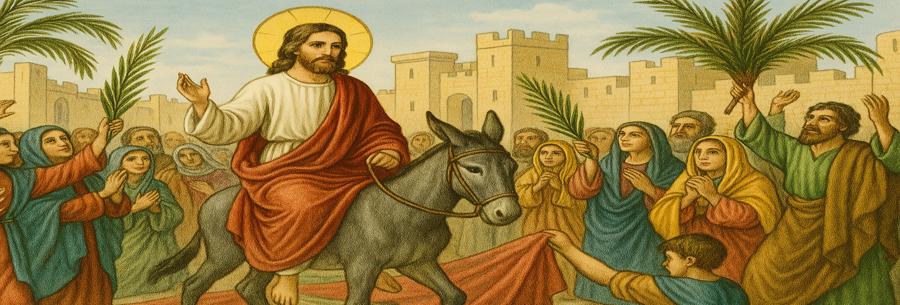
Palm Sunday ushers in a powerful moment in the Gospel: Jesus arrives in Jerusalem, acclaimed by the crowds, hailed as a king, recognised as the Messiah. This day marks the beginning of Holy Week, a week that is both luminous and serious, joyful and sorrowful, in which the truth of God's love is gradually revealed.
Accompanying Jesus on his triumphal entry is not just about remembering an event. It means choosing, today, to walk with him, to welcome him into our hearts, and to prepare the way inwardly towards Easter. These five verses are steps for opening our hearts to his coming, welcoming him with faith and following him with confidence.
"Rejoice, daughter of Zion! Behold your king comes to you, humble, riding on a donkey." Zechariah 9:9
This verse, quoted in the Gospels, is the prophecy that announces Jesus' entry into Jerusalem. He does not come as a conqueror. He does not ride a war horse, but a donkey. He did not come to dominate, but to serve. He is king, but of a new kingship, humble and offered.
To accompany him is to learn to recognise his kingship in gentleness, in self-denial, in truth. It means welcoming a God who does not impose himself, but gives himself. It also means making room for this humility in our lives: giving up our illusions of power, our pride, to follow a Messiah who makes himself poor.
"Hosanna! Blessed is he who comes in the name of the Lord!" Mark 11:9
This cry of the crowd is a cry of joy, of expectation, of faith. It comes from Psalm 118, sung during the great Jewish festivals. Today, it becomes our prayer. We welcome Jesus into our hearts, into our lives, as the Saviour sent by the Father.
Acclaiming Jesus means recognising that he is our hope. It means opening the doors of our lives to him, as Jerusalem opens its gates. It means believing that he comes to bring us peace, light and strength. And even if, at times, we are like the crowd that changes its mind, that acclaims him and then abandons him, he continues to come. With patience. With love.
"Even the stones will cry out." Luke 19:40
When the Pharisees ask Jesus to silence the cheering crowd, he responds with this astonishing phrase: "If they keep silent, the stones themselves will cry out." This means that the truth of who he is cannot be suppressed. That not even the silence of men can silence the whole of creation.
This verse invites us not to be silent about our faith. Not to be ashamed to praise, to pray, to bear witness. To let true, simple, spontaneous praise spring from us. Even if others refuse to see or believe, the light continues to shine. And we too are called to become bearers of that light.
"Prepare the way of the Lord, make straight his paths." Luke 3:4
This verse, borrowed from John the Baptist, resonates in a special way on this day. Before Jesus enters Jerusalem, the people spread out their cloaks, lay down branches. They are preparing the way.
Preparing the way of the Lord in our lives means tidying up our hearts. It means removing what clutters, what detracts, what weighs us down. It means telling him that we really want him to come. To make him the centre. It's an inner process, requiring silence, attention, desire.
"Father, glorify your name." John 12:28
As the Passion approaches, Jesus prays. He does not ask to be glorified for himself. He is not looking for applause. He wants his Father's name to be glorified. Even in suffering. Even in trial. That is his triumph: to love to the end, so that the Father's love may shine out.
To accompany Jesus in his triumphal entry is to understand that his glory is in the gift. It is not an outward triumph, but an inward victory. And that is where our hope lies: in a love stronger than hatred, in a light that nothing can extinguish.
Conclusion
These verses are like a spiritual path. They allow us to enter Holy Week by following in Jesus' footsteps, not as spectators, but as disciples. As we watch him enter Jerusalem, acclaimed but already facing the cross, we are invited to offer him our hearts, our struggles, our questions, our silences.
Bearing a branch on that day is much more than a rite. It's a commitment. It's telling Jesus that we want to walk with him. That we really want to let him in. And that, in our lives too, he can be recognised as king... humble, gentle, and full of love.