Devotion to the Divine Mercy of Jesus is one of the Catholic Church's most profound and contemporary spiritual treasures. It was born in the heart of the twentieth century, a time marked by wars, ideologies of death and the wounds of humanity. Through the intermediary of a humble Polish nun, Sister Faustina Kowalska, Christ wanted to remind the world that his mercy is boundless, offered to all, and that it constitutes the ultimate plank of salvation for souls.
Praying the Divine Mercy is not just about asking forgiveness for one's faults: it is about entering into the depths of God's heart, which never tires of loving, lifting up, healing. It means uniting ourselves with the crucified and risen Jesus, and allowing ourselves to be transformed by the power of his love.
The origin of the devotion: Saint Faustina, apostle of mercy
Helena Kowalska, known today as Saint Faustina, was born in 1905 in Poland. A nun in the Congregation of the Sisters of Our Lady of Mercy, she received many mystical visions of Christ between 1931 and her death in 1938. The Lord entrusted her with a mission: to proclaim his merciful love to the world.
In her Little Diary, Faustina recounts these words of Jesus:
"Tell suffering humanity to snuggle up in my merciful Heart. I want to pour out my graces on souls, but they don't want to receive them."
Through her, Jesus asks for the institution of a Feast of Mercy, the recitation of the Chaplet of Divine Mercy, the veneration of the icon of Merciful Jesus, and an attitude of trust and mercy towards others.
The pillars of devotion to the Divine Mercy
To pray the Divine Mercy is to live and practise five main forms of this devotion:
1. The image of Merciful Jesus
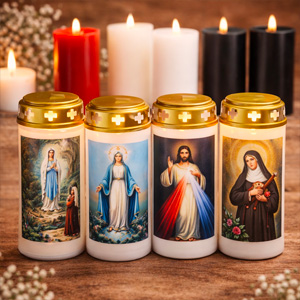
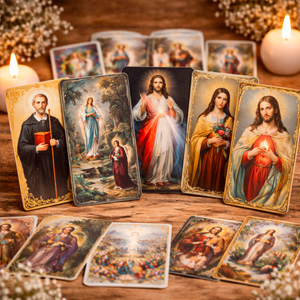
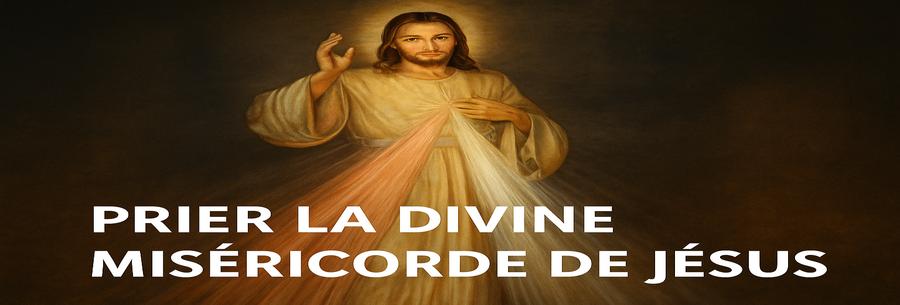
This image, painted at the request of Christ himself, depicts Jesus raising his right hand in blessing and touching his heart with his left hand. Two rays stream from his side: the red symbolises blood (life), and the pale symbolises water (baptism and purification). Beneath the image are the words:
"Jesus, I trust in You."
This image is a visual reminder of Jesus' love, of his active mercy. It is often placed in homes, churches, or used as a support for prayer.
2. The Feast of Divine Mercy (Sunday after Easter)
Christ asked that the Sunday after Easter be celebrated as the Feast of Divine Mercy. On this day, the faithful can receive extraordinary graces, including the total remission of faults and sorrows, provided they go to confession and receive Holy Communion with a trusting heart.
This feast, officially instituted by St John Paul II in 2000, is an explosion of spiritual joy, a source of healing, forgiveness, and a call to return to God without fear.
3. The Chaplet of Divine Mercy
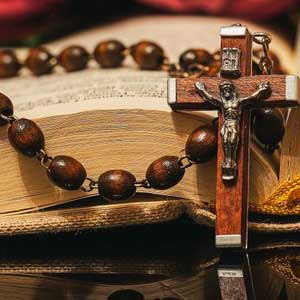
The Chaplet of Mercy is recited with a traditional rosary. It is a powerful prayer that Jesus taught Sister Faustina to intercede for sinners and the whole world.
The central prayer is repeated:
"Through his sorrowful Passion, be merciful to us and to the whole world."
It can be recited at any time, but Christ asked that it be prayed especially at 3pm, the hour of his death on the Cross, called the Hour of Mercy.
4. The Hour of Mercy (3pm)
Jesus asked that the hour of his death be honoured, every day at 3pm, with a short prayer, a meditation on his Passion, or the Rosary. It is a privileged moment to unite ourselves to the Cross and to implore graces for ourselves and for the world.
It is not necessarily a long prayer, but a gesture of love, a glance towards the Cross, an act of faith in the salvation offered by Jesus.
5. Trust and works of mercy
Finally, the very heart of this devotion is summed up in two attitudes:
absolute trust in God's mercy and
the active practice of mercy towards others.
Jesus insists:
"Souls who proclaim and glorify my mercy will be especially loved by Me. At the hour of death, I will not be a judge for them, but a Saviour."
To be a devotee of Mercy is to become merciful oneself: to forgive, to console, to support the poor, to visit the sick, to pray for the dead... so many concrete acts that make God's love visible and active.
A prayer for today's world
In a world wounded by violence, loneliness, discouragement and injustice, praying to the Divine Mercy is a prophetic act. It reminds us that love is stronger than sin, that grace is always offered, and that no one is lost if they turn to Christ.
John Paul II, the great apostle of this devotion, said:
"There is no other source of hope for man than the Mercy of God."
Mercy is not weakness: it is the very power of God, capable of transforming hearts, healing the deepest wounds, and bringing light into the heart of darkness.
Conclusion: living Mercy every day
To pray to the Divine Mercy of Jesus is to enter into a current of infinite love. It means approaching the open Heart of the Saviour every day to draw peace, strength and forgiveness from it. It also means learning to live mercy towards ourselves, towards those around us, towards the whole world.
In tears as in joy, in weakness as in faith, we can always repeat this simple prayer, which springs from the depths of our soul:
"Jesus, I trust in You."