The sacrament of the Eucharist is one of the seven sacraments of the Catholic Church and constitutes the heart of the Christian faith. Through this sacrament, Jesus Christ makes himself truly present under the species of bread and wine, which he consecrated at the Last Supper. The Eucharist is an intimate encounter with Christ, an act of adoration and thanksgiving, as well as a call to unity and charity.
1. The biblical origins of the Eucharist
a) Prefigurations in the Old Testament
The Eucharist is announced in the Old Testament through events and rites that prefigure the gift of the Body and Blood of Christ:
The sacrifice of Melchisedek (Genesis 14:18): Melchisedec, priest and king, offers bread and wine, symbolising the future Eucharistic offering.
The manna in the desert (Exodus 16): God feeds his people with bread from heaven, a prefiguration of Christ, "bread of life" (John 6:35).
The paschal lamb (Exodus 12): The Jewish Passover meal, with the slain lamb, foreshadows the sacrifice of Christ, the Lamb of God.
b) Institution by Jesus Christ
The Eucharist was instituted by Jesus at the Last Supper:
"Take, eat: this is my body." (Matthew 26:26)
"Drink of it, all of you, for this is my blood, the blood of the covenant, shed for many for the forgiveness of sins." (Matthew 26:27-28)
By offering his Body and Blood, Jesus anticipates his sacrifice on the cross and inaugurates a new covenant between God and humanity.
c) Apostolic practice
After the resurrection, the apostles celebrate the Eucharist, called the breaking of bread:
"They were assiduous in the apostles' teaching, fellowship, breaking of bread and prayers." (Acts 2:42)
2. The spiritual significance of the Eucharist
a) A real presence
In the Eucharist, the bread and wine really become the Body and Blood of Jesus Christ through consecration, a mystery known as transubstantiation.
b) A memorial of Christ's sacrifice
The Eucharist actualises Christ's sacrifice offered once and for all on the cross. Each mass is a participation in the paschal mystery.
c) A communion with God and the Church
By receiving the Eucharist, the believer is united to Christ and to the whole ecclesial community.
d) Spiritual nourishment
The Eucharist nourishes the soul, strengthens the faith, and gives the grace to live in conformity with the Gospel.
3. The symbols of the Eucharist
a) The bread and wine
These elements, simple and universal, become the Body and Blood of Christ, recalling God's solidarity with humanity.
b) The altar
The altar represents Christ himself, priest and victim of the sacrifice.
c) The chalice
The chalice contains the consecrated wine and symbolises the new covenant in the Blood of Christ.
d) The paschal candle
The light of the paschal candle, present in the Eucharistic liturgy, recalls the resurrection of Christ, source of life for believers.
4. The rite of the Eucharist
a) The Liturgy of the Word
Before the celebration of the Eucharist, the faithful listen to the biblical readings, meditate on the Word of God, and pray for their needs and those of the world.
b) The Eucharistic liturgy
The Eucharistic liturgy comprises several stages:
The preparation of the offerings:The bread and wine are brought to the altar.
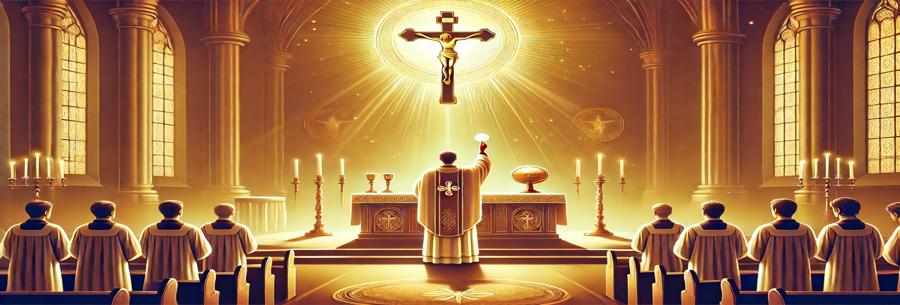
The Eucharistic Prayer: The priest invokes the Holy Spirit to consecrate the offerings.
The Consecration: The words of Jesus at the Last Supper are spoken, making Christ present under the species of bread and wine.
Communion: The faithful receive the Body and Blood of Christ, often accompanied by prayers and songs.
5. The spiritual fruits of the Eucharist
a) A union with Christ
The Eucharist profoundly unites the believer to Jesus, who dwells in him:
"He who eats my flesh and drinks my blood abides in me, and I in him." (John 6:56)
b) A strengthening of charity
Eucharistic communion nourishes love for God and neighbour, and impels to acts of charity.
c) An anticipation of eternal life
The Eucharist is a foretaste of the heavenly banquet, where believers will be reunited with God for eternity.
6. The Eucharist and the life of the Church
a) The centre of Christian life
The Eucharist is called the heart and summit of the Church's life, for it expresses and strengthens the unity of believers.
b) A source of mission
The faithful, nourished by the Eucharist, are sent into the world to witness to their faith and serve others.
c) A universal celebration
Each Mass, celebrated throughout the world, is an expression of the unity of the Church in Christ.
7. Preparation for the Eucharist
To receive the Eucharist, the faithful must prepare themselves by:
Regular confession to be in a state of grace.
Inner prayer and a Eucharistic fast of at least one hour before communion.
An attitude of reverence and recollection.
8. Conclusion : An encounter with the living Christ
The sacrament of the Eucharist is an extraordinary gift from God to his people. It enables believers to encounter the living Christ, to receive his grace, and to live in union with him. The Eucharist is a source of joy, peace and strength for the faithful, sustaining them on their spiritual journey and guiding them towards eternal life. Through this sacrament, the Church remains connected to her Lord, united in faith and called to share divine love with the whole world.