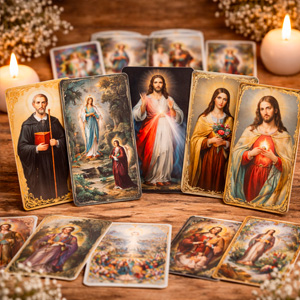
Discover the main Christian festivals in November: All Saints’ Day, All Souls’ Day, St Martin’s Day, St Cecilia’s Day, Christ the King and Catholic traditions.
Christian feasts in November: a time of remembrance, holiness and hope
The month of November holds a special place in the Catholic Church’s liturgical calendar. As autumn progresses and the days grow shorter, Christians are invited to experience a time of reflection, prayer and hope.
From the very first days of the month, two major celebrations lend November a profound spiritual dimension: the Solemnity of All Saints’ Day on 1 November, and the Commemoration of All Souls on 2 November.
These two closely linked days remind us that the Christian faith does not end at the boundaries of earthly life. They express the hope of the Resurrection, the communion of saints and trust in God’s mercy.
But November is not limited to these two celebrations.
Throughout the month, the Church honours many saints whose lives continue to inspire the faithful: Saint Martin of Tours, Saint Charles Borromeo, Saint Leo the Great, Saint Elizabeth of Hungary, Saint Cecilia and Saint Andrew, Apostle of Christ.
November also marks the end of the liturgical year with the Solemnity of Christ the King of the Universe. This feast reminds us that Jesus Christ is the Lord of history and that his Kingdom is founded on truth, justice, peace and love.
Finally, depending on the year, the last days of November mark the beginning of Advent, a period of spiritual preparation for the birth of Jesus.
To discover the Christian feasts of November is to journey from the remembrance of those who have gone before us to the hope of eternal life, and then to the joyful anticipation of the Saviour.
1. 1 November: All Saints’ Day, the great feast of all the saints
All Saints’ Day is one of the principal solemnities in the Catholic calendar.
Every year, on 1 November, the Church celebrates all the saints who live in the glory of God.
This feast day is not limited to the great Christian figures who have been officially canonised, such as Saint Francis of Assisi, Saint Thérèse of Lisieux or Saint John Paul II.
It also honours the multitude of men and women who lived in faithfulness to God and who now share in his glory, even if their names do not appear in any calendar.
What is the origin of All Saints’ Day?
The collective celebration of martyrs and saints dates back to the early centuries of Christianity.
At that time, Christian communities paid tribute to the martyrs who had given their lives for their faith.
Gradually, the Church came to wish to celebrate all the saints on a single feast day.
In the 7th century, Pope Boniface IV consecrated the Pantheon in Rome to the Virgin Mary and to all the martyrs, a significant event in the history of this celebration.
The date of 1 November then gradually became established in the Western Church, particularly from the 8th and 9th centuries onwards.
What does All Saints’ Day mean for Christians?
All Saints’ Day reminds us that every baptised person is called to holiness.
Being a saint does not mean having led a perfect life, free from weakness or difficulty.
It means having sought to love God and one’s neighbour, by welcoming divine grace and walking the path of the Gospel.
The saints experienced trials, doubts and, at times, great suffering.
But they chose to place their trust in God.
Their example reminds us that holiness is accessible to everyone, in the ordinary circumstances of life.
The Gospel of the Beatitudes
During the Mass on All Saints’ Day, the Church proclaims the Beatitudes, taken from the Gospel according to Saint Matthew.
In them, Jesus declares blessed the poor in spirit, the meek, the merciful, the peacemakers, and those who hunger and thirst for righteousness.
These words constitute a true programme for Christian life.
They show that holiness does not rest on the pursuit of power or wealth, but on love, humility and faithfulness to God.
How can we celebrate All Saints’ Day as a family?
All Saints’ Day can be a wonderful opportunity to pass on the faith to children.
Parents can tell the story of a saint’s life, explain the meaning of a Christian name or attend Mass together.
It is also possible to pray before a statue of the Virgin Mary or one’s patron saint.
Above all, this day invites us to remember that we are all called to become saints, each according to our own vocation.
2. 2 November: the Commemoration of All the Faithful Departed
The day after All Saints’ Day, the Catholic Church celebrates the Commemoration of All the Faithful Departed.
This day is devoted to prayer for the deceased.
It holds a particularly important place in Christian tradition, as it expresses the hope of the Resurrection and trust in God’s mercy.
What is the difference between All Saints’ Day and All Souls’ Day?
These two celebrations are often confused.
However, their meanings are different.
On 1 November, All Saints’ Day celebrates the saints who share in God’s glory.
On 2 November, the Church prays especially for the faithful departed.
The first day is a feast of joy and hope.
The second is more devoted to remembrance, intercession and contemplation.
These two celebrations are nevertheless deeply linked by faith in the communion of saints.
Why do Catholics pray for the dead?
In the Catholic faith, death does not put an end to the bond of love that unites the members of the Church.
Christians believe that God calls people to share in his eternal life.
Prayer for the departed expresses this hope and asks God to welcome them into his peace.
This tradition is based in particular on the ancient practice ofintercession for the dead, attested to in biblical tradition and in the early centuries of Christianity.
The Church teaches that prayer can assist the departed who still need to be purified before entering fully into the glory of God.
Visiting the cemetery
In France, many families visit the cemetery on All Saints’ Day or 2 November.
They clean the graves, lay flowers and take a moment to reflect.
Chrysanthemums are traditionally associated with this time of year.
Beyond the flowers, the most important act for believers remains prayer.
Reflecting in front of a grave allows one to entrust a departed loved one to God’s mercy and to renew the hope of being reunited with them in eternal life.
A prayer for the departed
Lord Jesus,
You who conquered death through your Resurrection,
We entrust to You those who have left us.
Welcome them into the light of Your Kingdom.
Forgive their sins and surround them with Your mercy.
Comfort the families who are grieving.
Strengthen our hope in eternal life.
May our departed rest in your peace.
Amen.
3. 4 November: Saint Charles Borromeo, a bishop in the service of the Church
On 4 November, the Church commemorates Saint Charles Borromeo, a leading figure of the 16th-century Catholic Reformation.
Born in 1538 into a noble Italian family, Charles Borromeo became Archbishop of Milan.
He devoted his life to reforming church life, training priests and providing spiritual guidance to the faithful.
A key figure in the Catholic Reformation
Saint Charles Borromeo played a part in implementing the decisions of the Council of Trent.
He encouraged better training for the clergy, developed seminaries and ensured the quality of religious education.
He also attached great importance to the catechesis of children and adults.
A pastor close to the sick and the poor
During the great plague that struck Milan in 1576, Charles Borromeo distinguished himself through his devotion.
He organised relief efforts, supported the sick and encouraged prayer.
His example reminds us that Christian responsibility is not limited to teaching the faith.
It also demands a tangible presence amongst those who are suffering.
Saint Charles Borromeo died in 1584.
He remains today a model of pastoral fidelity, charity and courage.
4. 9 November: the dedication of the Basilica of St John Lateran, mother of all churches
On 9 November, the Catholic Church celebrates the dedication of the Basilica of St John Lateran in Rome.
This feast day may seem less well-known than those dedicated to the saints.
It is, however, of particular importance.
Why is the Lateran Basilica so important?
St John Lateran is the cathedral of the Bishop of Rome, that is to say, the Pope.
Contrary to popular belief, St Peter’s Basilica in the Vatican is not the Pope’s cathedral.
It is in fact the Basilica of St John Lateran that fulfils this role.
It is traditionally regarded as the mother and head of all the churches in Rome and throughout the world.
The spiritual significance of this feast
The celebration of the Dedication of the Lateran is not merely about a monument.
It reminds us that the Church is, above all, a community of believers gathered around Christ.
Religious buildings are places consecrated for prayer, the proclamation of the Word of God and the celebration of the sacraments.
This feast invites Christians to love their parish church and to take part in the life of their community.
It also recalls the unity of the Catholic Church centred on the successor of Saint Peter.
5. 10 November: Saint Leo the Great, Pope and Doctor of the Church
On 10 November, the Church honours Saint Leo the Great, Pope in the 5th century.
His pontificate, from 440 to 461, had a profound impact on the history of Christianity.
Saint Leo is particularly known for his teaching on the person of Jesus Christ.
A defender of the faith in the Incarnation
Saint Leo the Great played a vital role in the theological debates of his time.
His teaching helped to clarify the Church’s faith in Jesus Christ, truly God and truly man.
His doctrinal letter, known as Tome to Flavian, exerted a major influence on the Council of Chalcedon in 451.
This doctrine is directly linked to the mystery of Christmas.
For Christians, the Child born in Bethlehem is the eternal Son of God who took on our human nature.
A Pope in the service of his people
Saint Leo is also known for his pastoral work and his role during a period of great political turmoil.
His courage, wisdom and fidelity to the faith have left their mark on the history of the Church.
He has been recognised as a Doctor of the Church.
His feast day reminds us of the importance of Christian teaching and fidelity to the truth of the Gospel.
6. 11 November: Saint Martin of Tours, the saint of sharing and charity
Saint Martin of Tours is one of the most popular saints in France.
His feast day is celebrated every year on 11 November.
Born in the 4th century, probably in what is now Hungary, Martin grew up in the Roman Empire.
He became a soldier before choosing a life entirely devoted to Christ.
The sharing of Saint Martin’s cloak
The most famous episode of his life took place in Amiens.
Whilst he was still a soldier, Martin met a poor man who was suffering from the cold.
Moved by the man’s distress, he split his cloak in two and gave him one half.
According to tradition, Christ then appeared to him in a dream, wearing the part of the cloak he had given to the poor man.
This event became a symbol of his charity.
It echoes the words of Jesus in the Gospel according to Saint Matthew: whatever we do for the least of our brothers, we do for him.
From soldier to bishop
After leaving military life, Martin devoted himself to prayer and the proclamation of the Gospel.
He founded a monastic community at Ligugé, near Poitiers.
In 371, he became Bishop of Tours.
He continued his work of evangelisation and was noted for his simple way of life.
Why is Saint Martin still so popular?
Saint Martin represents a form of holiness accessible to all.
His act of sharing shows that a simple gesture can become a profound testimony of faith.
He invites Christians to look upon those in need with compassion.
His feast day is a wonderful opportunity to teach children about generosity and caring for the most vulnerable.
7. 12 November: Saint Josaphat, witness to Christian unity
On 12 November, the Church commemorates Saint Josaphat, a 17th-century bishop and martyr.
Born in a region that is now part of Ukraine, Josaphat belonged to the Eastern Christian tradition.
He became a monk and later Archbishop of Polotsk.
A life dedicated to the unity of the Church
Saint Josaphat worked to promote ecclesial communion between Christians of the Eastern tradition and the Church of Rome.
His commitment took place against a backdrop of intense religious and political tensions.
He was killed in 1623.
The Catholic Church venerates him as a martyr.
The message of Saint Josaphat today
His memory invites Christians to pray for unity.
It serves as a reminder that religious divisions have often been a source of suffering.
The unity sought by Christians must always be accompanied by respect, charity and a sincere search for the truth.
8. 17 November: Saint Elizabeth of Hungary, a life dedicated to the poor
Saint Elizabeth of Hungary is one of the great female figures of Christian charity.
Born in 1207 into a royal family, she married Louis IV of Thuringia.
Despite her high social standing, she led a life deeply marked by prayer and service to the poor.
A princess with a generous heart
Elizabeth used her resources to help the destitute.
She distributed food, cared for the sick and supported those living in poverty.
After her husband’s death, she continued her commitment to a life of simplicity and charity.
In particular, she founded a hospital in Marburg, where she devoted herself to caring for the sick.
A saint who teaches us the true meaning of wealth
Saint Elizabeth died in 1231, aged just twenty-four.
Her life reminds us that material wealth has no true value unless it is used for the common good.
She teaches us that Christian charity is not merely about giving away what we no longer need.
It calls on us to share generously and to recognise the dignity of every person.
9. 21 November: The Presentation of the Blessed Virgin Mary
On 21 November, the Church celebrates the feast of the Presentation of the Blessed Virgin Mary.
This feast has its origins in an ancient Christian tradition concerning Mary’s childhood.
A tradition dating back to the early centuries
The canonical Gospels do not recount Mary’s presentation in the Temple.
The account comes in particular from an ancient text known as the Protoevangelium of James, which is not part of the Bible.
According to this tradition, Mary’s parents, Joachim and Anne, are said to have presented their daughter at the Temple in Jerusalem to consecrate her to God.
The feast developed within the Eastern Churches before spreading to the West.
The spiritual significance of the Presentation of Mary
Beyond the traditional account, this celebration highlights Mary’s openness to the divine will.
It reminds us that her whole life is oriented towards God.
The Virgin Mary thus appears as a model of trust, humility and faithfulness.
As Advent approaches, this feast invites Christians to prepare their hearts to welcome Christ, following the example of his mother.
10. 22 November: Saint Cecilia, patron saint of musicians
On 22 November, the Church honours Saint Cecilia, a virgin and martyr from the early centuries of Christianity.
She is particularly well known as the patron saint of musicians and sacred music.
Who was Saint Cecilia?
The reliable historical information concerning her life is limited.
Christian tradition presents her as a young Roman woman who devoted her life to Christ.
She is said to have been martyred for her faith.
Her veneration dates back to ancient times and has become widespread within the Church.
Why is she the patron saint of musicians?
Saint Cecilia’s patronage of music developed from liturgical traditions and accounts associated with her life.
Over the centuries, she has become a figure particularly dear to singers, organists, choirs and composers.
Many musical societies and parish choirs celebrate her feast day.
Music, a form of prayer
The feast of Saint Cecilia reminds us of the important place music holds in the Catholic liturgy.
Since the earliest centuries, Christians have used singing to praise God and express their faith.
Psalms, hymns and canticles accompany the Church’s prayer.
Sacred music enables us to lift our hearts to God and to participate more deeply in the celebrations.
11. 30 November: Saint Andrew, the first to be called amongst the Apostles
On 30 November, the Church celebrates Saint Andrew, one of the twelve Apostles of Jesus.
Andrew is the brother of Saint Peter.
A native of Bethsaida, he worked as a fisherman.
According to the Gospel of Saint John, he was one of the first disciples to follow Jesus.
Saint Andrew leads his brother Peter to Jesus
After meeting Christ, Andrew went to find his brother Simon Peter.
He tells him that they have found the Messiah.
Then he brings him to Jesus.
This episode reveals an essential aspect of the apostolic mission: making Christ known to others.
A missionary apostle
Christian tradition associates Saint Andrew with the evangelisation of various regions of the ancient world.
He is said to have been martyred in Patras, Greece.
He is often depicted with an X-shaped cross, known as the Cross of Saint Andrew.
A feast day that prepares for Advent
The feast day of Saint Andrew falls close to the beginning of Advent.
His example reminds us of the importance of responding to Jesus’ call.
Like Andrew, Christians are called to follow Christ and to lead others to him.
12. The Solemnity of Christ the King of the Universe: the last major feast of the liturgical year
The Solemnity of Our Lord Jesus Christ, King of the Universe, is celebrated on the last Sunday of Ordinary Time, just before the start of Advent.
This feast holds a special place in the Catholic calendar, as it brings the liturgical year to a close.
In 2026, the Feast of Christ the King will be celebrated on Sunday 22 November.
What is the origin of the Feast of Christ the King?
The Solemnity of Christ the King was instituted in 1925 by Pope Pius XI, in the encyclical Quas primas.
At that time, Europe was undergoing profound political and social changes.
The Pope wished to remind people that Christ is the true Lord of history and that his teaching must guide people’s lives.
Following the reform of the liturgical calendar after the Second Vatican Council, the feast was placed on the last Sunday in Ordinary Time.
Why is Jesus called King of the Universe?
Christ’s kingship is different from that of earthly rulers.
Jesus does not seek to rule through force or wealth.
In the Gospels, he presents himself as one who serves, who forgives and who gives his life out of love.
His Kingdom is founded on truth, justice, holiness, grace and peace.
The Feast of Christ the King reminds us that humanity’s ultimate destiny finds its fulfilment in God.
Christ the King and the end of the liturgical year
By placing this solemnity at the end of the liturgical year, the Church invites the faithful to contemplate the fulfilment of the history of salvation.
Christ, who died and rose again, is recognised as the Lord of all creation.
This celebration also opens up a perspective of hope.
It reminds us that Christians await the glorious return of Christ and the definitive fulfilment of the Kingdom of God.
13. The start of Advent: when November is already preparing for Christmas
Depending on the year, the first Sunday of Advent can fall between 27 November and 3 December.
It therefore happens that the month of November ends with the start of a new liturgical year.
In 2026, the first Sunday of Advent will be celebrated on 29 November.
What is Advent?
The word ‘Advent’ comes from the Latin adventus, which means ‘coming’.
During this period, Christians prepare to celebrate the birth of Jesus at Christmas.
They are also invited to renew their hope in the glorious return of Christ.
Advent is a time of prayer, conversion and joyful anticipation.
The four Sundays of Advent
Each Sunday brings the faithful closer to Christmas.
The Advent wreath, with its four candles, is a symbol particularly cherished by families.
The gradual lighting of the candles evokes the light of Christ coming to illuminate the world.
A spiritual transition between November and December
The transition from November to December holds a beautiful significance.
At the start of the month, Christians celebrate the saints and pray for the departed.
At the end of the month, they contemplate Christ the King and begin to prepare for the Saviour’s birth.
The liturgical calendar thus reveals a profound unity.
The Christian life is a journey leading towards God, in the hope of eternal life.
14. The calendar of the main Catholic feasts in November
Here is a summary of the main celebrations for the month of November in the General Roman Calendar, including the dates for Christ the King and Advent in 2026.
Date | Feast or celebration |
|---|---|
1 November | All Saints’ Day |
2 November | Commemoration of All the Faithful Departed |
4 November | St Charles Borromeo |
9 November | Dedication of the Lateran Basilica |
10 November | Saint Leo the Great |
11 November | Saint Martin of Tours |
12 November | Saint Josaphat |
17 November | Saint Elizabeth of Hungary |
21 November | The Presentation of the Virgin Mary |
22 November | Saint Cecilia |
22 November 2026 | Solemnity of Christ the King of the Universe |
30 November | Saint Andrew, Apostle |
29 November 2026 | First Sunday of Advent |
Some celebrations may be adapted in accordance with local liturgical calendars or the rules of precedence between feasts.
15. How can we live out our Christian faith during the month of November?
November can become a true time of spiritual renewal.
The feasts that mark this month invite us to deepen our faith, to remember those who have gone before us, and to prepare our hearts for the coming of Christ.
Praying for the departed
The month of November is traditionally devoted to praying for the souls in purgatory.
The faithful may have a Mass said for their departed loved ones, visit the cemetery or say a prayer for the repose of their souls.
This practice expresses trust in God’s mercy and hope in the Resurrection.
Discovering the lives of the saints
Each week, you can read about the life of a saint whose feast day falls during that month.
Saint Martin teaches us about sharing.
Saint Elizabeth of Hungary shows us charity towards the poor.
Saint Cecilia reminds us of the beauty of praise.
Saint Andrew invites us to follow Christ and to make him known.
These examples can enrich personal prayer and family life.
Attending Mass
Taking part in the Eucharist enables us to experience the major celebrations of the liturgical calendar to the full.
All Saints’ Day and Christ the King are particularly important.
The faithful may also attend Masses celebrated for the deceased.
Performing acts of charity
The witness of the saints reminds us that faith must be expressed through deeds.
November can be an opportunity to visit someone who is lonely, to support a family in need, or to take part in a charitable initiative.
These simple acts bring the teaching of the Gospel to life in our daily lives.
Preparing one’s heart for Advent
As December approaches, Christians can begin to reflect on their spiritual preparation for Christmas.
Setting up an Advent wreath, setting up the nativity scene or setting aside a daily time for prayer helps us to gradually enter into this season of anticipation.
16. Why is November associated with the remembrance of the dead in the Christian tradition?
In many European cultures, November is associated with remembering those who have passed away.
The shortening of daylight hours and the end of autumn help to create an atmosphere of contemplation.
But Christian tradition gives this remembrance a special significance.
Death is not the end of hope
For Christians, death remains a painful ordeal.
Separation from a loved one causes real suffering.
However, faith in the Resurrection of Christ offers a perspective of hope.
The Church proclaims that human life is called to find its fulfilment in God.
Prayer for the dead expresses this confidence.
The communion of saints
The communion of saints is an important truth of the Catholic faith.
It expresses the spiritual union of all those who belong to Christ.
The Church traditionally distinguishes between the faithful living on earth, the departed who are undergoing purification, and the saints who contemplate God in his glory.
All are united in Christ.
This communion reminds us that Christian love transcends the boundaries of death.
An invitation to reflect on the meaning of life
Remembering the departed can also lead us to reflect on our own existence.
What values do we wish to pass on?
What place do we give to family, prayer and charity?
How do we live out our faith in daily life?
The month of November invites us to consider these questions with serenity and confidence.
17. A prayer to help us live the month of November in faith
Lord our God,
In this month of November, we turn our hearts towards you with confidence.
We thank you for all the saints who have borne witness to your love throughout the centuries.
May their example encourage us to live in faith, humility and charity.
We also entrust to you all our departed loved ones, particularly those in our families and those who have no one to pray for them.
Welcome them into your mercy and let the light of your face shine upon them.
Comfort those who are grieving and strengthen their hope.
Following the example of Saint Martin, teach us to share.
Following the example of Saint Elizabeth, make us attentive to the poorest among us.
Following the example of the Virgin Mary, help us to accept your will.
May Christ the King reign in our hearts through peace, justice and love.
And when the season of Advent begins, prepare us to welcome with joy the birth of your Son Jesus.
Amen.
Conclusion: November, a Christian month focused on eternal life and hope
The month of November is one of the richest periods in the Christian calendar.
Through All Saints’ Day, the Church celebrates the multitude of saints who have answered God’s call.
By commemorating the faithful departed, she expresses her trust in divine mercy and her hope in the resurrection.
The feasts of Saint Martin, Saint Elizabeth of Hungary, Saint Cecilia and the other saints of the month remind us that holiness can take many different forms.
Some devoted their lives to teaching and defending the faith.
Others bore witness to the Gospel through charity, music, prayer or martyrdom.
They all show us that the Christian life is a path of love and faithfulness.
The Solemnity of Christ-King then comes to crown the liturgical year, reminding us that Jesus Christ is the Lord of history and that his Kingdom will never pass away.
Finally, the beginning of Advent opens a new period of anticipation and hope.
November thus teaches us that the Christian faith is deeply oriented towards life.
Remembering the departed does not lead to despair, but to trust in the promise of the Resurrection.
The celebration of the saints does not distance us from our daily lives, but encourages us to live out the Gospel with greater generosity.
And the anticipation of Christmas reminds us that God himself came to share in our human condition to open the way to salvation for us.
As the days go by, November thus becomes an invitation to pray, to love, to remember and to hope.
For Christians, the light of Christ remains stronger than the darkness, and God’s love is destined to triumph over death.