Discover the origins of the Miraculous Medal, the message entrusted to Saint Catherine Labouré and the spiritual significance of the feast of Our Lady of the Miraculous Medal.
The Feast of the Miraculous Medal: a sign of trust and grace
On 27 November, the Church honours Our Lady of the Miraculous Medal. This feast day commemorates the apparition of the Virgin Mary to Saint Catherine Labouré on 27 November 1830, in the chapel of the Daughters of Charity on Rue du Bac in Paris.
This day holds a special place in the prayers of many of the faithful. The Miraculous Medal is worn throughout the world as a sign of devotion to the Virgin Mary, of trust in her maternal intercession and of hope in God’s grace. It is neither a good-luck charm nor a magical object. It is an invitation to turn to Christ with faith, through the intercession of she who is fully united to him.
The apparition on Rue du Bac
In 1830, Catherine Labouré was a young novice with the Daughters of Charity of Saint Vincent de Paul. Originally from Burgundy, she had recently joined this community, whose mission is to serve the poor, the sick and the vulnerable.
On the night of 18–19 July 1830, she experienced her first apparition of the Virgin Mary in the chapel on Rue du Bac. Mary then told her that an important mission would be entrusted to her and invited her to come and pray at the foot of the altar, where graces would be poured out upon those who asked for them with confidence.
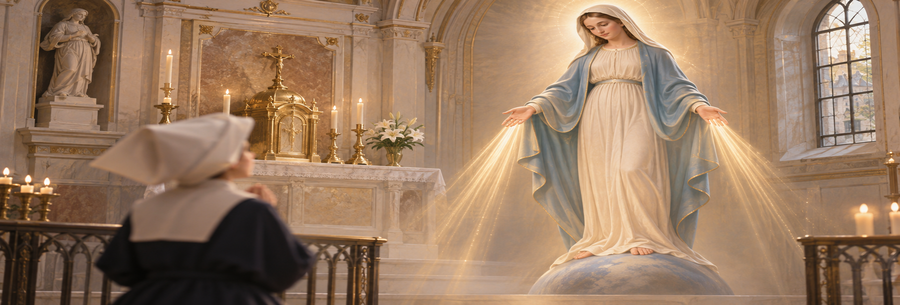
On 27 November 1830, during the community’s time of prayer, Catherine saw the Virgin Mary once more. The vision took place in the choir of the chapel. Mary appeared standing on the globe, holding in her hands a smaller globe surmounted by a cross, which she raised towards God.
This image conveys a truth of great depth: Mary presents the world to the Lord. In her prayer, she carries the nations, families, those in distress, the sick, the poor and all those who entrust themselves to her.
The rays of grace
In the vision recounted by Saint Catherine Labouré, rays of light stream from the Virgin’s outstretched hands. Mary explains that these rays symbolise the graces she obtains for those who ask for them.
This image has had a profound impact on Catholic devotion. It reminds us that God remains the source of all grace and that Mary intercedes for her children. She does not take the place of Christ: she leads us to him. She teaches us to humbly accept what God wishes to give, rather than believing that we can achieve everything through our own efforts.
The rays emanating from Mary’s hands also represent God’s tenderness towards humanity. In times of anxiety, illness, loneliness or trial, the feast of the Miraculous Medal invites us not to close our hearts to hope.
According to Catherine’s account, some of the rays were less bright. Mary is said to have explained to her that they represented the graces which people forget to ask for. These words are a gentle invitation to pray more, not out of fear, but with the simple trust of a child turning to their mother.
‘O Mary, conceived without sin’
An oval then formed around the apparition, bearing the now famous invocation:
‘O Mary, conceived without sin, pray for us who have recourse to you. ”
This prayer expresses the Church’s faith in the unique holiness of the Virgin Mary. Twenty-four years before the official proclamation of the dogma of the Immaculate Conception in 1854, the Miraculous Medal already bore these words, which proclaim that Mary was preserved from sin from the very first moment of her conception.
But this invocation is, above all, a prayer of trust. It is not addressed to a distant or abstract idea. It is addressed to a caring mother, capable of presenting to God our joys, our sorrows, our intentions and our most secret needs.
To say this prayer is to acknowledge that we need God’s help. It is also to choose not to go it alone. In an age that often values absolute autonomy, Mary teaches us the humility of one who dares to ask, to receive and to give thanks.
The reverse of the Miraculous Medal
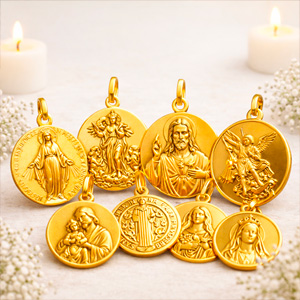
The Virgin asked Catherine Labouré to have a medal struck according to the model shown to her. On the obverse, Mary is depicted standing on the globe, crushing the serpent – a sign of the victory of good over evil and of grace over sin.
The reverse of the Medal is also rich in symbolism. It features the letter M, surmounted by a cross. These symbolise Mary’s profound union with Jesus Christ and his work of salvation. Below them appear the two Hearts of Jesus and Mary: the former surrounded by a crown of thorns, the latter pierced by a sword.
These two united Hearts speak of Christ’s love for the world and of Mary’s compassion at the foot of the Cross. Finally, the crown of twelve stars recalls the woman of the Book of Revelation, a sign of the Church, of light and of Christian hope.
The Miraculous Medal is therefore a true summary of the faith. It leads us to contemplate the mystery of the Incarnation, the Cross, Christ’s redeeming love and Mary’s maternal intercession.
Why is it called the ‘Miraculous’ Medal?
The first medals were struck in 1832, during a painful period for Paris, which was struck by a severe cholera epidemic. They were initially distributed to the sick, to families in distress and to those in need.
Very quickly, numerous accounts of conversions, healings, protection and reconciliations became associated with this devotion. The Christian people began spontaneously to refer to it as the ‘Miraculous Medal’.
The Church, however, urges us to understand this name correctly. The medal has no power in itself. The graces received come from God. The medal is a visible sign that helps us to live with inner trust, to remember Mary’s presence and to renew our desire to follow Christ.
True grace is never limited to receiving material help. It may be a renewed sense of peace, a conversion of the heart, the courage to forgive, the strength to endure a trial, or the light needed to make an important decision.
Wearing the Miraculous Medal with faith
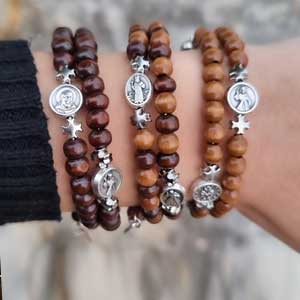
Wearing a Miraculous Medal can become a daily act of prayer. By looking at it or holding it in your hand, you can entrust to Mary a loved one, a family difficulty, an illness, a project or a more private intention.
It can be worn round the neck, kept in a wallet, placed in a place of prayer, or given to someone going through a difficult time. The key is to accept it as a sign of faith and not as an automatic guarantee against trials.
The Miraculous Medal reminds us that the Christian life is based on a relationship of trust. Mary does not promise a life without the cross. She accompanies us on our journey, she leads us to Jesus and she teaches us to keep hope alive even when everything seems uncertain.
A feast that leads to charity
The feast day on 27 November cannot be separated from the life of Saint Catherine Labouré. After the apparitions, she sought neither glory nor recognition. She lived for many years in obscurity, serving the elderly and the poor in a Parisian hospice.
Her life shows that Marian devotion bears fruit when it leads us to love more deeply. To pray to Mary is to learn to serve as she did, to care for the most vulnerable, to comfort those who suffer and to offer a little peace to those around us.
The Miraculous Medal therefore invites us to combine prayer and charity. It reminds us that trust in God is made tangible through simple acts: listening, forgiving, helping, visiting, encouraging and caring.
Prayer to Our Lady of the Miraculous Medal
O Mary, conceived without sin,
pray for us who have recourse to you.
Faithful Virgin and mother full of tenderness,
we entrust to you our families,
our joys, our sorrows and our hopes.
Teach us to turn to Jesus
with a simple and trusting heart.
Obtain for us peace in times of trial,
the strength to forgive
and the grace to live each day in charity.
Our Lady of the Miraculous Medal,
watch over those who suffer
and lead us to your Son.
Amen.