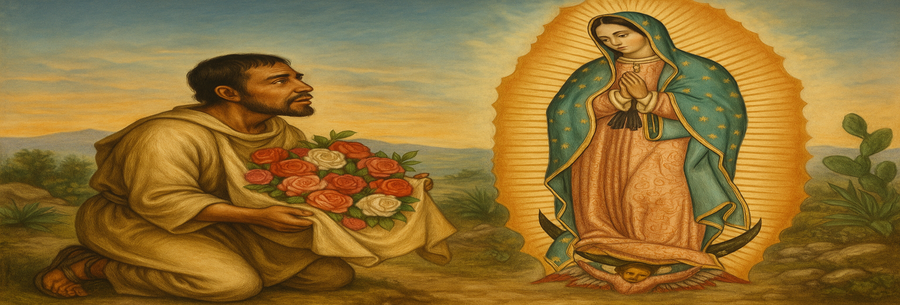
We are at the beginning of the XVIᵉ century, in the aftermath of the Spanish conquest. Mexico was going through a troubled period: the indigenous peoples were in upheaval, their social and religious structures destroyed, and missionaries were struggling to proclaim the Gospel in a climate of tension and incomprehension.
It was against this backdrop that one of the greatest Marian events in history took place: the apparitions of Our Lady of Guadalupe in December 1531.
Juan Diego Cuauhtlatoatzin: a humble man with an open heart
Juan Diego, from his indigenous name Cuauhtlatoatzin, which means "the talking eagle", was a man of Nahua origin, born around 1474. Baptized around 1524 by the first Franciscan missionaries, he led a simple and austere life. Recently widowed, he lives near Mexico City and regularly walks several kilometres to attend Mass and receive catechesis.
His sincere faith and profound humility make him God's chosen messenger for an extraordinary mission. Juan Diego is neither a nobleman nor a scholar: Mary manifests herself to a simple man, poor, but rich with an open heart.
The first apparition: 9 December 1531
On his way to mass at dawn, Juan Diego hears celestial music coming from Mount Tepeyac, a place once dedicated to the Aztec goddess Tonantzin.
There he sees a resplendent young woman, dressed like an Aztec princess, surrounded by light. She introduces herself as follows:
"I am the Mother of the Most True God."
Marie asks Juan Diego to go and find the bishop, Juan de Zumárraga, to have a church built for her on Tepeyac, so that she can "listen to the cries and heal the sufferings of her children".
The Virgin's repeated requests
Juan Diego obeys, but the bishop remains cautious and asks for a sign.
The next day, Mary appears again and sends Juan Diego back to the bishop.
This time he asks for concrete proof.
Juan Diego, a humble and shy man, begs the Virgin to choose a messenger more important than himself. Mary gently replies:
"My little son, it is you I am sending."
These words reveal Mary's tenderness and preference for the humble.
The miracle of the roses: 12 December 1531
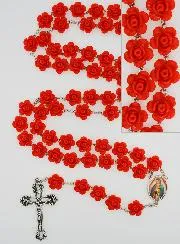
On 12 December, while Juan Diego is looking for a priest for his dying uncle, Mary appears to him again. She tells him that his uncle is already cured and sends him to gather roses on the arid summit of Tepeyac.
In the middle of winter, Juan Diego discovers Castilian roses, impossible to find at this time of year and in this place. He gathers them in his tilma (coat made of agave fibres) and returns to see the bishop.
The revelation of the miraculous image
When Juan Diego opens his tilma, the roses fall to the ground.
But above all, a prodigy stuns the witnesses:
On the cloth suddenly appears an image of the Virgin, intact, alive, with mixed-race features, surrounded by symbols understandable to the natives.
The bishop, moved and convinced, falls to his knees. A small church was soon built on the site of the apparitions.
An image that speaks to the peoples
The image of Our Lady of Guadalupe is a veritable theological and cultural language:
The brown skin: Mary appears as a mother close to the indigenous peoples.
The black belt: Aztec sign indicating that she is pregnant - Mary is carrying Jesus in her womb.
The stars on her cloak: correspond to the winter solstice sky map of 1531.
The moon beneath her feet and the sun behind her: symbols that go beyond the Aztec deities, showing that she is the Mother of the one God.
The four-petalled flower on her tunic: symbol of the supreme God for the Aztecs.
Through her image, Mary addresses a wounded, humiliated, lost people. She speaks their language.
The fruits of the apparitions: conversion without violence
After the apparitions, an extraordinary thing happened:
nearly 9 million indigenous people asked for baptism in ten years.
The Virgin of Guadalupe brought about a reconciliation between Spaniards and Indigenous people and became the Mother of a new people, announcing an authentically peaceful evangelisation.
Juan Diego: faithful witness
Juan Diego devotes his life to welcoming pilgrims and recounting what happened. He lived in a small house near the chapel built on Tepeyac.
He died in 1548, aged 74, surrounded by a great reputation for holiness.
He was canonised by St John Paul II on 31 July 2002, becoming the first indigenous saint of the Americas.
The message of Guadalupe today
Our Lady of Guadalupe is today:
the patroness of the Americas,
the Mother of the indigenous peoples,
a symbol of unity, compassion and gentle evangelisation,
a powerful sign of Mary's maternal presence in history.
Her message lives on:
"Am I not here, I who am your Mother?
These words addressed to Juan Diego continue to console millions of believers throughout the world.