The pilgrimage to Santiago de Compostela has its roots in the heart of the Middle Ages, at a time when Christianity was seeking to affirm its faith and gather around holy places. After Jerusalem, the Holy Land and Rome, the shrine of Compostela was to become one of the greatest spiritual centres in the West. The figure of the apostle James the Greater, disciple of Christ and first martyr of the apostles, became the pivot of this devotion.
Jacques, son of Zebedee and brother of the apostle John, had witnessed the Transfiguration and the agony of Jesus in Gethsemane. After the Resurrection, he set off to evangelise, and according to tradition, he preached in Spain. Returning to Jerusalem, he was put to death by King Herod Agrippa around 44 AD. His disciples are said to have transported his body by boat to the Galician coast, then buried it in a field in the region.
The miraculous discovery of the tomb
For several centuries, the apostle's tomb remained hidden and forgotten. It was in the early 9th century that a hermit named Pelagius had a vision. Guided by mysterious lights in a starry field - called "Campus Stellae", which later became "Compostela" - he discovered a sepulchre. Bishop Theodomir was alerted and had the relics officially recognised as those of the apostle James.
This revelation shook Christianity to its core. King Alfonso II of Asturias, known as "the Chaste", made a pilgrimage to the site, becoming the first royal pilgrim. He had a primitive church built over the tomb, establishing Compostela as a recognised shrine.
The development of medieval pilgrimage
Very quickly, pilgrimage to Compostela developed. In the 10th and 11th centuries, Christian Spain, struggling against Muslim occupation, found in the figure of Saint James a symbol of unity and reconquest. The battle cry "Santiago!" became the watchword of the Christian armies, associating the saint not only with faith but also with the defence of Christendom.
The Church, for its part, encouraged the pilgrimage as a work of penance and conversion. Coming to Compostela was a way of obtaining forgiveness for sins and getting closer to God. Numerous sovereigns and popes supported the construction of roads, bridges, hospitals and abbeys to accommodate pilgrims.
The basilica, enlarged over the centuries, became an architectural masterpiece. By the 12th century, it was already welcoming huge crowds from all over Europe. The roads to Compostela - the via Turonensis (Tours), the via Lemovicensis (Vézelay), the via Podiensis (Le Puy-en-Velay) and the via Tolosana (Arles) - were signposted and dotted with shrines and spiritual stops.
The symbolism of the pilgrimage
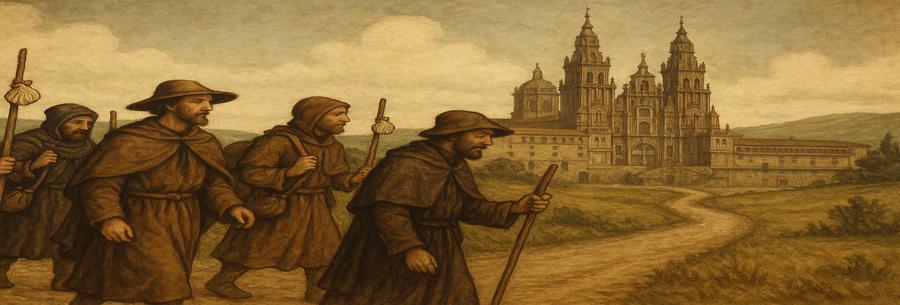
The pilgrimage to Compostela had a dual dimension. Firstly, it was an act of faith: walking hundreds of kilometres to the tomb of the apostle was a reminder of the path of the Christian life, made up of perseverance and hope. But it was also an act of community: men and women from all walks of life, nobles, monks, peasants and craftsmen, walked together towards the same goal, creating a unique fraternity.
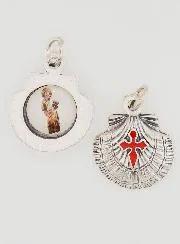
The best-known symbol of the pilgrim is the scallop shell, picked up on the beaches of Galicia. It became the emblem of the walkers, a sign of recognition and blessing. The shell also represented new life and the coming together of peoples towards a single centre.
Conclusion
The origin of the pilgrimage to Santiago de Compostela is therefore rooted in a triple dimension: an apostolic tradition (the preaching and death of James), a miraculous discovery (the rediscovery of his relics), and a spiritual and political development (the defence and unity of medieval Christendom). Even today, millions of pilgrims walk these paths, continuing a history that goes back more than a thousand years.