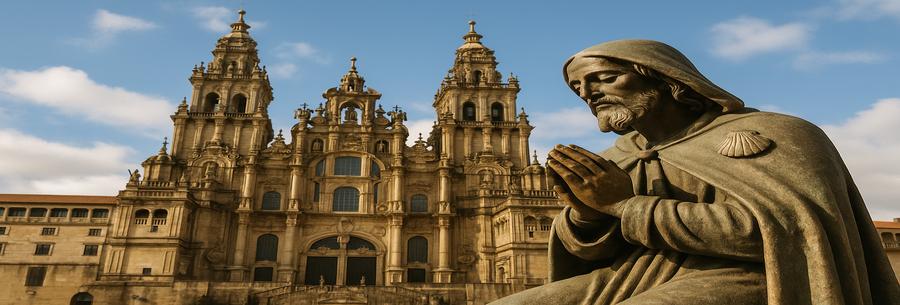
Saint James of Compostela, also known as James the Greater, was one of the twelve apostles of Jesus Christ. The son of Zebedee and brother of the apostle John, he was one of the first disciples called by the Lord. The Gospels present him as a fiery man, sometimes carried away, but deeply faithful. Jesus nicknamed him, along with his brother, "son of thunder", which no doubt reflects his passionate nature. James was one of the three privileged apostles who witnessed key moments in Christ's life, including the Transfiguration and the agony in the Garden of Gethsemane.
According to tradition, after Pentecost James set off to evangelise the West, reaching the Iberian Peninsula. His ministry in Spain remains difficult to establish historically, but it is at the heart of the Compostela devotion. After preaching, James returned to Judea, where he was martyred around 44 AD under King Herod Agrippa. He was beheaded in Jerusalem, thus becoming the first martyred apostle. According to tradition, his disciples carried his body to the shores of Galicia in Spain, where he was buried.
The discovery of the tomb and the birth of a pilgrimage
In the early 9th century, tradition has it that a hermit named Pelagius was guided by mysterious lights into a starry field, the "campus stellae", from which the name Compostela is said to have come. Bishop Theodomir of Iria Flavia recognised that this was the tomb of the apostle James. This discovery gave rise to one of the greatest Christian pilgrimages of the Middle Ages.
King Alfonso II of Asturias was one of the first to visit the tomb, thus establishing official recognition of the shrine. A basilica was soon erected to welcome pilgrims, and Compostela became one of the three great pilgrimage sites of Christendom alongside Rome and Jerusalem.
The Pilgrim's Way to Compostela
The pilgrimage to Santiago de Compostela, known as the "Camino de Santiago", developed over the centuries. Routes were traced throughout Europe, coming from France, Germany and Italy and converging on Galicia. Four major routes crossed France: the Tours route, the Vézelay route, the Puy-en-Velay route and the Arles route. All these routes came together to cross the Pyrenees and lead to the cathedral of Santiago de Compostela.
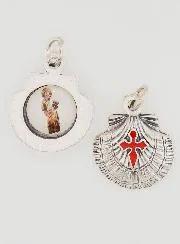
In the Middle Ages, walking to Compostela was both an act of faith and penance. Pilgrims wore the scallop shell as a distinctive sign, a symbol that evoked both the resurrection and the road travelled. The roads to Compostela also became a meeting place for peoples, cultures and nations, forging a genuine spiritual unity in Christian Europe.
Spiritual and cultural importance
The pilgrimage to Santiago de Compostela is not just a physical walk, but an inner journey. Each stage is an invitation to meditation, prayer and self-denial. It is a journey that transforms pilgrims, leading them to reflect on the meaning of their lives, purify their hearts and draw closer to God.
Culturally, the roads to Compostela have given rise to an exceptional heritage: Romanesque churches, abbeys, bridges, pilgrim hospitals and entire villages have developed thanks to this spiritual movement. Romanesque art in particular flourished on the roads to Compostela.
Today, pilgrimage continues to attract millions of people every year, believers and non-believers alike. The walk to Compostela retains this universal character: it is at once an act of faith, a quest for inner peace, a personal challenge or a human adventure.
The Feast of Saint James
Saint James the Greater is celebrated on 25 July. This solemnity is particularly celebrated in Galicia, where he is the patron saint. During the "Holy Years" - when 25 July falls on a Sunday - Compostela becomes an exceptional gathering place. On this occasion, the holy door of the cathedral is opened, and many pilgrims flock to obtain the indulgences associated with this jubilee.
Saint James of Compostela represents much more than an apostle: he has become the symbol of a journey of faith, fraternity and hope. His shrine remains a spiritual beacon for the whole world, reminding us that the Christian life is itself a pilgrimage, a journey towards God.