When silence speaks louder than words
Among all the gestures Jesus makes during his public life, the washing of his feet undoubtedly remains one of the most striking. It is neither a spectacular miracle nor a complex theological teaching. It was a simple, concrete gesture, almost commonplace at the time. And yet, that evening, in the Last Supper room, this gesture became a summit. It reveals the whole heart of God. It heralds the cross. It transforms the way we love.
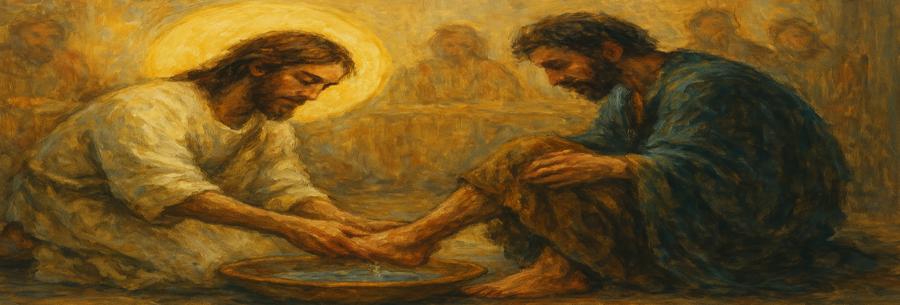
That evening, Jesus did not give a long speech on service, humility or charity. He stands up. He takes a towel. He pours water. He kneels down. And he washes the feet of his disciples, one by one. This gesture, more than a symbol, is an action full of truth. It moves. It teaches. It touches.
The gesture of a servant, performed by the Master
In Jewish culture, washing feet was a task reserved for servants, often the humblest. The roads were dusty, the feet dirty, the sandals open. You didn't wash the feet of an equal, let alone a superior. And now Jesus, the Master, the Lord, bends down to touch the dirt, to purify what is tired, wounded, worn.
He could have talked about service, given a definition of it, explained what love is in deed. But he preferred to do so. Not in a distant way, but by getting involved, physically, silently. This gesture, done quietly, contains the whole logic of the Gospel: to make oneself small, to make oneself close, to make oneself a gift.
A love that does not shrink from dust
What is striking about this washing of the feet is that Jesus does not sort. He doesn't just wash those who love him. He also washes the feet of Judas, the man who is going to betray him. He washed the feet of Peter, who would deny him. He washes the feet of the other disciples, who will run away. He does not pretend not to know. He loves knowingly.
This gesture tells us that God does not shrink from our dirt. He does not turn away from our betrayals, our inconsistencies, our evasions. He comes to kneel at our lowest point, where we would be ashamed to let him see us. And there, without judgement, he washes. He lifts us up. He blesses.
God's love is not afraid of what is damaged. It does not stand at a distance. It touches. He comes to heal through tenderness. He comes to us where no one else would.
A gesture to be imitated, not just admired
After washing his disciples' feet, Jesus rises and says to them, "You call me Teacher and Lord, and you are right, for I am. If then I, the Lord and Teacher, have washed your feet, you also ought to wash one another's feet." This gesture is not just something to contemplate. It is an invitation. A way of life. A mission.
It's not about reproducing the gesture literally every day. It's about living in the same spirit. To become, each in our own place, people capable of leaning in. To listen. To serve without expecting anything in return. To humble ourselves not out of obligation, but out of love.
In a world often marked by the race for recognition, by pride, by the fear of losing one's place, this gesture shakes up our reference points. It shows us that true greatness does not lie in what we possess or in what we know, but in the capacity to love concretely, silently, faithfully.
A gesture that foreshadows the cross
This gesture of foot washing is not isolated. It prepares for what is to come. Jesus doesn't just bend down. He is going to give everything. He is going to give his life. The cross is already there, in the making, in this silent moment. Jesus begins to lower himself so that we may be lifted up. He descends to the lowest depths to reach us in our wounded humanity.
The washing of the feet is a living parable of the Passion. It is its threshold, its gentle entrance. It already says everything about what Jesus will experience on the cross: a love that surrenders itself, that does not judge, that offers itself to the end.
Conclusion
The washing of the feet is not a detail of Holy Thursday. It is the heart of it. It is a gesture more powerful than any speech. A gesture that expresses the essence of Christian love. A humble, concrete, silent love. A love that stoops to lift itself up. A love that does not choose its recipients. A love that is embodied in hands, in water, in patience.
This gesture continues today. Every time someone chooses to serve in the shadows. Every time forgiveness is given without glitter. Every time a wounded heart is listened to without being judged. There, in secret, Christ's love continues. And his gesture continues to speak.