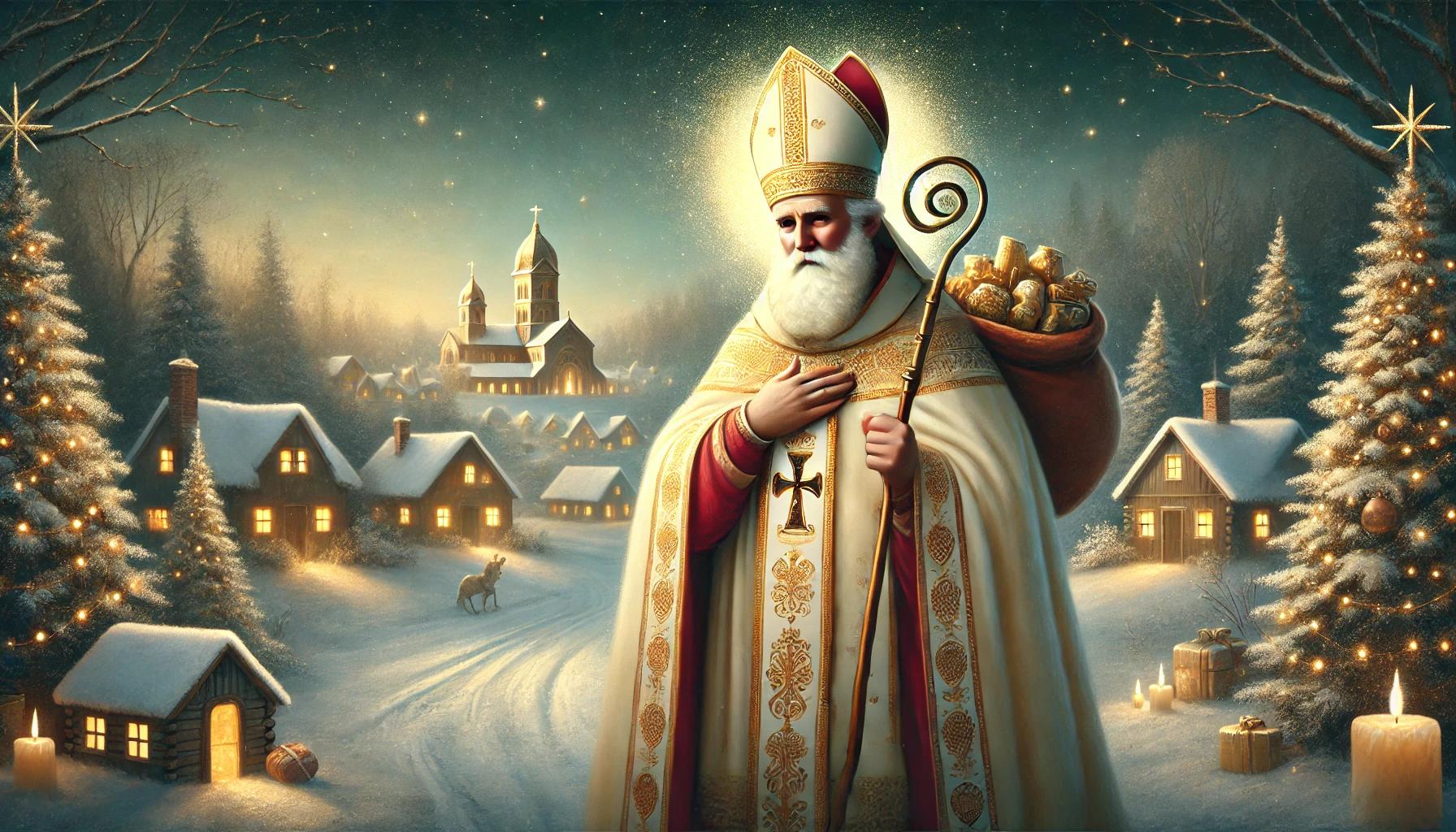
St Nicholas, one of Christianity's most popular saints, is celebrated for his charity, compassion and defence of the weakest. Bishop of Myre in the IVᵉ century, he is best known for his many acts of kindness and for the legends that have made him a key figure of the Advent and Christmas seasons. His feast day, 6 December, is a particularly joyous one, marked by traditions that vary around the world. Here is an in-depth look at the life, miracles and legacy of Saint Nicholas.
The life of Saint Nicholas
Origins
Nicolas is said to have been born around 270 in Patara, a town in the region of Lycia in Asia Minor (now in Turkey). Born into a wealthy Christian family, he lost his parents in his youth to an epidemic. Heir to a large fortune, he chose to devote his life to God and charity.
Bishop of Myre
Nicolas was appointed Bishop of Myre (present-day Demre, Turkey). He distinguished himself by his pastoral zeal, devotion and commitment to the poor and oppressed. He is said to have participated in the First Council of Nicaea in 325, where he defended the Christian faith against the Arian heresy.
Miracles of Saint Nicholas
Numerous miracles are attributed to him, contributing to his reputation as the patron saint of children, sailors, travellers and the poor.
1. The rescue of the young girls
The legend tells of Nicholas saving three young girls from poverty and shame. Their father, unable to provide them with a dowry, was planning to sell them into slavery. Nicholas, learning of their situation, secretly threw gold purses through their window during the night, thus enabling them to marry. This miracle is the origin of the tradition of distributing gifts in honour of Saint Nicholas.
2. The resurrection of the three children
Another famous legend relates that Nicholas resurrected three children who had been killed and put in the salting tub by a malevolent butcher. This miracle reinforced his role as protector of children and the innocent.
3. Saving sailors
Nicolas is also venerated as the patron saint of sailors. One story has it that he calmed a storm on the open sea with his prayers, saving a crew in distress. Since then, sailors have invoked his name for safe navigation.
4. Freeing the innocent
Nicolas is said to have interceded to save three men unjustly sentenced to death, proving his commitment to justice and truth.
The veneration of Saint Nicholas
1. In the East
St Nicholas is particularly venerated in the Orthodox Church, where he is nicknamed "Nicholas the Thaumaturge" because of his many miracles. His relics, transferred to Bari (Italy) in 1087, still attract pilgrims from all over the world today.
2. In the West
In medieval Europe, his popularity spread rapidly. He became the patron saint of many nations and professions, including children, sailors, travellers and merchants. His feast day, 6 December, is celebrated with processions, masses and local traditions.
St Nicholas and Christmas traditions
1. The transformation into Father Christmas
The legend of Saint Nicholas, combined with local traditions, evolved into the figure of Father Christmas in English-speaking countries. This process was particularly marked by the Dutch colonists who brought the figure of "Sinterklaas" to America in the XVIIᵉ century.
2. Gifts and sweets
The tradition of handing out gifts and sweets on St Nicholas Day is particularly alive in many European countries. For example:
In Germany and Austria, children leave their shoes outside the door to find them filled with sweets and small gifts.
In France, especially in the east, Saint Nicholas is accompanied by Père Fouettard, who reminds people of the importance of being good.
In the Netherlands, "Sinterklaas" arrives by boat, accompanied by his assistants, to distribute gifts to children.
3. Saint Nicholas markets
In many European cities, Christmas markets have their roots in the fairs organised for the feast of Saint Nicholas. These markets offer crafts, decorations and culinary specialities, extending the saint's spirit of generosity.
The spiritual message of Saint Nicholas
1. Charity
St Nicholas is above all an example of generosity and love of neighbour. He reminds us of the importance of sharing our resources with those in need, especially during the Advent and Christmas seasons.
2. Protecting the innocent
Through his miracles, Nicholas shows himself to be a defender of the most vulnerable: children, the poor, and the oppressed. His example invites us to protect the rights and dignity of all.
3. Faith and prayer
Nicolas is also a model of deep faith and constant prayer. His life demonstrates that faith can work miracles and bring hope even in the most desperate situations.
Conclusion
St Nicholas is much more than a legend or folk figure: he is a timeless model of charity, justice and faith. His legacy continues to shine through the traditions associated with him and the values he embodies. In celebrating his feast day, we are invited to follow his example by spreading love, generosity and hope in our lives and in the lives of others. May the spirit of Saint Nicholas illuminate this Advent and Christmas season, reminding us that the true meaning of this season lies in giving and sharing.