Discover the Gospel of the Day, a Christian reflection on the parable of the talents, faithfulness and the gifts entrusted by God.
Gospel of the Day – Wednesday 18 November 2026
The Gospel according to Saint Luke (Lk 19:11–28)
“ ‘It is I who have chosen you, so that you may go forth, bear fruit, and that your fruit may remain.’
On this Wednesday of the 33rd week in Ordinary Time, the Church presents us with the parable of the talents. Jesus is near Jerusalem and his listeners imagine that the Kingdom of God is about to appear immediately, in a spectacular manner. He then tells them the story of a man who sets off to be crowned king and who entrusts a sum of money to each of his servants. On his return, he asks them what they have done with what had been entrusted to them.
Today’s Gospel speaks to us of trust, responsibility and fruitfulness. God gives each of us a share of his gifts: life, time, human qualities, faith, the capacity to love, to serve, to forgive or to comfort. These gifts are not meant to be buried out of fear; they are meant to become a source of good for those around us.
The Catholic liturgy thus invites us to ask ourselves a simple yet profound question: what are we doing with what God has placed in our hands?
The Parable of the Minas: a call to faithfulness
In Saint Luke’s account, the master gives each of his servants the same sum. He does not ask them to accomplish the impossible, nor to succeed by human standards. He entrusts something to them and gives them a mission: to bring to life what they have received.
The first servant made his trust grow abundantly; the second did so too, though with a different result. Both are recognised for their faithfulness. The master does not harshly compare them with one another: he considers the way in which each has responded to the trust placed in them.
This is a precious aspect of Christian reflection on this Gospel. God does not ask us to replicate the lives of others. He does not ask us to have the same talents, the same opportunities, the same health, the same life journey or the same responsibilities. He calls each of us to make what has been entrusted to us grow, at our own pace.
For one person, this might mean listening attentively to someone who is suffering. For another, it may be quiet faithfulness in their daily work. For a family, it might be passing on the faith, learning to forgive, showing patience in the face of difficulties, or welcoming someone who is isolated. For someone going through a trial, the first fruit may simply be not losing faith and continuing to pray.
God sees these hidden fruits that the world does not always notice.
Do not let fear bury our gifts
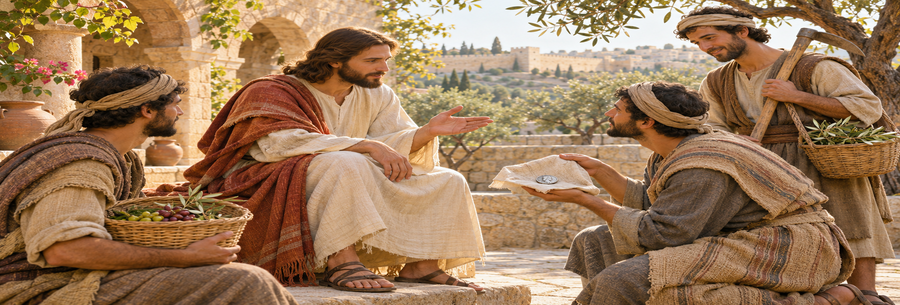
The third servant keeps his talent wrapped in a cloth. He did not want to lose it, but neither did he dare to use it. He explains his attitude by citing fear.
Fear is often what paralyses the heart. Fear of not knowing how to do something, of making a mistake, of being judged, of not measuring up, of committing to a relationship, of asking for forgiveness, or of starting again after a failure. We may then be tempted to set aside our abilities, our generous impulses and even our faith.
Yet the Gospel does not call us to a perfect, risk-free existence. It invites us to trust. God does not entrust us with gifts so that they remain locked away, but so that they may become a means of service, sharing and hope.
Making the most of the gifts we have received does not mean seeking success at any cost, accumulating wealth or comparing ourselves with others. In the light of the Gospel, it is rather a matter of allowing love to grow. A word of comfort, a faithful prayer, help offered without expecting anything in return, a reconciliation begun with humility: these are the fruits that endure.
It is good to ask ourselves today: what gift might I have neglected? A capacity to forgive? A talent I could put at the service of others? A desire to pray? A word of peace that I dare not speak? The Lord does not ask us to accomplish everything in a single day. He invites us to take a first step.
The Kingdom of God grows over time
Those who listened to Jesus were hoping for an immediate manifestation of the Kingdom. Jesus prepares them to understand that the Kingdom of God does not impose itself as a visible power. It often begins humbly, over time, through hearts that choose truth, justice and charity.
Between the Master’s departure and his return, there is a time of responsibility. This is also our time: the time when the Church proclaims the Gospel, when Christians are called to bear witness through their actions, their words and their way of life.
The Kingdom becomes visible when a person chooses not to respond to violence with violence, when a family remains united in the face of adversity, when a sick person offers their suffering in prayer, when a believer holds on to hope despite discouragement, when a neighbour looks after another.
We must never look down on the small things done with love. Jesus shows us that faithfulness in simple matters prepares the heart to receive more. A faith lived out in daily life, quietly but with perseverance, often bears fruit far greater than we can imagine.
Understanding the difficult words of the parable
The ending of this parable may come as a surprise due to its severity. It is important to remember that this is a figurative story, set in the context of a king returning to take possession of his kingdom. Jesus never calls on his disciples to resort to violence. Throughout the Gospel, he teaches forgiveness, mercy, love for one’s enemies and the rejection of vengeance.
The heart of the passage is the call to welcome Christ as King of our lives. This does not mean submitting to domination; it means recognising that his reign is a reign of love, truth and peace. To let Jesus reign in our hearts is to choose not to give priority to selfishness, fear, indifference or resentment.
The parable thus becomes an invitation to live out an active faith. Christ entrusts us with his Word and his love. He calls us to let them shine forth in our homes, our work, our relationships and our daily choices.
Christian meditation for today
Today, we can present to the Lord everything He has given us: our joys as well as our frailties, our strengths as well as our limitations, our plans as well as our worries.
Perhaps we feel we possess only a small ‘treasure’, that is to say, few resources or little strength. Yet, in God’s hands, even what seems small can bear fruit. A little patience can bring peace to a family. A daily prayer can sustain someone in distress. A gesture of generosity can restore hope. A word of faith can open up a path.
Let us ask the Lord to free us from the fear that closes our hearts. May he grant us the grace to recognise the gifts we have received and to use them with simplicity, not for our own glory, but for the good of those he places in our path.
Prayer based on the Gospel of the day
Lord Jesus,
you have entrusted to me life, faith, time and the capacity to love.
Teach me not to bury the gifts you have given me.
Deliver me from the fear that holds me back
and grant me a faithful heart in the little things.
May my words, my actions and my prayers
bear fruit in peace, goodness and hope.
Help me to serve without seeking recognition,
to give generously
and to welcome your presence in my life every day.
Amen.
FAQ – Gospel for 18 November 2026
What is the Gospel for 18 November 2026?
Today’s Gospel is taken from Saint Luke, chapter 19, verses 11 to 28. In it, Jesus tells the parable of the talents entrusted to servants before their master’s departure.
What does the mina represent in this parable?
The mina symbolises everything that God entrusts to each of us: life, faith, talents, time, human qualities and the capacity to love and serve.
What does it mean to make God’s gifts bear fruit?
To make the gifts we have received bear fruit means to put them at the service of good: to love, to help, to forgive, to spread hope, to work honestly and to remain faithful in prayer.
Why is the third servant rebuked?
The third servant allowed fear to prevent him from acting. The parable invites us not to shut ourselves away in fear, but to trust in God and dare to live out our faith in practical ways.
What is the Catholic feast day on 18 November?
On 18 November 2026, the Church also observes the optional memorial of the dedication of the Basilicas of Saints Peter and Paul in Rome. The liturgy for the day features the Gospel reading from Luke 19:11–28.