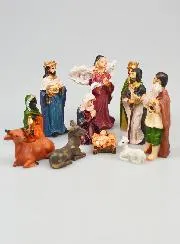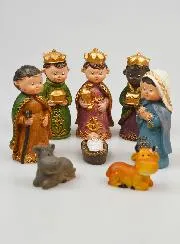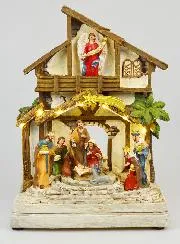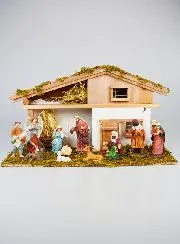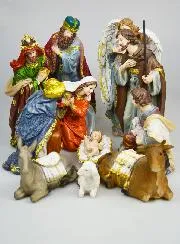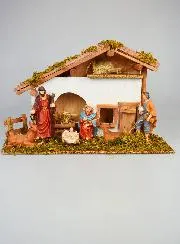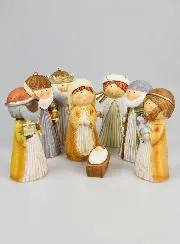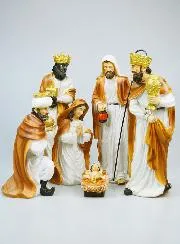
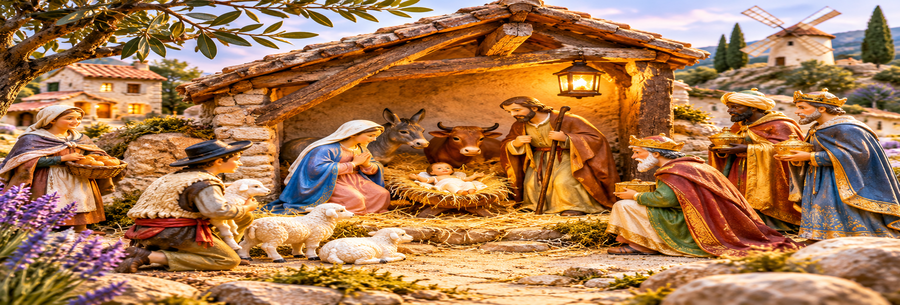
Find out how to set up a santon nativity scene at home: essential figures, choosing your santons, Provençal décor and tips for enhancing your Christmas nativity scene.
How to start your own santons nativity scene at home? A guide to creating a lovely Christmas tradition
Setting up a santons nativity scene at home is much more than just a Christmas decoration. It is a tradition deeply rooted in Christian and Provençal culture, a time for family togetherness and a lovely way to prepare your heart for the birth of Jesus.
Every year, as Christmas approaches, young and old alike enjoy bringing out their santons, imagining new scenes and bringing a whole Provençal village to life around the Holy Family. Some people have impressive nativity scenes, comprising dozens of figures, houses and backdrops. Others start with just a few santons.
But how do you go about creating your first santon nativity scene? Which figures should you buy first? What size should you choose? How can you create a lovely display without spending a fortune? And how can you gradually expand your collection?
Here is a comprehensive guide to help you create your first nativity scene, even if you’re short on space or on a tight budget.
1. Why start a nativity scene at home?
The nativity scene depicts the birth of Jesus in Bethlehem. It commemorates this founding event of the Christian faith: God becoming man and coming into the world in the humility of a manger.
According to tradition, it was Saint Francis of Assisi who, in 1223, organised a live nativity scene in Greccio, Italy, to help the faithful contemplate the mystery of Christmas.
Over the centuries, this tradition has spread to many countries, taking on different forms depending on the culture.
In Provence, it has given rise to a particularly endearing world: that of the santons.
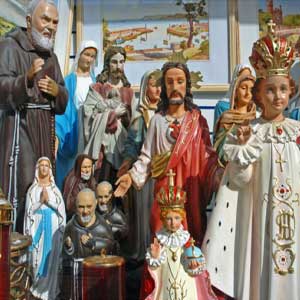
The word ‘santon’ comes from the Provençal santoun, which means ‘little saint’. These figurines depict not only the biblical characters of the Nativity, but also the inhabitants of Provençal villages: shepherds, craftsmen, farmers, merchants, musicians and folk figures.
All seem to be making their way to the stable to welcome the Baby Jesus.
Creating a santon nativity scene at home thus brings together three essential aspects:
A spiritual dimension, by placing the birth of Christ at the heart of the Christmas celebrations.
A family dimension, by sharing a moment of creativity and passing on traditions between generations.
A cultural dimension, by keeping alive artisanal craftsmanship and a Provençal tradition dating back several centuries.
A nativity scene doesn’t need to be large to be beautiful. Just a few carefully arranged santons are enough to create a warm and meaningful atmosphere.
2. Which are the essential santons to start your nativity scene with?
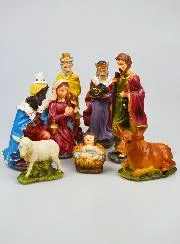
When starting a collection of Provençal santons, it is best to begin with the essential Nativity figures.
There’s no need to buy twenty figurines straight away. A small nativity scene comprising five to eight figures can already look very harmonious.
The Holy Family: the heart of your nativity scene
The Virgin Mary
Mary occupies a central place in the nativity scene. Usually depicted kneeling or sitting beside her child, she symbolises maternal tenderness, humility and trust in God.
Saint Joseph
Saint Joseph watches over Mary and Jesus. Often depicted standing, holding a staff or a lantern, he embodies protection, faithfulness and devotion to family.
The Baby Jesus
The Baby Jesus is, of course, the central figure in the nativity scene. He lies in a manger lined with straw, a reminder of the simplicity of his birth.
In many Christian families, a lovely tradition is to leave the manger empty during Advent and to place the Baby Jesus in it on the night of 24th to 25th December.
The ox and the donkey: two traditional animals
The ox and the donkey traditionally accompany the Holy Family.
Although they are not explicitly mentioned in the Gospel accounts of Jesus’ birth, their presence is deeply rooted in Christian iconography.
They also lend a touch of tenderness and realism to the Nativity scene.
The first shepherds and their sheep
The shepherds play an important role in the Christmas story. According to the Gospel of Saint Luke, they were among the first to receive the news of the Saviour’s birth.
To begin with, you could choose a shepherd accompanied by two or three sheep.
These figures allow you to create an initial scene around the stable and add depth to your nativity scene.
The Three Wise Men: a lovely addition for Epiphany
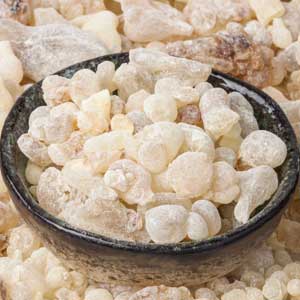
Melchior, Caspar and Balthazar are traditionally depicted bringing gold, frankincense and myrrh to Jesus.
You can add them in the first year or wait until the following year to complete your collection.
One tradition is to place them some distance from the stable at the start of Advent, then gradually move them closer until Epiphany.
3. What size santons should you choose for your first nativity scene?
This is one of the most important questions to consider before starting a collection.
Provençal santons come in several sizes, usually measured in centimetres. This measurement corresponds to the approximate height of a standing adult figure.
Common sizes include 4 cm, 6 cm, 7 cm, 8 cm and 10 cm santons, as well as larger models.
6 cm santons: ideal for a small nativity scene
6 cm santons are particularly suitable for those with limited space.
They allow you to create a pretty Provençal village on a chest of drawers, a shelf or a small piece of furniture.
Their main advantage is that they allow you to gather many figures within a relatively compact setting.
They are also an excellent choice for starting a collection that you wish to expand gradually.
8 cm santons: an excellent compromise
8 cm santons make a striking visual impression whilst remaining easy to display.
Their details are generally more visible, and they allow you to create expressive scenes featuring shepherds, craftsmen, animals and traditional figures.
This size is particularly well-suited to family nativity scenes displayed on a sideboard or a dedicated table.
10 cm and larger santons: for large nativity scenes
Large santons are particularly suitable when you wish to create a spacious display.
They allow you to showcase the costumes, expressions and details of the figures.
However, they take up more space and require proportionate houses, stables and accessories.
Our advice: choose a main size from the outset and stick to it for future purchases. This will allow you to expand your nativity scene each year without creating overly significant differences in proportions between the figures.
4. Where should you set up your santon nativity scene in the house?
Choosing the right location is essential to show off your nativity scene to its best advantage and enjoy it throughout the Christmas period.
You don’t need an entire room. A small, well-organised space may be enough.
On a sideboard or chest of drawers
This is one of the most practical places.
You can place a small stable in the centre, arrange the figures on either side and create a few paths using decorative sand or small pebbles.
This arrangement is particularly suitable for nativity scenes measuring 6 or 8 cm.
At the foot of the Christmas tree
Placing the nativity scene near the Christmas tree brings together two great Christmas traditions.
The light from the fairy lights creates a cosy atmosphere, whilst the santons remind us of the Christian significance of the festival.
However, do ensure you protect the fragile figurines and keep them at a safe distance from electrical installations.
On a table set aside especially for it
If you’d like to gradually build up a proper Provençal village, a table reserved for the nativity scene is an excellent solution.
You can add houses, paths, hills, trees, fountains and numerous figures.
Ideally, choose a stable location, sheltered from damp and high footfall.
5. How can you easily create the setting for your first nativity scene?
One of the great joys of the Provençal nativity scene is imagining and building your own landscape.
You don’t need to be particularly handy to achieve a successful result.
Just a few simple materials are enough to create a natural and authentic atmosphere.
Start with a stable or a cave
The stable forms the centrepiece of your display.
You can choose a small wooden structure, a cork cave or a pre-decorated stable.
Ideally, place it at the back of your display, slightly raised if space allows.
It should remain the main focal point of your nativity scene.
Creating the ground for your Provençal village
To make your scene look realistic, you can use various materials:
Crumpled kraft paper to create texture.
Cork to represent rocks and hills.
Decorative sand to mark out paths.
Small pebbles to mark out the paths.
Artificial decorative moss to represent vegetation.
A few twigs and branches to suggest trees.
Choose materials that are clean, dry and stable, particularly if your nativity scene is set up on a wooden piece of furniture.
Add a few elements of vegetation
Provence naturally brings to mind olive trees, cypresses, hills and Mediterranean landscapes.
A few miniature trees are enough to give your display character.
You could also add a small well, a fountain or a low stone wall.
The aim is not to overload the scene with accessories, but to create a cohesive whole that showcases the santons.
Playing with light
Soft lighting instantly transforms the atmosphere of a nativity scene.
A small string of warm-coloured LED lights can be hidden behind the stable or along a path.
For added safety, opt for LED lights that do not get very hot and avoid open-flame candles near paper, wood, foam and other decorative materials.
6. Which Provençal santons should you add after the Holy Family?
Once the main figures are in place, you can begin to explore the wonderful world of traditional santons.
The distinctive feature of the Provençal nativity scene is that it depicts an entire village making its way towards the Baby Jesus.
Each santon tells a story, represents a trade or evokes a folk tradition.
Le Ravi: an iconic figure
Le Ravi is one of the best-known santons in Provence.
Usually depicted with his arms raised towards the sky, he expresses a simple and spontaneous joy at the birth of the Saviour.
He symbolises wonder, trust and the ability to welcome the good news of Christmas with a child’s heart.
The Washerwoman
The Washerwoman depicts a woman busy washing clothes.
Often depicted with a basket or a piece of cloth, she evokes everyday life in the Provençal villages of yesteryear.
She naturally finds her place near a washhouse, a fountain or a small stream.
The Miller
With his sack of flour, the miller serves as a reminder of the importance of bread and traditional trades.
He can be placed near a mill or on a path leading to the barn.
The baker
The baker brings a particularly warm touch to the nativity scene.
He evokes the work of artisans and the simplicity of village life.
The fisherman
The fisherman, often depicted with a net or a basket of fish, evokes the villages of the Mediterranean coast.
He helps to add variety to the scenes and introduce a small water feature into larger nativity scenes.
The shepherd and his flock
Even if you already have a shepherd, it’s worth gradually adding more.
Some carry a lamb on their shoulders, whilst others hold a crook or walk alongside their sheep.
They allow you to create magnificent pastoral scenes on the hills surrounding the Nativity scene.
The musicians
Drummers, flute players and other Provençal musicians bring joy and liveliness to the village.
They symbolise the celebration and joy that accompany the birth of Christ.
All these figures can be added over the years, depending on your preferences and the space available.
7. How should you arrange the santons to create a beautiful Christmas scene?
A successful nativity scene does not depend solely on the number of figurines. Their arrangement plays a key role.
To create a harmonious composition, start by placing the Holy Family in the stable.
Then position the ox and the donkey near the manger.
The shepherds and sheep can be placed at the sides, slightly set back.
The other Provençal figures take their places along the paths, as if they were all heading towards Bethlehem.
Creating multiple levels
If you have enough space, feel free to create small hills.
These help to add depth to the scene and make the figures at the back more visible.
However, make sure you keep the surfaces stable to prevent the santons from falling over.
Direct the figures towards the Nativity
One of the secrets to a beautiful nativity scene is to naturally direct the figures’ gaze and movements towards the Baby Jesus.
The shepherds can make their way towards the stable, the villagers can follow the paths, and the Three Wise Men can arrive from further afield.
In this way, the entire scene tells a story: that of a people coming to welcome their Saviour.
Don’t overcrowd your nativity scene
When you start a collection, it’s tempting to want to add lots of figures.
However, a nativity scene that’s too crowded can lose its charm.
Leave enough space between the figurines so that each scene remains visible.
A simple, well-balanced and beautifully lit arrangement will often be more pleasing than an overly dense display.
8. Should you choose santons made of clay, resin or PVC?
The choice of material depends on your preferences, your budget and how you intend to use them.
Traditional clay santons
Terracotta santons are emblematic of Provençal craftsmanship.
They may be hand-painted and often feature a wealth of detail.
They are particularly prized by collectors and enthusiasts of regional traditions.
However, they remain relatively fragile and must be handled with care.
Resin santons
Resin santons generally offer fine detail and a wide variety of designs.
They are an attractive option for creating a decorative nativity scene.
However, their durability depends on how they are made and the delicacy of the figures depicted.
PVC santons
PVC santons are particularly practical for families wishing to start an affordable and easy-to-handle collection.
Lightweight and durable, they are well suited to nativity scenes that are set up and taken down every year.
Some models feature intricate detailing and vibrant colours, allowing you to create very attractive Provençal nativity scenes.
The most important thing is to choose santons that you like and that suit your project. A modest nativity scene, created with care and affection, is just as meaningful as a large collection.
9. How do you start a santon nativity scene on a tight budget?
It is by no means necessary to spend a large amount of money to create your first nativity scene.
The best approach is to take it step by step.
First year: the essential figures
Start with Mary, Joseph, the Baby Jesus, the ox, the donkey and a small stable. You could also add a shepherd and a few sheep.
Second year: the Three Wise Men
Complete your nativity scene with Melchior, Caspar and Balthazar, then a few more animals.
Third year: the first Provençal santons
Choose the Ravi, the washerwoman, the baker or a character that reminds you of your childhood.
In subsequent years: build your village
Add a house, a mill, a fountain, a few trees or some new figures.
This gradual approach allows you to keep your budget under control whilst still enjoying the pleasure of discovering new santons each year.
It also transforms your nativity scene into a genuine family collection, enriched over time.
10. Make setting up the nativity scene a family tradition
One of the most wonderful aspects of the santon nativity scene is its ability to bring generations together.
Children can help set up the scene, arrange the sheep, create the paths and choose where to place the figures.
Parents and grandparents can recount the story of the Nativity, explain the significance of the santons and share memories of their own Christmases.
When should you set up your nativity scene?
In many Christian families, the nativity scene is set up at the start of Advent, the four weeks leading up to Christmas.
This period of anticipation allows the home and our hearts to be gradually prepared for the birth of Jesus.
Some families add the figures as the weeks go by.
Others set up the entire display at the start of December, leaving the space for the Baby Jesus empty until Christmas.
A nativity scene that grows with the children
Giving a new nativity figure each year can become a lovely tradition.
At Christmas, a child might receive a shepherd, a washerwoman, a musician or an animal to complete the family nativity scene.
Over time, each figure becomes associated with a particular memory.
This collection can then be passed down from one generation to the next, like a small family heirloom steeped in emotion.
11. How should you store and protect your santons after Christmas?
To ensure your collection lasts for many years, it is important to store your santons carefully after the festive season.
Start by gently dusting them with a soft, dry brush.
Avoid harsh cleaning products, particularly on hand-painted santons.
Next, wrap each fragile figurine individually in tissue paper or a suitable protective material.
Store them in sturdy boxes, ideally with compartments, to prevent them from knocking against one another.
To make setting them up easier the following year, you can also sort your figures into groups: the Holy Family, shepherds, animals, craftsmen and villagers.
Store the santons in a dry place, away from significant temperature fluctuations and damp.
With a few precautions, a collection of santons can be enjoyed by a family for several decades.
12. The santon nativity scene: a beautiful way to pass on the true meaning of Christmas
Beyond its decorative aspect, the nativity scene is, above all, an invitation to contemplate the birth of Christ.
Provençal santons remind us that the good news of Christmas is for everyone.
Gathered around the Baby Jesus are figures from all walks of life: shepherds, craftsmen, merchants, peasants, people of humble means and travellers.
Each comes with what they have, with their own story and their work.
This popular depiction conveys a deeply Christian message: in God’s eyes, everyone has a place and dignity.
Setting up a nativity scene at home is therefore to welcome into one’s home a tradition that unites faith, family and the beauty of simple gestures.
It is also to create a space for contemplation, where one can take a few moments to pray, give thanks and prepare oneself inwardly for Christmas.
13. Frequently asked questions about setting up a nativity scene with santons
How many santons do you need to start a nativity scene?
You can start with just three figures: Mary, Joseph and the Baby Jesus. For a more complete nativity scene, add the ox, the donkey, a shepherd and a few sheep. There is no requirement to have a specific number of santons.
What size of santons should I choose to start with?
The 6 cm and 8 cm santons are particularly suitable for first nativity scenes. The 6 cm figures are suitable for small spaces, whilst the 8 cm ones allow you to appreciate the figures’ details more clearly.
Can you mix santons of different sizes?
It is best to maintain a consistent scale, particularly for the adult figures. However, slight differences can be used to create a sense of perspective by placing the smaller santons at the back of the scene.
Where can you buy your first Provençal santons?
You can find santons from santon-makers, at santon fairs, in shops specialising in Christmas decorations and in religious goods shops. Opt for collections that you can add to over the years.
Can you set up a Provençal nativity scene even if you’re not from Provence?
Of course. The Provençal nativity scene is a tradition open to everyone. It allows you to discover cultural heritage and craftsmanship whilst celebrating the Nativity.
When should the Baby Jesus be placed in the nativity scene?
According to a widespread Christian tradition, the Baby Jesus is placed in the manger on Christmas Eve, after midnight mass or on the morning of 25 December. This custom symbolises the anticipation of the Saviour’s birth during Advent.
When should the Christmas nativity scene be taken down?
Traditions vary depending on the family and the region. Some take down their nativity scene after Epiphany, whilst others keep it up until the Feast of the Presentation of the Lord on 2 February, also known as Candlemas.
How can you expand your nativity scene collection each year?
The simplest way is to choose one or two new figures each Christmas. You can also gradually add houses, trees, animals and accessories, whilst maintaining the same scale throughout your collection.
Conclusion: a first nativity scene today, a tradition for a lifetime
Starting a santon nativity scene at home is an adventure that is at once simple, creative and deeply endearing.
All it takes is a few figures, a small stable and a little imagination to create a charming Christmas display.
Over the years, your nativity scene can be enriched with new Provençal santons, little houses, animals and landscapes, each of which will tell a part of your family’s story.
But never forget what really matters: the beauty of a nativity scene is not measured by the number of its figurines, but by the prominence it gives to the birth of Jesus and the joy of Christmas.
Whether it consists of just a few figurines or an entire village, your nativity scene may well become one of the most cherished traditions in your home.
And every year, when you bring out your nativity figures, you will also rediscover a little of the magic of your past Christmases, the joy of moments shared, and that ever-renewed invitation to welcome the Baby Jesus into your home.