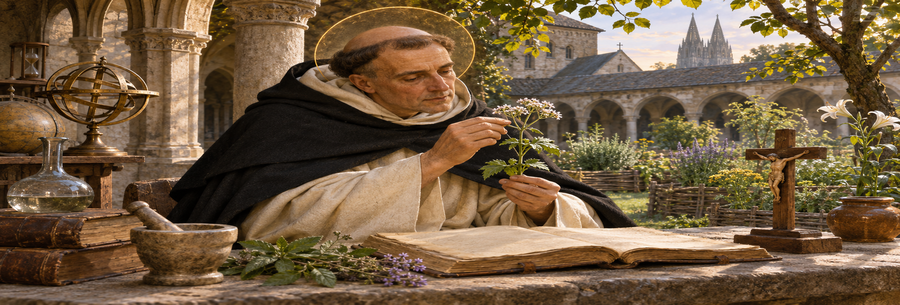
Discover Saint Albert the Great, a Dominican friar, bishop, teacher of Saint Thomas Aquinas and patron saint of scientists, whose feast day is 15 November.
Saint Albert the Great: faith, learning and wisdom in the service of God
On 15 November, the calendar of saints commemorates Saint Albert the Great, bishop and Doctor of the Church. In 2026, however, this optional memorial is superseded in the liturgy by the 33rd Sunday in Ordinary Time. Saint Albert nevertheless remains the saint proposed by the daily calendar and a remarkable figure of the Christian faith.
He is known as a great scholar of the Middle Ages, a teacher, theologian, philosopher and observer of nature. But it would be reductive to see him merely as a brilliant mind. Saint Albert the Great was first and foremost a man of God, a Dominican friar committed to poverty, a teacher attentive to his pupils, a humble bishop and a believer convinced that the search for truth leads to the Creator.
His witness is highly relevant today. In a world where faith is sometimes pitted against science, he reminds us that intelligence, when it remains humble, can become a true praise of God.
A young man drawn to learning and to God
Albert was born around the year 1200 in Lauingen, Bavaria. Coming from a noble family, he received a thorough education and went to study in Italy, notably in Padua. There he discovered the liberal arts, which at that time comprised grammar, logic, rhetoric, mathematics, geometry, astronomy and music.
He possessed remarkable intelligence and a great thirst for learning. Yet he gradually came to realise that knowledge alone was not enough to fulfil the human heart. He sought a path where study could be combined with prayer, fraternal life and the service of God.
He chose to join the Dominicans, also known as the Order of Preachers. This decision did not seem obvious to those around him. The Dominicans were then a relatively new order, characterised by evangelical poverty, preaching and theological study.
Albert realised that this vocation corresponded to his deepest desire: to seek the truth and pass it on, not for personal glory, but to help people come to know God better.
A master of faith and reason
After joining the Dominican Order, Albert was entrusted with numerous teaching assignments. In particular, he taught in Cologne and Paris, two major intellectual centres of medieval Europe.
In his day, the works of the Greek philosopher Aristotle were being rediscovered in the Latin world, often through translations and commentaries originating from the Arab world. This rediscovery sparked significant debates. Some feared that ancient philosophy would lead people away from the Christian faith.
Albert chose a different path. He did not reject the questions posed by reason. He sought to understand them, to explore them in greater depth and to shed light on them in the light of faith.
For him, truth cannot contradict itself. If God is the Creator of the universe and the source of all truth, the study of nature, matter, plants, animals or the stars can help humankind to admire the Creator’s work all the more.
St Albert thus demonstrates that it is possible to love God with all one’s heart, with all one’s soul and with all one’s mind.
A scholar attentive to creation
Saint Albert the Great took an interest in many fields: philosophy, theology, the natural sciences, botany, zoology, astronomy and the study of matter.
He observed nature with curiosity and precision. He was not content merely to repeat what ancient authors had written. He sought to observe, compare and understand. This approach, highly innovative for its time, explains why he is sometimes regarded as one of the forerunners of Western scientific research.
His interest in creation never diverted him from God. On the contrary, the universe appeared to him as an open book that speaks of divine wisdom. Plants, animals, stones, the seasons and the movements of the heavens all become signs inviting us to contemplate the beauty of God’s work.
This attitude can still inspire us today. Protecting creation, respecting all living things and marvelling at nature are not concerns alien to the faith. They can become a way of thanking God for the world he has entrusted to us.
The teacher of Saint Thomas Aquinas
One of the best-known aspects of Saint Albert’s life is his connection with Saint Thomas Aquinas. Thomas was his pupil in Paris, and later in Cologne. Albert very quickly recognised the exceptional intelligence of this young Dominican, whilst some of his fellow students underestimated him because of his silence and reserved nature.
Albert guided Thomas with kindness. He instilled in him a love of learning, intellectual rigour and a commitment to uniting faith with reason. Their relationship was that of a master and a disciple, but also one of genuine spiritual friendship.
After the death of Saint Thomas Aquinas, Albert was deeply moved. He also came to his defence when some of his ideas were challenged. This gesture reveals his loyalty and courage.
Saint Albert reminds us of the importance of teachers, educators and spiritual guides. A word of encouragement, a show of trust at the right moment, or patient guidance can help a person to develop the gifts that God has placed within them.
A humble bishop close to the poor
Albert would gladly have devoted his entire life to study and teaching. However, out of obedience, he agreed to become Bishop of Regensburg in 1260.
This was a difficult task. He arrived in a diocese marked by tensions and material hardships. Albert chose to live simply, without seeking the comforts or honours associated with his office. He often travelled on foot, faithful to the spirit of poverty of his religious order.
His way of life sometimes surprised people. Some expected a bishop to display pomp and outward power. Albert preferred simplicity, closeness to the poor and attention to the real needs of his diocese.
After a period of service, he was permitted to step down from his post as bishop and returned to Cologne. He then returned to teaching, prayer and the fraternal life of the Dominicans.
His example reminds us that every responsibility – whether family, professional, community-based or religious – must be lived as a service. True greatness does not consist in dominating, but in making oneself available to others.
Science does not replace God; faith does not fear the truth.
Saint Albert the Great is often invoked as the patron saint of scientists and researchers in the natural sciences. This patronage does not mean that science should be conflated with faith, nor that faith provides immediate answers to all scientific questions.
Science studies how the world works: it observes, experiments, measures and seeks to understand. Faith, on the other hand, sheds light on the ultimate meaning of existence, the vocation of humankind, the dignity of every person and the love of God revealed in Jesus Christ.
These two approaches are not at odds with one another. They address different questions and can enrich one another. Faith protects science from the risk of believing that humankind can control everything. Science also helps the believer to marvel even more at the complexity and beauty of creation.
Saint Albert invites us to seek the truth without fear, with humility and with respect for the mystery of God.
What Saint Albert the Great can teach us today
The life of Saint Albert the Great is an inspiration, first and foremost, to students, teachers, researchers and all those seeking to deepen their knowledge. Studying can be a way of serving God when one seeks the truth with honesty.
He also teaches us never to dismiss questions. Doubting, seeking to understand and asking for explanations are not necessarily signs of weakness in faith. They can mark the beginning of a deeper journey.
Saint Albert also reminds us that knowledge must remain humble. Great knowledge that does not become service can trap a person in pride. Conversely, an intellect offered to God becomes a means of helping, enlightening and building peace.
Finally, he invites us to contemplate creation. Taking the time to look at a flower, the sky, a tree, an animal or the patient unfolding of the seasons can become a silent prayer. The created world is not merely a resource to be exploited: it is also a gift to be welcomed and protected.
Prayer to Saint Albert the Great
Saint Albert the Great,
you who sought the truth
in prayer, study and the observation of creation,
pray for us.
Help us to love God
with all our heart, with all our soul
and with all our mind.
Grant students a love of learning,
teachers the patience to impart knowledge,
researchers humility in the face of mystery
and each of us the desire to serve.
Teach us to contemplate the beauty of the world
as a sign of the Creator’s wisdom.
Saint Albert the Great,
patron saint of scientists,
grant us an enlightened faith,
a generous mind
and a humble heart.
Amen.