Discover the meaning of the 33rd Sunday in Ordinary Time and the parable of the talents: to welcome God’s gifts, to make them grow, and to live with fruitful trust.
The Parable of the Talents: a call to make the gifts we have received grow
On 15 November, the Church celebrates the 33rd Sunday in Ordinary Time, in Liturgical Year A. As the end of the liturgical year draws near, the readings invite us to reflect deeply on our lives: not out of fear of the future, but with trust and vigilance.
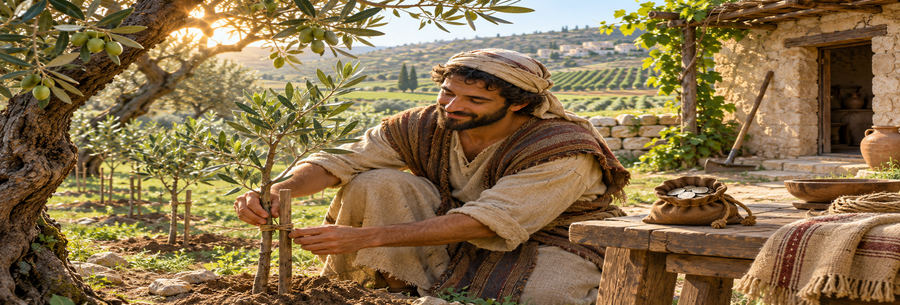
The Gospel according to Saint Matthew presents the Parable of the Talents. A master, before setting off on a journey, entrusts his possessions to his servants. To one he gives five talents; to another, two; to the third, just one. Each receives according to his abilities. On his return, the master asks what has been done with what was entrusted to them.
This parable is sometimes misunderstood. It is not merely about money, success or returns. It reminds us that God gives each of us gifts, a vocation, time, qualities, relationships and a unique capacity to love. He invites us not to bury these treasures out of fear, but to make them grow in the service of others.
Talents: everything God entrusts to each of us
In Jesus’ time, a talent was a very significant unit of currency. In the parable, it therefore represents considerable wealth. The master does not give his servants a small sum: he entrusts them with something precious.
The talents God gives us can take many forms. They may include the ability to listen, to comfort, to teach, to work with care, to create, to bring people together, to pray or to serve. They may also be the experience gained over the years, the patience developed through trials, the love shown within a family, or the courage to start afresh after a setback.
We all receive different gifts. The parable does not compare the servants with one another. The master does not reproach the one who received two talents for not having received five. He expects each person to respond faithfully to what has been entrusted to them.
These are liberating words. God does not ask us to be someone else. He does not call us to imitate the apparent success of those around us. He asks us to embrace our own lives, with their strengths and weaknesses, and to make them bear fruit.
The danger of burying one’s talent out of fear
The third servant receives one talent. Instead of making it grow, he buries it in the ground. He does not lose it, nor does he squander it, but he does nothing with it.
His attitude is driven by fear. He tells his master that he was afraid. This fear prevented him from acting, taking risks, creating and trusting.
Many people may recognise themselves in this servant. Sometimes we bury our talents because we are afraid of failing, afraid of what others might think, afraid of not measuring up, or afraid of committing ourselves.
Sometimes, we have been on the receiving end of hurtful words that have led us to believe we are good for nothing. Sometimes, we have experienced a disappointment that has caused us to withdraw. At other times, we wait until we are perfectly ready before we begin to serve, to create or to love.
But the Gospel reminds us that fear must not rule our lives. God does not ask us for perfect success. He invites us to move forward with confidence, even when our resources seem small.
A buried talent bears no fruit. On the other hand, even the smallest gift, when shared, can become a source of joy for many.
Making the most of God’s gifts in daily life
Making the most of one’s talents does not mean seeking wealth, recognition or success. It is about nurturing what God has placed within us so that it may become a blessing to others.
Someone who knows how to listen can offer a space of peace to someone who is suffering. An organised person can help a family or a charity. Someone who enjoys sharing knowledge can support a child in their learning. Someone who has faced hardship can offer particularly sensitive support to those going through the same pain.
Talents also develop through small acts of faithfulness. Preparing a meal with care, carrying out one’s work honestly, visiting someone who is isolated, checking in on a loved one, praying for someone or offering forgiveness are all ways of making what has been entrusted to us bear fruit.
God does not look only at visible deeds. He sees hidden generosity, service performed quietly, patience in a difficult relationship, and prayer offered in silence.
Faithfulness in small things
In the parable, the master says to the faithful servants: ‘You have been faithful in a very little; I will put you in charge of much.’
These words are full of hope. They remind us that holiness is rarely built on extraordinary deeds. It grows through daily faithfulness.
Being faithful in small things means choosing to do good when no one is watching. It means keeping a promise, carrying out one’s duty conscientiously, taking the time to pray, being patient with a child, listening to a partner or helping someone in need.
The world often admires great achievements, but the Gospel values the quiet acts that help life flourish around us. A word of comfort, a visit, a smile, a favour done or a prayer for someone may seem like small things. Yet they become true seeds of peace.
Faithfulness is not rigidity. It is a way of loving consistently. It enables us to remain present, even when daily life is demanding or the fruits of our efforts are not immediately visible.
Working without forgetting charity
This Sunday’s first reading describes a woman whose hands work willingly, but whose hands also open to help the poor and the unfortunate.
These words shed very practical light on the parable of the talents. Work, skills and responsibilities are not merely means of advancing one’s own interests. They can become opportunities for service and charity.
To make the gifts we have received bear fruit is to put them at the service of a more fraternal life. Christian success is not measured solely by what we possess or the position we hold. It is measured by the quality of our love.
A person may have many talents and yet keep them to themselves. Another, with few resources, may give enormously through their presence, compassion or faith. In God’s eyes, no act of charity is wasted.
Watching as children of the light
In the second reading, Saint Paul urges Christians to be vigilant. This does not mean living in anxiety or being obsessed with the future, but remaining inwardly alert.
To be a child of light is to refuse to live in indifference. It is not to let routine, fear or selfishness lull our hearts to sleep. It is to choose each day to remain open to God and attentive to others.
Christian vigilance can take very simple forms: taking a moment of silence in the morning, reflecting on the day in the evening, asking for forgiveness, thanking God, making oneself available to someone who calls, or choosing a soothing word rather than a hurtful one.
A Christian does not know the day or the hour of their final encounter with God. But they need not live in fear. They are invited to live fully in the present, trusting in God and allowing his love to bear fruit.
How can we discover our own talents?
It is not always easy to recognise the gifts God has entrusted to us. We sometimes tend to see only what we lack. Yet everyone has a unique way of serving.
To discern one’s talents, it can be helpful to ask oneself: what do I do with joy? In what situations do others come to me for help? Which need around me touches me particularly? What good can I do today, however small?
Talents are not reserved for the most prominent, the wealthiest or the most gifted. They are found in the courage of a parent, the patience of a carer, the willingness of a volunteer, the loyalty of a friend, the perseverance of someone who is ill, or the prayer of an elderly person.
God can bring forth wonderful things from a gift offered humbly.
A prayer to help the gifts we have received bear fruit
Lord Jesus,
you entrust gifts to us—
time, talents and people to love.
Help us not to bury what you give us
out of fear, discouragement or a lack of confidence.
Teach us to recognise our talents
and to put them at the service of our loved ones,
our family, our work
and those who need us.
Grant us faithfulness in the little things,
the courage to start again after a failure
and the joy of serving without seeking recognition.
Make our lives a seed of peace,
charity and hope.
Amen.