Discover the history of the Miraculous Medal, revealed to Saint Catherine Labouré in 1830, the meaning of its symbols and its place in Catholic prayer.
SEO Title: The Miraculous Medal: history, symbols, prayer and the grace of Our Lady
Meta description: Discover the history of the Miraculous Medal, revealed to Saint Catherine Labouré in 1830, the meaning of its symbols and its place in Catholic prayer.
The Miraculous Medal: a sign of Mary’s tenderness towards the world
The Miraculous Medal is one of the best-known and most widespread Marian devotions in the Catholic world. It is worn by millions of people, given as a gift at a baptism, entrusted to someone who is ill, placed in a home or kept close at hand during difficult times.
Yet it is much more than a piece of religious jewellery or a mere symbol of protection. The Miraculous Medal is an invitation to faith, prayer and trust. It reminds us that God never turns away from his people and that the Virgin Mary, mother of Jesus and mother of believers, intercedes ceaselessly for those who turn to her.
The feast of Our Lady of the Miraculous Medal is celebrated on 27 November. It commemorates the apparition of the Virgin Mary to Saint Catherine Labouré in 1830, in the chapel of the Daughters of Charity on Rue du Bac in Paris.
Saint Catherine Labouré: a modest young woman chosen by Mary
Catherine Labouré was born in 1806 in a village in Burgundy, into a large family. She lost her mother when she was only nine years old. According to tradition, deeply distraught by this death, she turned to an image of the Virgin Mary and simply told her that she would henceforth be her mother.
This childlike trust in Mary would continue to grow. Catherine spent her youth in work, prayer and service. She helped her father on the farm, looked after the house and, from a very early age, showed concern for others. She wished to join the Daughters of Charity, the community founded by Saint Vincent de Paul and Saint Louise de Marillac, but her father initially opposed this.
After several years of waiting, Catherine was finally able to join the community. She arrived in Paris in 1830, at the mother house of the Daughters of Charity on Rue du Bac. She was then a young, almost unknown novice, with no remarkable education or particular ambition. Nothing, from a human perspective, predestined her to become the instrument of a message that would touch the whole world.
It is precisely this modesty that makes her witness so powerful. Mary chose a humble young woman, who was subsequently called to live in silence and in the service of the poor. Catherine never sought to make herself known. She kept the secret of her name for a long time and devoted the rest of her life to caring for the elderly and the sick.
The apparitions of 1830 on Rue du Bac
The Virgin’s first apparition to Catherine Labouré took place during the night of 18–19 July 1830. Catherine reported that Mary invited her to come to the foot of the altar, where graces would be poured out upon all those who asked for them with confidence.
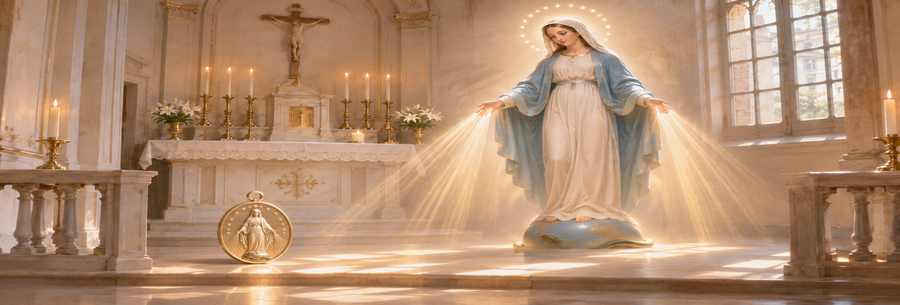
This first encounter paved the way for the great apparition of 27 November 1830. On that day, during the community’s time of prayer, Catherine saw the Virgin Mary in the chapel. Mary appeared standing on the globe, clothed in white, her hands outstretched and radiant with light.
At first, Catherine sees the Virgin holding in her hands a small globe surmounted by a cross. Mary offers it to God as a prayer for the whole world, for France and for each person in particular. This image is essential: Mary turns away from no human life. She brings everyone before God, with their joys, their worries, their struggles and their hopes.
Then Catherine sees rays of light emanating from the Virgin’s hands. These rays represent the graces that Mary obtains from her Son for those who ask for them with confidence. Mary’s open hands hold nothing back: they give, they welcome, they intercede.
Finally, an oval forms around the apparition, within which the invocation appears:
‘O Mary, conceived without sin, pray for us who have recourse to you. ”
Catherine then heard the request to have a medal struck according to this design and to distribute it widely.
Why is the Medal called ‘miraculous’?
The first medals were struck in 1832, two years after the apparition. At that time, Paris was struck by a severe cholera epidemic. The Daughters of Charity distributed the medal to the sick, to families in distress and to the destitute.
Very quickly, the faithful began to report conversions, healings, unexpected protection, family reconciliations and a return to prayer. The medal then began to be spontaneously referred to as ‘miraculous’.
This name must be understood with faith and discernment. The Miraculous Medal is not a talisman. It does not work automatically and does not replace prayer, the sacraments or the care required when a person is ill. It is a visible sign that helps one to place one’s trust in God.
The deepest graces are not always spectacular. They may take the form of a renewed sense of peace, new strength in the face of trial, forgiveness granted, an enlightened decision or a desire to return to God. The greatest miracle is often that of a transformed heart.
The meaning of the obverse of the Medal
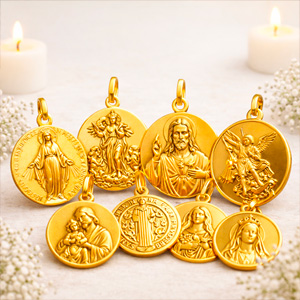
The obverse of the Miraculous Medal depicts the Virgin Mary standing on the globe. Beneath her feet lies the serpent, a symbol of evil and sin overcome by God’s grace.
This depiction refers to the Book of Genesis, in which God promises victory over evil. It also reminds us that Mary is wholly turned towards God and that her entire life manifests the victory of grace.
Mary is depicted with outstretched arms. Rays emanate from her hands. They symbolise the graces she pours out upon those who ask for them. This image is that of a mother who welcomes and watches over, of an intercession that never tires.
Surrounding Mary is the invocation: ‘O Mary, conceived without sin, pray for us who have recourse to you. ’ This prayer is one of the simplest and most profound in Marian devotion. It can be repeated every day, in times of joy as well as in times of trouble.
It proclaims the Immaculate Conception of Mary. In 1854, Pope Pius IX officially defined this dogma: from the very first moment of her conception, Mary was preserved from original sin by a special grace from God, in view of her mission as Mother of the Saviour.
The spiritual richness of the reverse side of the Medal
The reverse side of the Miraculous Medal is equally rich in meaning. First of all, it features the letter M, surmounted by a cross. This image expresses the inseparable bond between Mary and Jesus Christ.
Mary never takes the place of the Saviour. She always leads us to him. She is present at the foot of the Cross, not as a powerless spectator, but as a mother who remains faithful in suffering and who unites herself with her Son’s sacrifice.
Beneath the Cross appear the two Hearts of Jesus and Mary. The Heart of Jesus is surrounded by a crown of thorns. It recalls the love of Christ, wounded by the sin of the world and yet offered unreservedly for the salvation of all.
Mary’s Heart is pierced by a sword. This image echoes Simeon’s prophecy: Mary too would know suffering as she followed her Son. Her pierced Heart recalls her compassion, her faithfulness and her maternal love for humanity.
Finally, twelve stars surround the whole image. They evoke the woman clothed with the sun described in the Book of Revelation. They also recall the twelve apostles and the whole Church, called to radiate the light of Christ.
A medal that leads to Christ
Devotion to the Miraculous Medal is profoundly Christ-centred. Mary does not draw the faithful to herself in order to lead them away from Jesus. She leads them to Christ, the source of all grace, all forgiveness and all new life.
Wearing the Miraculous Medal can serve as a discreet reminder of this presence. When a person touches or looks at it, they may simply say:
‘Mary, lead me to Jesus.’ ”
This short prayer can accompany a difficult day, a journey, a wait at hospital, concern for a loved one or a moment of decision. The medal then becomes a call to renew one’s trust.
It may also be worn after having been blessed by a priest. This blessing does not confer any special power on the object: it helps the faithful to receive the medal as a sacramental, that is to say, as a sign that disposes the heart to welcome God’s grace.
How can one practise devotion to the Miraculous Medal?
Devotion to the Miraculous Medal is practised with simplicity. There are no complicated formulas or specific obligations. The essential thing is to wear it and pray with confidence.
One can begin the day by reciting the invocation inscribed on the medal. One can also entrust a specific intention to Mary: a child, a sick person, a family situation, a job search, inner suffering or someone who has strayed from the faith.
The medal can be given as a gift on the occasion of a baptism, a First Communion, a Confirmation, a wedding, a birth or a bereavement. It is particularly touching when given with a prayer and a word of hope.
But it must always be presented accurately. It is not a promise of a life free from trials. The Virgin Mary herself experienced poverty, anxiety, exile, misunderstanding and sorrow at the foot of the Cross. She does not promise a life free from difficulties; she accompanies those who choose to walk with Christ.
The message of the Miraculous Medal today
The message from Rue du Bac remains surprisingly relevant today. Our world is marked by divisions, violence, loneliness, illness, economic worries and family strife. Faced with these realities, the Miraculous Medal reminds us that no one is forgotten by God.
Mary is depicted holding the world in her hands. This image invites us to pray for nations, for families, for those who are alone, for the sick and for those who suffer in silence. It also reminds us of our responsibility: we cannot ask for peace without seeking to become peacemakers ourselves.
The life of Saint Catherine Labouré gives a very concrete direction to this devotion. After receiving the apparitions, she chose a hidden life, lived faithfully and devoted to others. Her message is not limited to an extraordinary vision: it extends into the daily service of the poor and the vulnerable.
To love Mary is to learn to love as she does. It is to care for those entrusted to our care. It is to offer a kind word, to visit someone who is isolated, to forgive, to support, to listen and to keep hope alive.
Prayer to Our Lady of the Miraculous Medal
O Mary, conceived without sin,
pray for us who have recourse to you.
Virgin Mary,
you who hold the world in your hands
and who present each of your children to God,
look upon our joys, our worries and our wounds.
Obtain for us the grace to believe more deeply,
to hope in the face of trials
and to love with a more generous heart.
Teach us to turn to Jesus,
to accept his forgiveness
and to become, amongst those around us,
instruments of peace and charity.
Our Lady of the Miraculous Medal,
watch over our families
and lead us to your Son.
Amen.