On 13 November, the Church commemorates Saint Abbon of Fleury, a Benedictine abbot, scholar and champion of peace, who died at La Réole in 1004.
Saint Abbon of Fleury: serving God through wisdom, truth and peace
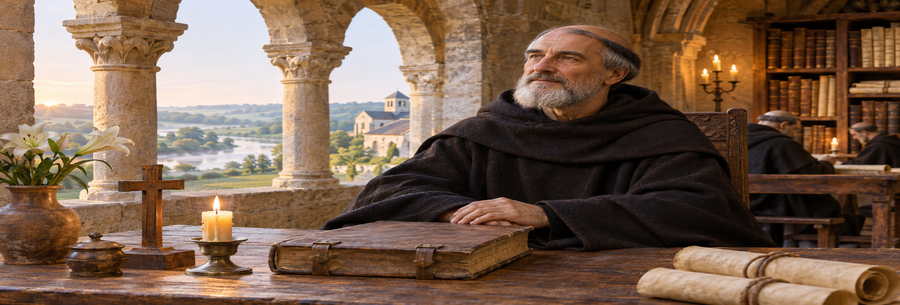
On 13 November, amongst the saints listed in the Catholic martyrology, the Church commemorates Saint Abbon of Fleury. A Benedictine monk, abbot, teacher, writer and reformer, he was one of the great spiritual and intellectual figures of France around the year 1000.
Saint Abbon was not merely a man of letters. His profound learning, his love for the Church and his devotion to monastic life led him to defend the truth, to train many disciples and to intervene in difficult situations. He died whilst seeking to restore peace to a divided community. His legacy remains particularly relevant today: the Christian faith never pits prayer against reason, nor the pursuit of truth against charity.
A vocation born near Fleury Abbey
Abbon was born around 940 in the Orléans region. Whilst still young, he was entrusted to the Benedictine Abbey of Fleury-sur-Loire, now known as Saint-Benoît-sur-Loire. This great monastery, founded around the tomb of Saint Benedict, was at that time an important centre for prayer, study and the transmission of the faith.
There he received a thorough education. In the medieval world, monasteries were not merely places withdrawn from the world. They preserved manuscripts, trained clerics, welcomed travellers and promoted Christian culture. Abbon studied the Scriptures, theology, grammar, philosophy, the sciences and the liberal arts.
His intelligence was quickly recognised. He became the scholaster, that is to say, head of the monastic school. He had a passion for teaching and a desire to impart knowledge with rigour. For him, learning was not a quest for personal prestige: it was a way of better contemplating God’s work and serving the Church more effectively.
A monk open to the Church’s influence
Saint Abbon was sent to England, to the monastery at Ramsey, to help revive Benedictine life. This mission demonstrated the trust placed in him. He did not travel for the sake of his reputation or to discover the world, but to help other communities rediscover the fervour of their vocation.
His time in England enabled him to broaden his perspective on the Church. He encountered other traditions, other ways of living the monastic life and other pastoral challenges. On his return to France, he brought to Fleury a wealth of experience and a keen capacity for discernment.
In 988, he was elected abbot of Fleury. He was then entrusted with the responsibility not only for a large community, but also for a spiritual and intellectual centre whose influence extended far beyond the banks of the Loire.
The Abbot of Fleury: a faith that seeks to understand
Under the abbacy of Saint Abbon, Fleury Abbey enjoyed a period of great influence. The monastic school educated pupils, manuscripts were copied, studies were encouraged and the life of prayer was deepened.
Abbon was a man of his time, but his love of truth retains a remarkable modernity. He believed that faith does not require one to abandon reason. On the contrary, those who believe are invited to seek, to explore more deeply, to contemplate and to better understand what they receive from God.
He wrote on numerous subjects. He took an interest in the liturgy, ecclesiastical matters, history, philosophy and the sciences. His vast learning earned him a reputation as one of the most brilliant minds of his time.
But this intellect was not separate from prayer. Benedictine life is based on a balance between the praise of God, work and spiritual reading. Saint Abbon knew that knowledge becomes barren when it feeds pride. It becomes fruitful when it leads to humility, gratitude and service to others.
A defender of the Church’s freedom
Saint Abbon lived in an age when relations between kings, lords, bishops and monasteries were often complex. Religious communities could be subject to considerable political or material pressure.
As abbot of Fleury, he defended the freedom of his monastery and the rightful place of the Church. This loyalty did not mean a rejection of the world or of civil authorities. It expressed the conviction that what belongs to God must not be seized by human interests.
He intervened in several conflicts and corresponded with bishops, abbots, sovereigns and popes. His stance could be firm, for he knew that a Christian community cannot grow without truth, without justice and without respect for its own mission.
Saint Abbon thus reminds us that Christian faithfulness does not mean fleeing from difficulties. It sometimes requires speaking out courageously, defending what is right and remaining true to one’s conscience, whilst always seeking peace.
A death in the service of reconciliation
Towards the end of his life, Abbon travelled to the priory of La Réole, in Gascony, which was under the jurisdiction of Fleury Abbey. The community was at that time experiencing serious tensions. The abbot wished to restore monastic discipline and re-establish a fraternal life more faithful to the Rule of Saint Benedict.
But the situation escalated. During a violent quarrel, Abbon attempted to intervene to calm tempers. He was fatally wounded on 13 November 1004.
His death is particularly moving. He did not die whilst seeking honour or power. He died whilst trying to restore peace amongst divided men. This is why the Church recognises him as a martyr: he gave his life in fidelity to Christ, to fraternal communion and to the truth.
It is wonderful to see that a man so learned, so committed to teaching and the debates of his time, should have ended his life not in a library or a palace, but in the midst of a conflict he was seeking to resolve. His knowledge led him to serve; his authority led him to give of himself.
What Saint Abbon can teach us
Saint Abbon invites us, first and foremost, not to set faith and reason against one another. Reading, learning, asking questions, and seeking to understand Scripture or the history of the Church can become genuine paths of prayer. An enlightened faith is not a cold faith: it can become deeper, more humble and more deeply rooted in life.
He also teaches us the value of passing on the faith. In an age where information is abundant but sometimes scattered, Saint Abbon reminds us of the importance of educating, explaining and helping the younger generation to grow in the truth. Teaching is an act of charity when it gives others the means to become free.
His life also speaks to us of courage. He did not merely observe the difficulties around him. He was willing to reach out, to engage in dialogue, to correct with justice and to uphold fraternal life. He did not seek conflict, but neither did he shirk his responsibility.
Finally, his death calls us to become peacemakers. In families, Christian communities, workplaces or everyday relationships, tensions can quickly take hold. Saint Abbon invites us not to fuel divisions, to seek the truth without violence and to foster reconciliation.
Prayer to Saint Abbon of Fleury
Saint Abbon,
you who loved prayer, study
and truth in the service of the Church,
teach us to seek God
with a humble and attentive heart.
Grant us a desire to pass on what is good,
the courage to defend justice
and the patience to build peace around us.
When divisions hurt us,
help us to become instruments of reconciliation.
May our minds, our words and our actions
always be at the service of Christ.
Amen.