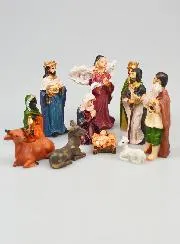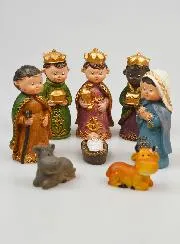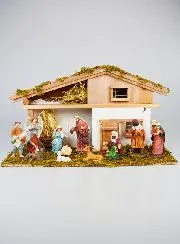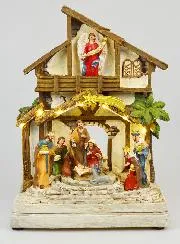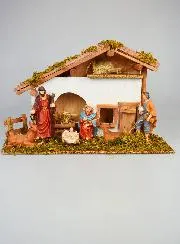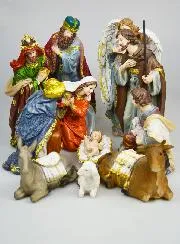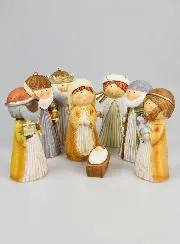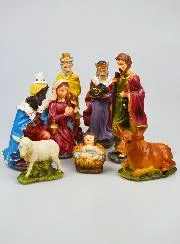
Discover the history of Provençal santons, their origins in Marseille, the traditional figures of the Provençal nativity scene, how they are handcrafted, and their Christian significance at Christmas.
The santons of Provence: history, traditions and symbols of the Christmas nativity scene
Every year, as Christmas approaches, a tradition deeply rooted in Provençal culture comes to life in homes: the setting up of the nativity scene and its santons. These small, colourful figurines, depicting not only the characters of the Nativity but also the inhabitants of villages of yesteryear, hold a special place in the religious and folk heritage of the south of France.
Far more than mere decorations, the santons of Provence tell the story of the birth of Jesus Christ, the history of a people and the richness of Christian traditions passed down from generation to generation.
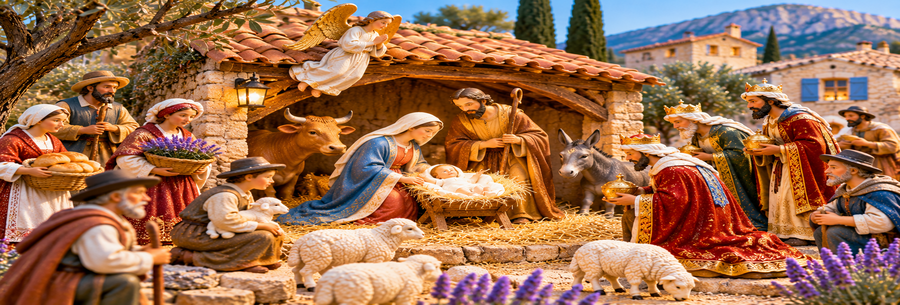
The shepherd, the washerwoman, the miller, the baker, the fisherman, the old woman carrying her bundle of firewood, and even the famous Ravi all seem to converge on the same place: the stable in Bethlehem, where the Baby Jesus has just been born.
This depiction has a profound spiritual significance. It reminds us that the birth of the Saviour concerns all people, regardless of their age, occupation or social status.
But where do Provençal santons come from? Why are they traditionally made of clay? Which figures are essential to a nativity scene? And how did this tradition become one of the most cherished symbols of Christmas in Provence?
1. What is a Provençal santon?
A santon is a small traditional figurine used to represent the characters in the Christmas nativity scene.
Its name comes from the Provençal word ‘santoun’, which means ‘little saint’.
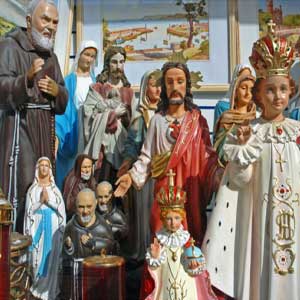
Santons are usually made of clay and then hand-painted. Some models are also dressed in real fabric clothes.
Naturally, they depict the biblical figures of the Nativity: Jesus, Mary, Joseph, the shepherds, the angels and the Three Wise Men.
But what makes the Provençal nativity scene unique is the inclusion of numerous figures drawn from everyday life.
It features craftsmen, shopkeepers, farmers and the inhabitants of Provençal villages.
They all seem to have paused in their daily tasks to come and pay their respects to the Baby Jesus.
A popular depiction of the Nativity
Unlike a nativity scene limited to biblical figures, the Provençal nativity scene brings an entire village into the Christmas story.
The figures wear traditional clothing and practise the trades of days gone by.
This scene symbolically transposes the birth of Jesus into a world familiar to the people of Provence.
It serves as a reminder that the message of Christmas does not belong solely to the past.
It speaks to every generation and every human community.
A tradition that is both religious and cultural
The santons have a dual significance.
Firstly, they are part of the Christian tradition, as they feature in the depiction of the birth of Christ.
But they also bear witness to Provençal heritage.
The costumes, trades, accessories and landscapes reflect part of the local history and customs.
It is this convergence of faith and popular culture that gives the santons of Provence their richness.
2. The origin of Provençal santons: a story linked to Christmas
The history of Provençal santons is closely linked to the development of Christian nativity scenes.
To understand their origin, we must look back to the tradition of depicting the Nativity.
St Francis of Assisi and the Greccio nativity scene
In 1223, St Francis of Assisi organised a Christmas celebration in Greccio, Italy.
He wanted to enable the faithful to contemplate the poverty and humility of Jesus’ birth in a more tangible way.
A manger filled with hay was prepared, along with an ox and a donkey.
Mass was celebrated in this setting.
This initiative played a major role in spreading the tradition of nativity scenes throughout the Christian world.
Over the centuries, depictions of the Nativity began to appear in churches and homes.
Nativity scenes in Provence before the advent of santons
Long before the little clay santons, Provençal churches featured depictions of the birth of Jesus.
Some consisted of large carved figurines, whilst others took the form of staged scenes.
These depictions helped the faithful to better understand the Gospel stories.
The tradition of the nativity scene was therefore already well established in Provence before the advent of the santon as we know it today.
The French Revolution and the rise of family nativity scenes
At the end of the 18th century, the French Revolution profoundly disrupted religious life.
The closure of many churches and the restrictions imposed on worship during certain periods led families to further develop domestic religious practices.
Small nativity scenes set up in homes thus took on particular significance.
It was against this backdrop that clay santons began to be produced in Marseille.
Their small size and relatively affordable cost meant that a greater number of families could own a nativity scene.
3. Jean-Louis Lagnel, one of the great pioneers of Provençal santons
The history of Provençal santons is particularly closely linked to Jean-Louis Lagnel, born in Marseille in 1764.
He is generally regarded as one of the pioneers of moulded clay santons.
An innovation in production
In the late 18th and early 19th centuries, Jean-Louis Lagnel contributed to the development of a method for reproducing the figurines using moulds.
This technique facilitated the mass production of santons whilst retaining their handcrafted quality.
The figurines could then be dried, fired and decorated.
This development played an important role in the spread of Provençal nativity scenes.
Characters inspired by everyday life
One of the defining features of santons is their depiction of everyday life.
The characters are no longer limited to the Holy Family and the shepherds.
They take on the features of the villagers.
The baker, the miller, the fishmonger, the shepherd and even the woman carrying a jug become familiar figures.
This approach gives the nativity scene a deeply human dimension.
It shows that everyone, in their daily lives, can share in the joy of Christmas.
4. Why are santons traditionally made from clay?
Clay is the iconic material used for Provençal santons.
This natural clay allows for the creation of detailed and expressive figurines.
It is also linked to the region’s history of craftsmanship.
A simple and accessible material
Clay is very malleable when wet.
It can be modelled by hand or pressed into a mould.
Once dried and fired, it becomes solid.
This technique allows figures of different sizes to be produced.
The work of the santonnier
The craftsman who makes the santons is called a santonnier.
His work requires precision, patience and genuine skill.
The creation of a new figure usually begins with an original, hand-sculpted model.
A mould is then made to enable its reproduction.
The clay is placed in the mould, then the figurine is removed from the mould and carefully refined.
Once dry, it is fired in a specialised kiln.
Next comes the painting stage.
Hand-painting
Traditional santons are often decorated by hand.
The santon maker applies colour to the clothes, faces and accessories.
The details are particularly important.
A basket of vegetables, a loaf of bread, a bouquet of flowers or a fishing net make it possible to immediately identify the character’s occupation.
Each workshop has its own style.
Some santons feature bright colours, whilst others favour natural, weathered shades.
5. Clothed santons: another Provençal tradition
Alongside santons made entirely of clay, there are also clothed santons.
These figurines generally have a rigid frame, onto which real miniature clothes are draped.
Costumes inspired by traditional Provence
Clothed santons replicate the clothing once worn in Provençal villages.
Women may wear a long skirt, an apron, a headscarf and a headdress.
Men are depicted wearing trousers, a jacket, a waistcoat or a hat.
The fabrics, colours and accessories help to distinguish between the different categories of figures.
Meticulous craftsmanship
Making a dressed santon requires a range of skills.
The figurine must be sculpted, the clothes made and the various elements assembled.
Some workshops pay particular attention to the historical accuracy of the costumes.
These santons are often prized for their decorative richness and expressiveness.
They can become genuine collector’s items.
6. The essential figures of the Provençal nativity scene
A Provençal nativity scene may comprise just a few figures or bring together several dozen santons.
However, certain figures occupy a fundamental place.
The Baby Jesus
The Baby Jesus is the central figure of the nativity scene.
He is depicted lying in a manger, usually surrounded by straw.
His birth recalls the mystery of the Incarnation.
For Christians, God became man in Jesus Christ in order to bring salvation to humanity.
In many families, the figure of Jesus is placed in the nativity scene on the evening of 24 December or the morning of 25 December.
The Virgin Mary
Mary is usually depicted kneeling or sitting beside the Baby Jesus.
Her demeanour expresses tenderness, prayer and contemplation.
She reminds us of the trust with which the Virgin Mary accepted God’s will.
Saint Joseph
Joseph is often depicted standing, holding a staff or a lantern.
He watches over Mary and Jesus.
He symbolises faithfulness, protection and family responsibility.
The ox and the donkey
The ox and the donkey are traditionally placed near the manger.
Their presence is not explicitly mentioned in the Gospel accounts of the Nativity.
It stems from an ancient Christian tradition.
These animals help to emphasise the simplicity of Jesus’ birth.
The angel Gloria
The angel Gloria announces the birth of the Saviour.
He is often placed above the stable.
He recalls the account in the Gospel according to Saint Luke, in which the angels announce the birth of Christ to the shepherds.
The shepherds and their sheep
The shepherds occupy a particularly important place in the nativity scene.
According to the Gospel of Saint Luke, they are the first to receive the news of Jesus’ birth.
In Provençal tradition, they are depicted with their flocks, their staffs and their work clothes.
They symbolise simplicity and a willingness to answer God’s call.
The Three Wise Men
The Wise Men come to pay homage to Jesus and offer him gold, frankincense and myrrh.
Christian tradition generally depicts them as a group of three.
They are often added to the nativity scene to mark Epiphany.
Their presence serves as a reminder that the birth of Christ concerns all peoples.
7. The Ravi: the most famous of the Provençal santons
Of all the Provençal santons, the Ravi is undoubtedly one of the most recognisable.
He is usually depicted with his arms raised towards the sky, his face beaming with joy.
Why is he called the Ravi?
The word ‘ravi’ evokes a person overcome with happiness and wonder.
In Provençal tradition, the Ravi is a simple figure, sometimes regarded as naïve.
But this simplicity carries a special meaning.
He brings neither wealth nor material gifts to the Baby Jesus.
He simply comes bearing his joy.
The symbol of wonder
The Ravi reminds us that Christmas is, above all, a celebration of joy.
He represents someone capable of marvelling at the birth of the Saviour.
His attitude invites us to rediscover a simple outlook on life.
He teaches us that the richness of the heart can be more precious than material possessions.
A profoundly Christian figure
In the nativity scene, each figure brings something.
The shepherd sometimes offers a lamb.
The baker brings bread.
The fishmonger carries fish.
The Ravi, for his part, offers his sense of wonder.
He reminds us that God welcomes everyone just as they are.
8. Traditional trades represented by the santons
The Provençal nativity scene is also a representation of village society of days gone by.
Each trade has its own figure.
This diversity is what makes the tradition so rich.
The baker
The baker usually carries loaves of bread or a basket of loaves.
He reminds us of the importance of bread in everyday life.
In a Christian context, bread can also symbolise sharing and the Eucharist.
The miller
The miller is often depicted with a sack of flour.
He symbolises the work of the mills, which were once essential to village life.
His presence serves as a reminder of the value of work and daily effort.
The washerwoman
The washerwoman carries laundry or stands near a washhouse.
She represents a trade traditionally carried out by women.
She serves as a reminder of the everyday tasks of family and village life.
The fisherman
The fisherman carries a net, a fishing rod or a basket of fish.
He evokes the villages of the Mediterranean coast.
In Christian tradition, his presence may also serve as a reminder of the first disciples of Jesus, several of whom were fishermen.
The fishmonger
The fishmonger is often depicted with a basket full of fish.
She bears witness to the importance of markets and trade in Provençal villages.
The shepherd
The shepherd remains one of the most important figures.
He represents both the rural world of Provence and the shepherds of Bethlehem.
He thus establishes a direct link between local tradition and the biblical narrative.
The knife-grinder
The knife-grinder travels with his grindstone to sharpen knives and tools.
This itinerant trade was once common in villages.
His presence helps to preserve the memory of a skill that is much less common today.
The water-carrier
The water-carrier carries buckets or jugs.
He reminds us of a time when running water was not available in every home.
He also highlights the importance of water in everyday life.
The spinner
The spinner works with wool or other textile fibres.
She represents the craft activities carried out in homes and workshops.
The drummer
The drummer is a traditional Provençal musician.
He usually plays the galoubet and the tambourine.
His presence adds a festive touch to the nativity scene.
He reminds us that Christmas is a time of joy and celebration.
9. The iconic characters of the Provençal Pastorale
The tradition of santons is closely linked to Provençal pastorales.
A pastorale is a popular theatrical performance recounting the birth of Jesus in a setting inspired by Provence.
The Maurel Pastorale
One of the most famous is the Maurel Pastorale, written in 1844 by Antoine Maurel.
This work helped to popularise several typical characters.
It tells the story of how the inhabitants of a village discover the birth of the Saviour and set off for the nativity scene.
The Pistachié
The Pistachié is a comic character who appears in certain pastorales.
His adventures and blunders add a humorous dimension to the story.
He represents human frailties, but also the possibility of transformation through contact with the Good News.
The blind man and his son
The blind man is a moving character in the pastoral tradition.
His story evokes suffering, trust and hope.
He reminds us that the birth of Christ is Good News for those who are suffering.
The elderly and the villagers
The nativity scenes also feature elderly people, craftsmen, shopkeepers and farmers.
Each character has their own personality and distinctive traits.
This diversity gives the Provençal nativity scene a profoundly human dimension.
10. Why is a Provençal village depicted around the nativity scene?
One of the key features of the Provençal nativity scene is its setting.
The Nativity is not merely depicted in an isolated stable.
It takes place at the heart of a real village.
There are houses, paths, bridges, fountains, mills and sometimes rivers.
A way of making Christmas feel close to everyone
By setting the birth of Jesus in a familiar landscape, the people of Provence wanted to show that the message of Christmas concerned them directly.
Christ did not come solely for the people of Bethlehem.
He came for all peoples and all generations.
The Provençal nativity scene expresses this universality.
The landscapes of Provence
The scenes may depict hills, olive trees, cypresses, fields of lavender or stone villages.
The houses often have tiled roofs.
Paths wind their way between the houses.
Windmills evoke rural landscapes.
These elements give the nativity scene a strong regional identity.
A lively scene
The Provençal nativity scene is not a static representation.
The figures appear to be walking, working, chatting or carrying their gifts.
They all gradually converge on the stable.
This scene serves as a reminder that the birth of Jesus sets the world in motion.
11. Santon fairs: an unmissable Christmas tradition in Provence
Santon fairs are one of the great Christmas traditions in the south of France.
They bring together craftspeople and nativity scene enthusiasts.
The Marseille santon fair
Marseille holds a major historical place in the santon-making tradition.
Its santon fair, whose origins date back to the early 19th century, is considered one of the oldest and most famous.
Every year, it offers visitors the chance to discover the work of the craftspeople.
Visitors can find traditional figures, new designs and a wide range of nativity scene accessories.
The fairs in Aubagne and Provençal villages
Aubagne is also an important town in the history of ceramics and santons.
Many towns in Provence organise markets and exhibitions during the Christmas period.
These events help to keep alive a craft tradition passed down through several generations.
A tradition of collecting
Some families buy a new santon every year.
Over time, their nativity scene grows.
New figures join those already present.
This custom creates a much-loved family tradition.
Each figurine may bring to mind a Christmas, a trip or a shared memory.
12. How do you set up a Provençal nativity scene at home?
Setting up a Provençal nativity scene is an important part of the Christmas preparations.
There is no single rule.
Each family can adapt their nativity scene to the space available and the figures they own.
Start with the Holy Family
The first step is to choose the location for the stable.
Mary and Joseph are placed near the manger.
The Baby Jesus can be added on the evening of 24 December or on Christmas morning.
Placing the shepherds
The shepherds can be arranged along the paths leading to the stable.
Their flocks accompany them.
They represent the first witnesses to the Nativity.
Add the villagers
Craftsmen, shopkeepers and other figures are then placed around the scene.
The baker can be placed near his oven.
The washerwoman stands near the washhouse.
The miller can be positioned near the mill.
The fisherman takes his place by a river or near a small harbour.
Creating the landscapes
Natural elements can be used to compose the scene.
Moss, stones, branches and sand can be used to represent paths and hills.
However, care should be taken not to damage natural environments whilst collecting these materials.
Preparing for the arrival of the Three Wise Men
The Wise Men can be placed some distance from the nativity scene during Advent.
They are gradually moved closer until Epiphany.
This tradition helps to prolong the joy of Christmas.
13. What is the Christian significance of the santons of Provence?
Beyond their artisanal beauty, the santons possess a genuine spiritual dimension.
They represent humanity journeying towards Jesus.
All people are invited to welcome Christ
In the Provençal nativity scene, the figures come from very different social backgrounds.
There are rich and poor people, young and old, craftsmen, farmers and shopkeepers.
All are making their way towards the Baby Jesus.
This diversity reminds us that the salvation proclaimed by Christianity is intended for everyone.
Every trade has its dignity
The santons honour ordinary trades.
The baker, the shepherd and the washerwoman are not insignificant, secondary figures.
They represent everyday life.
Christian tradition reminds us that work carried out with honesty and love possesses true dignity.
The offering of oneself
Some santons bring a gift to the Baby Jesus.
The shepherd offers a lamb.
The baker brings bread.
Others present fruit, vegetables or flowers.
These offerings symbolise the desire to give something of oneself.
They remind us that everyone can offer God what they have, even when it seems modest.
The joy of Christmas
The ‘Ravi’ (the Joyful One) particularly expresses this aspect.
He has nothing to offer but his joy.
He reminds us that the birth of Jesus is Good News that must be welcomed with wonder.
14. Why pass on the tradition of the santons to children?
The Provençal nativity scene is a wonderful tool for passing on both the Christian faith and regional heritage.
Children discover the birth of Jesus through tangible figures.
They also learn to recognise the trades and traditions of days gone by.
Telling the Christmas story
Parents can gradually introduce the figures of the Nativity.
They can explain who Mary, Joseph, the shepherds and the Magi are.
The nativity scene thus becomes a vivid way of recounting the Gospels.
Discovering traditional trades
The santons also provide an opportunity to talk about daily life in the past.
Why did the water-carrier carry jugs?
How did a mill work?
What was a knife-grinder’s job?
These questions can lead to wonderful conversations between generations.
Fostering creativity
Setting up a nativity scene requires imagination.
Children can help create the paths, hills and houses.
They learn to arrange a scene and look after the figurines.
Creating family memories
In some families, santons have been passed down through several generations.
Each figure has its own story.
Setting up the nativity scene then becomes a moment of passing on traditions.
Children discover the traditions of their parents and grandparents.
15. How can you recognise a genuine, handcrafted Provençal santon?
Provençal santons come in a wide variety of styles and materials.
Some are made entirely by hand.
Others are produced using moulds, following traditional craft techniques.
The material
Fired clay is the most characteristic historical material.
Its texture and weight differ from those of resin or plastic figurines.
However, the material alone is not enough to guarantee a santon’s authenticity.
The paint
Handcrafted santons are often hand-painted.
The details of the faces, clothing and accessories bear witness to the care taken in their creation.
The workshop’s signature
Some santon makers inscribe their name, trademark or signature beneath the figurines.
This detail can help to identify their origin.
Craftsmanship
The value of a handcrafted santon lies in the work involved in its creation, moulding, finishing and decoration.
Each workshop develops its own style.
Choosing a santon made by a Provençal craftsman helps to support the passing on of this expertise.
However, it is important to distinguish genuine local handcrafted creations from mass-produced figurines that are merely inspired by Provençal aesthetics.
16. Santons of Provence today: a tradition that lives on
Despite changes in society, the tradition of santons remains very much alive.
Many workshops are still in operation.
Santon fairs still attract families and collectors.
Between tradition and creativity
Santon makers continue to produce historical figures.
But some also create new designs.
Contemporary professions or characters inspired by modern life may find their way into nativity scenes.
This development shows that the tradition remains alive.
A heritage to be preserved
The craft of making santons represents a valuable skill.
It combines sculpture, moulding, ceramics and painting.
Passing on these techniques helps to preserve part of Provence’s cultural identity.
A tradition that extends beyond Provence
Today, Provençal santons are appreciated throughout France and in many other countries.
They offer an original and heart-warming way of depicting the Nativity.
Their success bears witness to a lasting attachment to Christmas traditions.
17. A prayer before the nativity scene and the Provençal santons
Lord Jesus,
As we contemplate this nativity scene and all the santons surrounding your birth,
we remember your arrival in the simplicity of Bethlehem.
Like the shepherds, teach us to respond to your call with trust.
Like the Magi, help us to seek you with perseverance.
Like the craftsmen and the villagers, teach us to offer you our work and our daily actions.
Grant us the joy of the Child, able to marvel at your love.
Following the example of the Virgin Mary, teach us to welcome your Word.
Following the example of Saint Joseph, grant us courage and faithfulness.
Protect our families and be with those who suffer.
May our home be a place of peace, sharing and charity.
And may the light of your birth shine in our hearts throughout the year.
Amen.
Conclusion: the santons of Provence, a living heritage in the service of the mystery of Christmas
The santons of Provence occupy a unique place in Christian Christmas traditions.
Born of the fusion between the depiction of the Nativity and Provençal folk culture, they tell a story rich in faith, simplicity and tradition.
From the first clay santons made in Marseille to the creations of contemporary workshops, this tradition has been passed down through the generations.
Each figure has its own identity.
The shepherd recalls the first witnesses to the birth of Jesus.
The baker, the miller and the washerwoman represent the dignity of daily labour.
The Magi evoke the search for God.
The ‘Ravi’ symbolises joy and wonder.
And at the centre of this gathering of figures lies the Baby Jesus, who came to bring hope and salvation to the world.
The Provençal nativity scene thus reminds us that the birth of Christ concerns all of humanity.
The santons of Provence are therefore not merely small decorative figurines: they bear witness to a living Christian tradition that unites faith, family and regional heritage.
Every year, when we set up our nativity scene, we bring to life a story that spans the centuries.
We symbolically invite the people of Provence to join the shepherds of Bethlehem.
And in the simplicity of these little clay figures, we rediscover the true meaning of Christmas: to welcome Jesus with a humble, joyful heart, filled with love.