Discover the history of the Christmas Mass, its origins, the tradition of Midnight Mass and the sequence of Catholic celebrations marking the Nativity of Jesus.
Christmas Mass: history, origins, traditions and the order of service for the celebration of the Nativity
Every year, on the night of 24–25 December, churches around the world welcome worshippers who have come to celebrate one of the most important events in the Christian faith: the birth of Jesus Christ in Bethlehem.
The bells ring out, candles light up the sanctuaries, traditional Christmas carols echo beneath the vaults, and families gather round the nativity scene. This special atmosphere makes Christmas Mass one of the most eagerly awaited celebrations of the liturgical year.
But behind the beauty of the carols, the lights and the traditions lies a particularly rich spiritual and liturgical history.
Why is Christmas Mass traditionally celebrated at midnight? Since when have Christians commemorated the birth of Jesus on 25 December? Why are there several Christmas Masses? What is the significance of the biblical readings, prayers, hymns and rituals performed during the celebration?
To fully understand this feast, it is worth looking back to the origins of Christianity and discovering how the Christmas liturgy has gradually developed over the centuries.
The Christmas Mass is not merely a religious tradition: it is, above all, a celebration of the mystery of the Incarnation, when God became man in Jesus Christ to bring salvation to humanity.
1. The origins of Christmas: when did Christians begin to celebrate the birth of Jesus?
The birth of Jesus in the Gospels
The story of Christmas is rooted in the Gospels of Saint Matthew and Saint Luke.
These two evangelists recount the events surrounding the birth of Jesus, highlighting different aspects of the mystery of the Incarnation.
In particular, Saint Luke recounts Mary and Joseph’s journey to Bethlehem, the birth of Jesus, his being laid in a manger, and the angels’ announcement to the shepherds.
The Gospel according to Saint Matthew focuses in particular on the role of Saint Joseph, the visit of the Magi from the East and the events connected with King Herod.
These accounts form the biblical basis for the Christian celebration of Christmas.
However, the Gospels do not specify the exact date of Jesus’ birth.
The early Christians placed particular emphasis on the Passion, death and Resurrection of Christ, celebrated at Easter.
The liturgical celebration of his birth developed gradually.
Why is Christmas celebrated on 25 December?
The date of 25 December is clearly identified as the feast of Christ’s birth in Roman sources from the 4th century.
A document known as the Chronograph of 354 bears particular witness to this celebration in Rome.
Several historical explanations have been put forward to account for the choice of this date.
One of these is based on ancient symbolic calculations linking the conception of Christ to 25 March, nine months before 25 December.
Another hypothesis highlights the context of Roman festivals linked to the sun and the winter solstice.
Historians continue to debate the respective roles of these various influences.
For Christians, 25 December has become the day on which the Church solemnly celebrates the birth of the Saviour.
This date carries strong symbolic significance: in the depths of winter, when the nights are long, the faithful celebrate the coming of Christ, recognised as the light of the world.
2. How has the celebration of Christmas developed over the centuries?
The earliest Christian celebrations
From the 4th century onwards, the feast of the Nativity gradually took on an important place in the liturgical life of the Church.
In Rome, Christmas celebrations developed around various basilicas and traditions specific to the city.
The birth of Christ became an occasion to solemnly proclaim the mystery of the Incarnation.
Biblical readings, prayers and hymns enabled the faithful to reflect on the coming of the Son of God amongst mankind.
Over the centuries, these traditions have spread to many parts of the Christian world.
The role of the Roman basilicas
The Roman Christmas tradition has developed particularly around three places of celebration.
The Basilica of Saint Mary Major, closely associated with devotion to the Nativity, played an important role in the night-time celebration.
The Church of Saint Anastasia was linked to the dawn Mass.
St Peter’s Basilica traditionally hosted the daytime celebration.
These practices contributed to the gradual establishment of the three traditional Christmas Masses: the Midnight Mass, the Dawn Mass and the Daytime Mass.
Even today, the Catholic liturgy retains this richness.
Christmas in the Middle Ages
In the Middle Ages, Christmas became a major festival in the life of European Christian communities.
Churches hosted solemn celebrations, accompanied by hymns, processions and religious performances.
Midnight Mass held a special place in popular piety.
The faithful gathered to celebrate the birth of Christ, sometimes after travelling long distances from neighbouring villages.
The bells heralded the festival and Christmas carols helped to create an atmosphere of joy.
Gradually, religious traditions have also come to be accompanied by family and folk customs.
3. Why is Midnight Mass traditionally celebrated at midnight?
Midnight Mass is one of the best-known Christmas traditions.
It is deeply rooted in Christian tradition and retains a particularly moving significance to this day.
The symbolism of the night
The night-time celebration recalls the account in the Gospel of Saint Luke, in which the shepherds are keeping watch during the night when they receive the news of the Saviour’s birth.
The night also has a spiritual significance.
It symbolically represents the darkness of the world, human struggles and the longing for salvation.
The birth of Jesus is thus celebrated as the arrival of a new light.
Christ comes to dispel the darkness and bring hope to mankind.
This symbolism is particularly evident in the hymns and readings of the Christmas Mass.
Does Midnight Mass have to start at midnight?
No.
Although the term ‘Midnight Mass’ remains very common, the Christmas Eve service is not necessarily scheduled for midnight.
Many parishes now offer a Mass on the evening of 24 December, sometimes at 6 pm, 8 pm or 10 pm.
These times make it easier for families with young children and elderly people to attend.
The midnight Mass retains its liturgical significance even when celebrated before midnight, in accordance with the applicable provisions.
What matters most is the celebration of the birth of Christ, not the exact time at which the service begins.
4. Why are there several Christmas Masses in the Catholic Church?
The Roman Liturgy provides for four forms of Mass for the Solemnity of the Nativity of the Lord.
Each has its own readings and prayers, allowing the mystery of Christmas to be contemplated from a particular perspective.
The Christmas Eve Mass
The Christmas Eve Mass is celebrated on the evening of 24 December.
It marks the beginning of the liturgical celebration of Christmas.
The Gospel reading from the lectionary for this Mass is taken from Saint Matthew.
It presents the genealogy of Jesus and the circumstances of his birth.
This reading reminds us that Christ is part of the history of the people of Israel and fulfils the promises made by God.
The Midnight Mass
The Midnight Mass places particular emphasis on the birth of Jesus in Bethlehem.
The Gospel according to Saint Luke recounts the census, the journey of Mary and Joseph, the birth of the Baby Jesus and the announcement made to the shepherds.
This is the celebration traditionally associated with Midnight Mass.
It emphasises the joy of the Saviour’s birth and the light that comes to illuminate the world.
Dawn Mass
Dawn Mass is celebrated on the morning of 25 December, traditionally at daybreak.
The Gospel recounts the shepherds’ visit to Bethlehem.
After hearing the angels’ announcement, they go to Mary, Joseph and the Baby Jesus.
This celebration highlights the simple and spontaneous faith of the shepherds, who welcome the good news and glorify God.
The Mass of the Day
The Mass on Christmas Day features a particularly profound text: the prologue to the Gospel according to Saint John.
It begins with these words:
‘In the beginning was the Word. ’ (John 1:1)
This reading takes us to the heart of the mystery of the Incarnation.
It proclaims that the eternal Word of God became flesh and dwelt amongst us.
The Mass of the day thus invites the faithful to look beyond mere contemplation of the Child of Bethlehem and to recognise in him the eternal Son of God.
5. How is a Christmas Mass conducted?
The Christmas Mass follows the usual structure of the Catholic Eucharistic celebration.
It comprises four main parts: the opening rites, the Liturgy of the Word, the Liturgy of the Eucharist and the concluding rites.
However, the solemnity of Christmas lends this structure a particularly festive dimension.
Part One: the opening rites
The celebration usually begins with an entrance hymn.
The congregation stands to welcome the priest and the ministers as they process towards the altar.
In some parishes, this procession can be particularly solemn.
The candles, the processional cross and the incense all help to convey the dignity of the celebration.
The priest greets the congregation and invites the faithful to join in prayer.
After the Act of Penance, which allows each person to acknowledge their need for God’s mercy, comes one of the most joyful moments of the Christmas Mass: the Gloria.
The return of the Gloria
During the Sundays of Advent, the Gloria is normally omitted.
It is sung once more during the Christmas celebration.
This hymn echoes the praise of the angels announcing the birth of the Saviour.
It expresses the glory of God and the joy of the Church.
In many parishes, it is sung with particular solemnity.
The opening liturgy concludes with the opening prayer, known as the Collect, recited by the priest.
6. The Liturgy of the Word: listening to the proclamation of the Saviour’s birth
After the opening rites, the Liturgy of the Word begins.
The faithful sit down to listen to the biblical readings.
These help us to understand the birth of Jesus in the light of the history of salvation.
The first reading
The first reading is usually taken from the Old Testament.
During the Midnight Mass, it is taken from the Book of the Prophet Isaiah.
The prophet announces the coming of a great light for the people who walked in darkness.
Christians understand this prophecy as a proclamation of the coming of the Messiah.
It reminds us that the birth of Jesus fulfils God’s promises.
The responsorial psalm
After the first reading, the congregation responds to the Word of God with a psalm.
The psalm is usually sung or recited, with a refrain repeated by the congregation.
On Christmas Eve, it particularly expresses the joy of the Saviour’s birth.
The second reading
The second reading is taken from the New Testament.
At Midnight Mass, it is taken from Saint Paul’s Letter to Titus.
It reminds us that God’s grace has been revealed for the salvation of all people.
This text invites Christians to live in righteousness, faith and hope.
The Christmas Gospel
The Gospel forms the high point of the Liturgy of the Word.
The faithful stand to listen to its proclamation.
During Midnight Mass, the priest or deacon reads the account of the birth of Jesus according to Saint Luke.
This passage recounts how Mary gave birth to her first-born son, wrapped him in swaddling clothes and laid him in a manger.
It also tells of the shepherds keeping watch in the fields and the angel who announced the Saviour’s birth to them.
This proclamation is one of the most moving moments of the celebration.
The priest’s homily
After the Gospel, the priest delivers the homily.
He explains the meaning of the biblical texts and helps the congregation to understand the mystery of Christmas.
The homily may, in particular, touch upon the humility of Jesus, the faith of Mary and Joseph, the joy of the shepherds, or God’s love for humanity.
It also invites Christians to put the message of Christmas into practice within their families and in society.
7. The Creed and the General Intercessions during Christmas Mass
After the homily, the congregation proclaims its faith by reciting or singing the Creed.
This profession of faith recalls the great truths of Christianity.
Why do we kneel during the Creed at Christmas?
The liturgy prescribes a specific gesture for the Solemnity of Christmas.
When the faithful recite the words referring to the Incarnation of the Son of God, they kneel, in accordance with the liturgical provisions.
This gesture expresses adoration and wonder at the mystery of God made man.
It reminds us that Jesus, whilst truly God, chose to share fully in our human condition.
The General Intercessions
After the Creed, the congregation presents various intentions to God.
In particular, the faithful pray for the Church, for the leaders of nations, for peace in the world and for those who are suffering.
At Christmas, special attention may be given to families, children, those who are isolated, the sick, and people affected by war or poverty.
This prayer reminds us that the joy of Christmas is meant for all humanity.
8. The Eucharistic Liturgy: the heart of the Christmas Mass
After the Liturgy of the Word, the Eucharistic Liturgy begins.
It forms the centre of every celebration of Mass.
The faithful do not come merely to hear the story of Jesus’ birth.
They also come to encounter Christ in the sacrament of the Eucharist.
The preparation of the gifts
The bread and wine are brought to the altar.
The priest presents them to God in prayer.
Through the Eucharistic consecration, these offerings will become the Body and Blood of Christ.
During this preparation, a hymn may accompany the liturgical gestures.
The Eucharistic Prayer
The Eucharistic Prayer is the central moment of the Mass.
The priest gives thanks to God for his work of salvation.
The congregation joins in this prayer, notably by singing the Sanctus.
During the consecration, the priest pronounces the words of Christ at the Last Supper.
According to the Catholic faith, the bread and wine truly become the Body and Blood of Jesus Christ.
The celebration of Christmas takes on a particularly profound meaning here.
The One born in Bethlehem is the same Christ who makes himself present in the Eucharist.
The mystery of the Incarnation and that of the Eucharist are thus intimately linked.
The Lord’s Prayer and the sign of peace
After the Eucharistic Prayer, the faithful recite the Lord’s Prayer together.
This prayer, taught by Jesus to his disciples, expresses their trust in God.
Next comes the rite of peace.
Depending on custom and circumstances, the faithful may exchange a sign of peace.
At Christmas, this gesture is a particular reminder of the message of brotherhood and reconciliation brought by Christ.
Communion
Catholic worshippers who are prepared to receive the Eucharist come forward to receive Communion.
Communion is a moment of intimate encounter with Christ.
It invites everyone to welcome his presence and to renew their commitment to living according to the Gospel.
This moment is usually accompanied by a hymn or a period of silence.
9. The concluding rites and the Christmas blessing
After Communion, the priest recites the post-Communion prayer.
The celebration concludes with the concluding rites.
The priest may give a solemn blessing specific to the Christmas season.
This blessing asks God to pour out his peace and grace upon the faithful.
The deacon or priest then dismisses the congregation.
This dismissal has an important significance: Christians are called to carry into their daily lives the joy and peace they have just celebrated.
The Mass may end with a particularly festive Christmas hymn.
In some parishes, the congregation then gathers before the nativity scene for a moment of quiet reflection.
10. The Christmas nativity scene in churches: a tradition inherited from Saint Francis of Assisi
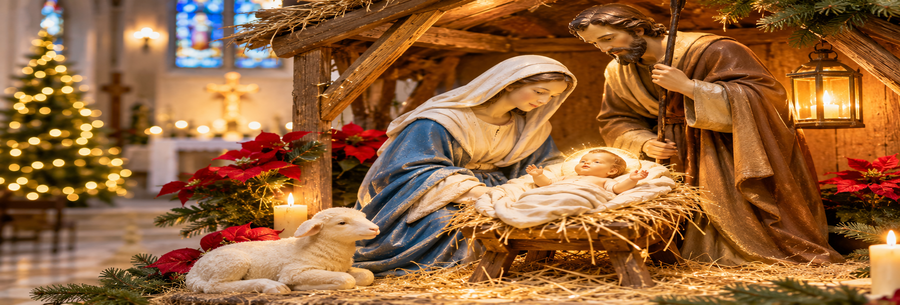
The nativity scene plays an important role in the popular celebration of Christmas.
It depicts the birth of Jesus in Bethlehem and allows the faithful to contemplate the mystery of the Incarnation in a tangible way.
The first live nativity scene in Greccio
In 1223, Saint Francis of Assisi organised a live re-enactment of the Nativity in Greccio, Italy.
He wished to help the faithful better understand the poverty and humility in which Jesus was born.
This initiative contributed greatly to the spread of nativity scenes throughout the Christian world.
Over the centuries, nativity scenes became widespread in churches, monasteries and homes.
The place of the nativity scene during Mass
In some parishes, the Baby Jesus is placed in the nativity scene during a Christmas service or at a time close to it.
This gesture, when practised, serves as a reminder that the entire anticipation of Advent finds its fulfilment in the birth of the Saviour.
It is, however, a local custom and not a mandatory part of the Mass.
The faithful may then come and pray before the nativity scene.
Children are particularly drawn to this depiction of the Nativity.
It helps to pass on the faith to them through characters and symbols that they can easily understand.
11. Traditional hymns for Christmas Mass
Music plays a vital role in Christmas celebrations.
The hymns express the joy, adoration and thanksgiving of the faithful.
They also help to pass on the faith from one generation to the next.
‘Il est né, le divin Enfant’
This traditional French hymn celebrates the birth of Jesus and invites Christians to rejoice.
It is particularly popular in parishes and families.
‘Les anges dans nos campagnes’
This hymn evokes the announcement made to the shepherds and the angels’ praise.
It recalls the joy that accompanies the birth of the Saviour.
‘Silent Night’
This famous Christmas carol was composed in Austria in the early 19th century.
It evokes the peace and contemplation surrounding the birth of Jesus.
Its gentle and solemn melody makes it one of the most popular carols during the Christmas season.
‘Midnight, Christians’
This 19th-century French hymn holds a special place in popular tradition.
It evokes the birth of the Saviour and invites the faithful to worship.
It is often associated with Midnight Mass, although its use depends on the musical choices of each parish.
Christmas carols are not merely decorative elements.
When incorporated into the liturgy, they form part of the congregation’s prayer and the proclamation of the faith.
12. Christmas Mass traditions in France
In France, Christmas Mass remains deeply rooted in religious and cultural traditions.
Each region has its own distinctive features.
In Provence: the ‘pastorales’ and the ‘santons’
In Provence, Christmas traditions hold a particularly important place.
The ‘pastorales’ recount, often in colloquial language and featuring regional characters, the journey of the villagers to the nativity scene.
Santons depict the characters of the Nativity, as well as the trades and inhabitants of Provençal villages.
In some parishes, local customs accompany the Christmas celebrations, notably processions or presentations of the Baby Jesus.
These traditions help to pass on the story of the Nativity from generation to generation.
In Alsace: Advent carols and traditions
Alsace has a rich Christian tradition centred on Advent and Christmas.
Advent wreaths, religious carols and church decorations play an important part in the preparations for the festival.
Christmas celebrations form part of a particularly vibrant spiritual and cultural heritage.
In Corsica: Christmas Mass and traditional carols
In Corsica, Christmas is also an important festival in family and religious life.
In many communities, the faithful gather at church to celebrate the Nativity.
Traditional Corsican carols may accompany certain celebrations, depending on local customs.
The passing on of the faith, the attachment to village churches and family reunions give this festival a special significance.
These customs serve as a reminder that Christmas is both a great universal celebration of the Church and a festival deeply rooted in the life of local communities.
13. Why does Christmas Mass attract so many worshippers?
Christmas Mass holds a special place in the hearts of many Christians.
Some people who rarely attend church choose to take part in this celebration.
There are several reasons for this attachment.
Memories of family traditions
For many, Christmas Mass evokes childhood memories.
The carols, the lights, the nativity scene and the atmosphere of contemplation bring to mind celebrations shared with parents or grandparents.
These memories help to maintain a connection with Christian tradition.
The search for peace and hope
The Christmas season naturally invites reflection on love, family and brotherhood.
In a world marked by difficulties, conflicts and uncertainties, the message of Christmas offers a word of hope.
The birth of Jesus reminds Christians that God does not abandon humanity.
The desire to rediscover a spiritual dimension
Beyond the practical preparations, some people feel the need to experience Christmas in silence and prayer.
Mass enables us to rediscover the profound meaning of the festival.
It invites everyone to contemplate the mystery of Christ’s birth and to renew their relationship with God.
14. How can one best prepare to attend Christmas Mass?
Spiritual preparation for Christmas begins during the season of Advent.
The four weeks leading up to Christmas Day offer a special opportunity to draw closer to God.
Attending Advent Masses
Each Sunday in Advent features readings and prayers that guide the faithful towards Christmas.
Taking part in these celebrations helps us to better understand the mystery of the Saviour’s birth.
Receiving the sacrament of reconciliation
Advent is a favourable time to go to confession.
This sacrament enables us to receive God’s forgiveness and to prepare our hearts inwardly for the feast of Christmas.
Taking time to pray
Personal or family prayer allows us to experience the anticipation of Christ’s coming with greater depth.
One can read the Gospel accounts of the Nativity, pray before the nativity scene or recite the Rosary.
Performing acts of charity
Preparing for Christmas should not be limited to prayer.
It also invites Christians to reach out to the most vulnerable.
Visiting someone who is lonely, helping a family in need or taking part in a charity collection are all practical ways of preparing for the Lord’s coming.
15. How can we explain the Christmas Mass to children?
The Christmas Mass is a wonderful opportunity to pass on the faith to the youngest members of the community.
Before the service, parents can take a few minutes to explain to their children what they are about to experience.
Telling the story of Jesus
Children can discover the story of the Nativity through an illustrated Bible or the figures in the nativity scene.
It is important to remind them that Christmas celebrates the birth of Jesus.
Explaining the rituals of Mass
You can show them why the congregation stands for the Gospel, why they pray together and why the priest celebrates the Eucharist.
These explanations help them to participate more attentively.
Looking at the nativity scene and decorations
Children can be encouraged to identify Mary, Joseph, the Baby Jesus, the shepherds and the angels.
In this way, they discover that the figures in the nativity scene correspond to a story told in the Gospels.
Joining in with the carols
Traditional Christmas carols are often easy to learn.
Children can learn them before Mass and thus take a more active part in the celebration.
The key is to convey to them that Christmas Mass is a time of joy, prayer and encounter with Jesus.
16. The profound spiritual significance of Christmas Mass
Beyond its history and traditions, Christmas Mass takes us to the very heart of the Christian faith.
It celebrates the mystery of a God who chooses to draw near to humankind.
God becomes man out of love
The birth of Jesus reveals God’s immense love for humanity.
God’s eternal Son agrees to share our human condition, with all its frailty and limitations, except for sin.
This truth lies at the heart of the mystery of the Incarnation.
The light of Christ comes to illuminate the world
The Christmas readings present Jesus as the light that has come into the darkness.
This image reminds us that Christ brings hope amidst human suffering and difficulties.
For Christians, no darkness is stronger than God’s love.
Christmas already heralds the mystery of salvation
The birth of Jesus cannot be separated from his mission as a whole.
The Child of Bethlehem is the one who will proclaim the Gospel, heal the sick, forgive sins and give his life for the salvation of the world.
The feast of Christmas therefore invites us to contemplate the visible beginning of this saving mission.
The Eucharist prolongs our encounter with Christ
During Mass, the Catholic faithful recognise the real presence of Christ in the Eucharist.
He who was born in Bethlehem continues to give himself to his Church.
The celebration of Christmas thus becomes a living encounter with Jesus, and not merely the remembrance of a past event.
17. A prayer for Christmas Eve
Lord Jesus,
On this holy night, we joyfully celebrate your birth in Bethlehem.
You, the Son of God, chose to come amongst us in simplicity and humility.
We thank you for the immense love you have for humanity.
May the light of your birth shine upon our hearts and our families.
Bring peace to those who live in fear, comfort to those who suffer, and hope to those who are going through trials.
Teach us to recognise your presence in the least and the most vulnerable.
Together with the Virgin Mary, Saint Joseph, the shepherds and the angels, we wish to welcome your coming in faith and love.
May this Christmas celebration renew our trust in you and help us to live each day according to your Gospel.
Remain with us, Lord Jesus, today and always.
Amen.
Conclusion: Christmas Mass, a celebration that spans the centuries
Since the early centuries of Christianity, the celebration of Christmas has held a central place in the life of the Church.
Over time, liturgical traditions have been enriched, hymns have been passed down from generation to generation, and popular customs have given this festival a special atmosphere.
Yet, despite historical and cultural changes, the central message of Christmas remains the same.
In Bethlehem, God became man in Jesus Christ to come to meet humanity and bring it salvation.
The Christmas Mass enables the faithful to contemplate this mystery through the biblical readings, prayer, hymns and the celebration of the Eucharist.
The Midnight Mass commemorates the Saviour’s birth in the humility of a manger.
The dawn Mass evokes the faith of the shepherds as they journey to Bethlehem.
The daytime Mass proclaims the greatness of the mystery of the Incarnation: the eternal Word became flesh and dwelt amongst us.
These celebrations invite us to look beyond mere festive traditions and rediscover the profound meaning of Christmas.
In the silence of the churches, by candlelight and to the sound of Christmas carols, Christians are called to welcome Christ with a renewed heart.
The Christmas Mass is thus much more than an annual ceremony.
It is a special moment of communion with God, with the Church and with all those who share in the joy of the Saviour’s birth.
And when the faithful leave the church after the service, they are invited to carry this joy forward into their daily lives, through acts of peace, forgiveness and charity.
For the message of Christmas does not stop at the church doors.
It reminds us that the light of Christ has come into the world and that every Christian is called to let it shine out around them.