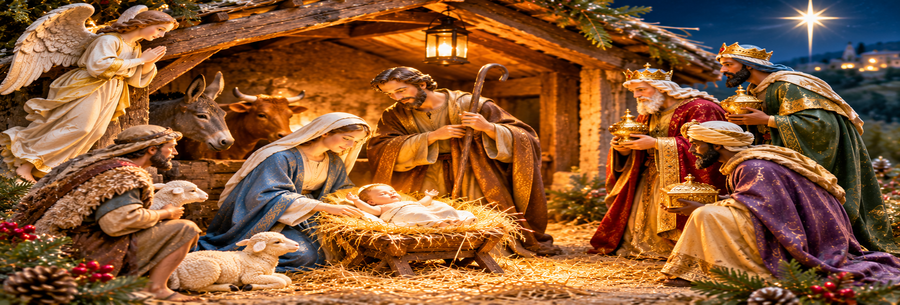
Find out why you should set up a nativity scene at home, its origins with Saint Francis of Assisi, the significance of the nativity figures, and its importance in passing on the Christian faith within the family.
Why put up a nativity scene at home? A Christian tradition to welcome Jesus into your home
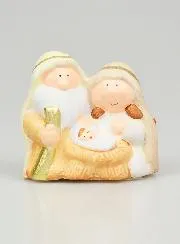
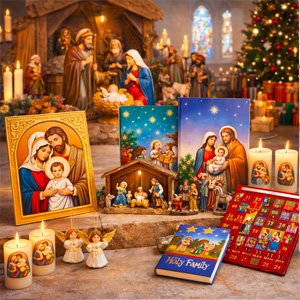
Every year, as Christmas approaches, many Christian families set up a nativity scene in their homes. Whether it consists of a few figurines arranged in a small stable or a full-scale Provençal village with its houses, shepherds and craftsmen, the nativity scene holds a special place in Christmas traditions.
For Christians, it is much more than just a decoration. The Christmas nativity scene depicts the birth of Jesus Christ in Bethlehem and recalls the mystery of the Incarnation: God became man to come and meet humanity.
Setting up a nativity scene at home means giving Jesus a prominent place at the heart of Christmas preparations. It is also a way of passing on the faith to children, of gathering as a family around the story of the Nativity, and of rediscovering the values of simplicity, humility, peace and love.
This tradition, deeply rooted in Christian history, invites us to contemplate an extraordinary event: the birth of the Saviour in the poverty of a manger, surrounded by Mary, Joseph and the first witnesses to his coming.
But where does the tradition of the nativity scene come from? Why is Jesus depicted in a stable? What is the significance of the different figures? And why is it important to keep this tradition alive in our homes?
1. The Christmas nativity scene: a depiction of the birth of Jesus
The word ‘crèche’ originally referred to a manger used to feed animals.
In the Gospel according to Saint Luke, Mary gives birth to Jesus in Bethlehem, wraps him in swaddling clothes and lays him in a manger.
This detail has become one of the most important symbols of the Nativity.
The account of the birth of Jesus in the Bible
The Gospel according to Saint Luke recounts that Mary and Joseph travelled to Bethlehem, a town associated with King David, for a census.
During their stay, Mary gave birth to Jesus.
The evangelist states that she laid him in a manger, as there was no room for them in the inn where they might have stayed.
Nearby, shepherds were tending their flocks.
An angel announces to them the birth of the Saviour, Christ the Lord.
The shepherds then go to Bethlehem and find Mary, Joseph and the Child lying in the manger.
This event lies at the heart of the Christian festival of Christmas.
Why was Jesus born in a manger?
The manger emphasises the simplicity of the circumstances of his birth.
The one whom Christians recognise as the Son of God does not come into the world in a palace.
From the moment of his birth, he shares in the fragility of the human condition.
The nativity scene thus reminds us that God’s greatness is revealed in humility.
It invites believers not to seek only wealth, power or honours, but to recognise the value of simple things.
The nativity scene helps us to contemplate the mystery of the Incarnation
The Incarnation is one of the fundamental truths of the Christian faith.
It means that the eternal Son of God took on our human nature in Jesus Christ.
By contemplating the Baby Jesus in the nativity scene, the faithful are invited to reflect on this love of God.
The nativity scene makes this mystery accessible to everyone, particularly children.
Through its figures and a familiar scene, it helps us to understand that Christmas celebrates, above all, God’s coming amongst humankind.
2. What is the origin of the Christmas nativity scene tradition?
The depiction of the birth of Jesus dates back to the early centuries of Christianity.
Images of the Nativity gradually appeared in early Christian art.
However, the tradition of the live nativity scene, which has strongly influenced today’s family nativity scenes, is particularly associated with Saint Francis of Assisi.
St Francis of Assisi and the Greccio nativity scene in 1223
In 1223, St Francis of Assisi organised a Christmas celebration in Greccio, a village in Italy.
He wanted to help the faithful better understand the poverty and humility in which Jesus was born.
He had a manger prepared with hay and brought in an ox and a donkey.
A Mass was celebrated in this setting.
Tradition has it that this re-enactment deeply moved those present.
St Francis wanted to bring home the mystery of the Nativity and invite everyone to contemplate God’s love manifested in the Child Jesus.
Why did Saint Francis wish to re-enact the Nativity?
Saint Francis attached great importance to evangelical poverty.
For him, the birth of Jesus in a manger was a particularly powerful expression of God’s humility.
He wanted Christians not merely to hear the Christmas story, but to grasp its depth in a tangible way.
The Greccio nativity scene thus became a major event in the history of devotion to the Nativity.
The spread of nativity scenes in churches and homes
Over the centuries, depictions of the Nativity became widespread in churches, monasteries and Christian homes.
The figures took on different forms depending on the region and artistic traditions.
In Italy, Neapolitan nativity scenes became particularly famous for the richness and diversity of their figures.
In Provence, the tradition of ‘santons’ gave rise to scenes depicting both the Nativity and everyday village life.
Today, nativity scenes can be found all over the world.
They can be made from wood, terracotta, ceramics, resin, stone or other materials.
Despite this diversity, they all convey the same message: Jesus came amongst mankind.
3. Why put up a nativity scene in your home?
Putting up a nativity scene at home adds a visible Christian dimension to the preparations for Christmas.
Decorations, garlands and the Christmas tree all help to create a festive atmosphere.
The nativity scene, however, serves as a reminder of the religious significance of this celebration.
Placing Jesus at the centre of Christmas
In the Christian tradition, Christmas is not merely a festival of presents and family reunions.
It is, above all, the celebration of the Saviour’s birth.
The nativity scene helps to keep this mystery present throughout Advent and the Christmas season.
It reminds us that the Baby Jesus is at the heart of the celebration.
Making your home a place of faith
The Christian faith is not lived out solely in church.
It also has its place in everyday life, within the family.
Setting up a nativity scene is a simple way of expressing this faith.
It can become a place of prayer, silence and meditation.
Sometimes, just a few moments spent before the nativity scene are enough to remember God’s presence and entrust to him the joys or difficulties of the day.
Rediscovering what really matters whilst preparing for Christmas
December can be a particularly busy month.
Shopping, preparing meals and numerous commitments often take up a large part of our time.
The nativity scene invites us to slow down.
It reminds us that the true meaning of Christmas does not lie in material abundance.
It lies in God’s love, in simplicity and in the joy of his coming.
4. The significance of the figures in the Christmas nativity scene
Each figure in the nativity scene has a special place.
Some are mentioned directly in the Gospel accounts, whilst others stem from Christian traditions that have developed over the centuries.
The Baby Jesus: the heart of the nativity scene
The Baby Jesus is the central figure.
His presence reminds us of the mystery of the Incarnation.
For Christians, this child is the Son of God who came to bring salvation to humanity.
His birth in simplicity teaches us humility and love.
In many families, the figurine of Jesus is placed in the manger on the evening of 24 December or the morning of 25 December.
This gesture symbolically marks the fulfilment of the Advent season.
The Virgin Mary: trust and faithfulness to God
Mary occupies a central place in the Nativity scene.
She welcomed the announcement from the angel Gabriel and agreed to become the mother of Jesus.
In the Gospel, she is portrayed as a woman of faith, attentive to God’s will.
The nativity scene usually depicts her with her child, in an attitude of tenderness and contemplation.
She invites us to welcome Christ with trust and humility.
Saint Joseph: protection and responsibility
Joseph is Mary’s husband and the legal father of Jesus.
He watches over his family and fulfils the mission entrusted to him.
In the Gospels, he is distinguished by his obedience to God, his discretion and his courage.
The nativity scene often depicts him standing or kneeling beside Mary and Jesus.
He reminds us of the importance of family protection, work and faithfulness.
The shepherds: the first witnesses to the birth
In the Gospel according to Saint Luke, the shepherds are the first to receive the angelic announcement of the Saviour’s birth.
They represent simple people, living by their labour.
Their presence emphasises that the Good News of Christmas is meant for everyone.
They teach us to respond to God’s call with trust and simplicity.
The angels: messengers of joy
Angels play an important role in the Nativity stories.
They announce the birth of Jesus to the shepherds and proclaim the glory of God.
At the manger, they remind us that Christmas is an event that concerns both earth and heaven.
Their presence expresses joy and praise.
The Three Wise Men: the coming of the Saviour for all peoples
The Gospel according to Saint Matthew recounts the visit of the Magi from the East who came to pay homage to Jesus.
They offer him gold, frankincense and myrrh.
Christian tradition generally depicts them as three in number and gives them the names Caspar, Melchior and Balthazar, although these details do not appear in the biblical account.
Their presence symbolises the recognition of Christ by the nations.
In many families, the Magi are added to the nativity scene or placed near the Baby Jesus to mark Epiphany.
The ox and the donkey: animals from Christian tradition
The ox and the donkey are frequently depicted beside the manger.
However, the Gospels do not explicitly mention their presence at the time of Jesus’ birth.
They form part of an ancient tradition, drawing in particular on the interpretation of certain passages from the Old Testament.
Their presence helps to emphasise the simplicity and humility of the scene.
5. Why do the santons of Provence hold a special place in nativity scenes?
In France, and particularly in Provence, the tradition of the santons holds great cultural and religious significance.
The word ‘santon’ comes from the Provençal santoun, which means ‘little saint’.
These small figurines depict the characters of the Nativity, but also the inhabitants of a traditional village.
A tradition that developed in the late 18th century
The production of Provençal santons flourished particularly in Marseille in the late 18th century.
During the Revolutionary period, whilst public religious practice was subject to severe restrictions, domestic nativity scenes took on particular significance.
Artisans produced small clay figurines that were affordable for families.
This tradition subsequently spread throughout Provence.
The trades and the villagers
Provençal nativity scenes do not merely depict Mary, Joseph and Jesus.
They also include shepherds, bakers, millers, fishermen, washerwomen and many other figures.
Everyone seems to be making their way towards the nativity scene to welcome the Baby Jesus.
This depiction has a beautiful meaning.
It reminds us that all people, whatever their trade, age or social status, are invited to come and meet Christ.
A tradition that unites faith and heritage
The santons form part of Provençal cultural heritage.
They help to pass on local traditions whilst keeping the Nativity story at the centre of the scene.
For many families, setting up the santons is a much-anticipated moment each year.
The figures are sometimes passed down from generation to generation.
The nativity scene thus becomes a link between faith, family and the memory of our ancestors.
6. Why is the Christmas nativity scene important for children?
The nativity scene is a wonderful way to explain the birth of Jesus to children.
Younger children often find it easier to understand a story when they can see and handle the figures.
The nativity scene makes the biblical story tangible and accessible.
Explaining the birth of Jesus in simple terms
Parents can introduce the figures one by one.
They can explain that Mary and Joseph travelled to Bethlehem, that Jesus was born in a manger and that shepherds came to see him.
This story can be told using words appropriate to the child’s age.
Learning the meaning of Christmas
For children, Christmas is often associated with receiving presents.
The nativity scene serves as a reminder that this festival celebrates, above all, the birth of Jesus.
It shows that, in the Christian faith, the greatest Christmas gift is the coming of the Son of God amongst mankind.
Discovering Christian values
Each figure can provide an opportunity to discuss a particular value.
Mary teaches trust.
Joseph symbolises protection and responsibility.
The shepherds represent simplicity.
The Magi symbolise the search for God and the act of giving.
The Baby Jesus reminds us of love and humility.
Involving children in setting up the nativity scene
Children can help arrange the nativity figures, animals and decorative elements.
They can also gradually move the shepherds or the Magi closer to the manger.
These simple actions make them active participants in the preparations for Christmas.
They help to create lasting family memories.
7. When should you set up the nativity scene at home?
There is no set date for setting up a family nativity scene.
Customs vary according to region and tradition.
Some families set it up as early as the first Sunday of Advent.
Others wait until the start of December or the Feast of the Immaculate Conception on 8 December.
Setting up the nativity scene during Advent
Setting up the nativity scene at the start of Advent allows you to gradually build up to Christmas.
The family can start by setting up the stable and the main figures.
The other figurines are added over the course of the weeks.
This gradual setting up becomes a spiritual activity.
When should the Baby Jesus be placed in the manger?
In many Christian families, the Baby Jesus is not placed in the manger straight away.
He is added on the evening of 24 December, after Christmas Mass, or on the morning of 25 December.
This gesture symbolises the birth of the Saviour.
It helps children understand that the whole period of Advent builds up to this event.
When should the Three Wise Men be placed?
The Wise Men are traditionally associated with Epiphany.
They can be placed some distance from the nativity scene during Advent and gradually moved closer.
In some families, they are placed by the manger on Epiphany.
This tradition helps to prolong the joy of Christmas.
8. How long can the Christmas nativity scene be left up?
The nativity scene can remain on display throughout the Christmas season.
In the Roman liturgical calendar, this season ends with the Feast of the Baptism of the Lord.
However, some family traditions keep the nativity scene up until 2 February, the Feast of the Presentation of Jesus in the Temple.
The tradition of 2 February
2 February is celebrated forty days after Christmas.
This feast commemorates the presentation of Jesus at the Temple in Jerusalem by Mary and Joseph.
It is also known as Candlemas.
In some regions, the nativity scene remains on display until this date.
This is a popular custom rather than a religious obligation.
Extending the contemplation of Christmas
Keeping the nativity scene up after 25 December serves as a reminder that the birth of Jesus is not limited to a single day.
The Christmas season invites us to reflect more deeply on the mystery of the Incarnation.
The nativity scene thus remains a sign of joy and hope at the heart of the home.
9. Where should the Christmas nativity scene be placed in the home?
There are no rules dictating a specific location.
The nativity scene can be set up in the living room, on a piece of furniture, near the Christmas tree or in a space set aside for prayer.
The main thing is to give it a place where it can be contemplated and where one can reflect in peace.
Near the Christmas tree
Placing the nativity scene near the Christmas tree is a widespread tradition.
The Christmas tree and its lights create a festive atmosphere.
The nativity scene serves as a reminder of the Christian significance of this festival.
These two elements can thus complement each other harmoniously.
In a prayer corner
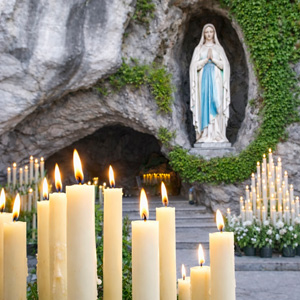
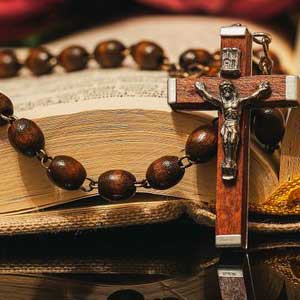
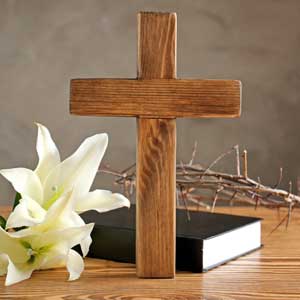
Some families prefer to place the nativity scene near a Bible, a cross or an image of the Virgin Mary.
It then becomes a place of contemplation.
It is possible to pause there each day to say a short prayer.
At the heart of family life
The nativity scene can also be set up in a place where the family gathers regularly.
Its presence serves as a reminder that Jesus must be welcomed into the heart of daily life.
A small, simple nativity scene can have just as much spiritual value as a large, richly decorated display.
10. Why say a prayer before the Christmas nativity scene?
The nativity scene naturally invites prayer.
As they contemplate the Baby Jesus, Christians can thank God for the gift of his Son.
They can also entrust their families, their difficulties and their hopes to Him.
A moment of silence and reflection
There is no need to recite long prayers.
A few moments of silence before the nativity scene may be enough.
This moment allows us to find inner peace and to remember the true meaning of Christmas.
A family prayer
Parents can gather the children round the nativity scene.
Everyone can offer up an intention.
We can pray for those who are ill, families in difficulty, or those spending Christmas alone.
This practice reminds us that Christian joy must be shared.
An invitation to charity
Praying before the nativity scene can also lead to concrete acts of kindness.
The Baby Jesus, born in poverty, invites us to be mindful of the most vulnerable.
Helping someone in need, sharing a meal or giving someone your time can become a way of carrying forward the message of Christmas.
11. The Christmas nativity scene teaches us humility and simplicity
One of the deepest lessons of the nativity scene is that of humility.
In the Christian faith, Jesus is the Son of God.
Yet he chose to come into the world in humble circumstances.
God draws near to humankind
The birth of Jesus reveals a God who does not remain distant from humanity.
He comes to share our human condition.
He knows the fragility, poverty and difficulties of human existence.
The nativity scene invites us to contemplate this closeness.
True greatness does not depend on wealth
In the manger at Bethlehem, there is neither a throne nor a palace.
There is a child, his mother and Joseph.
This simplicity reminds us that human dignity does not depend on wealth or social status.
It invites Christians to regard others with respect and compassion.
Rediscovering the meaning of what really matters
At Christmas, it is easy to get caught up in the pursuit of ever more decorations or ever more expensive presents.
The nativity scene reminds us that happiness can be found in simplicity.
The presence of loved ones, prayer, sharing and love are the true riches.
12. The Christmas nativity scene, a symbol of peace and hope
The birth of Jesus is announced to the shepherds as a great joy intended for all people.
The angels proclaim the glory of God and announce peace.
The nativity scene thus becomes a symbol of reconciliation and hope.
An invitation to peace within families
The Christmas season can be an opportunity to renew family ties.
Contemplating the nativity scene invites us to move beyond grudges and divisions.
It reminds us that Jesus came to proclaim love and forgiveness.
A thought for those who are suffering
The nativity scene can also lead us to think of those living in precarious circumstances.
The Holy Family experienced the hardships of travel, uncertainty and, according to the Gospel of Matthew, exile in Egypt.
These accounts invite Christians to be mindful of displaced families, the homeless and all those facing hardship.
Hope for the world
The birth of Jesus reminds us that God does not abandon humanity.
Even in a world marked by conflict and suffering, the Christian faith proclaims that God’s love remains present.
The nativity scene thus becomes a sign of light amidst difficulties.
13. Should one have one’s Christmas nativity scene blessed?
In the Catholic tradition, it is possible to have a nativity scene blessed.
Some parishes offer a blessing of family nativity scenes during Advent or in the run-up to Christmas.
However, this blessing is not compulsory.
The meaning of a blessing
A blessing is a prayer through which the Church gives thanks to God and asks for his help.
Having a nativity scene blessed allows us to entrust our Christmas preparations and family life to the Lord.
It is not a matter of attributing any special power to the figurines.
The blessing serves as a reminder that the nativity scene is intended to support prayer and nourish faith.
A prayer when setting up the nativity scene
Even without a specific blessing, a family can gather round the nativity scene to pray.
This moment symbolically marks the start of the run-up to Christmas.
It allows us to entrust the coming weeks to God.
14. Why should we keep the tradition of the Christmas nativity scene alive today?
In a society where Christmas is sometimes portrayed more as a commercial festival than as a religious celebration, the nativity scene retains a special significance.
It serves as a reminder of the Christian origins of Christmas.
Preserving the memory of the Nativity
The nativity scene conveys a story that has occupied a central place in the Christian faith for nearly two thousand years.
It helps to keep the memory of Jesus’ birth alive.
Passing on the faith across generations
Many families own nativity figures passed down by their parents or grandparents.
Every year, setting up the nativity scene becomes a time for sharing.
The older members of the family recount the traditions of their childhood.
The children discover the figures and their significance.
The nativity scene thus creates a bond between generations.
A simple expression of one’s faith
Setting up a nativity scene at home is also a discreet and peaceful way of expressing one’s Christian faith.
It reminds us that Christmas has a profound spiritual dimension.
It invites us to contemplate God’s love manifested in the birth of Jesus.
15. A prayer to say before the Christmas nativity scene
Lord Jesus,
As we contemplate your birth in the stable at Bethlehem,
We thank you for coming amongst mankind.
You who are the Son of God,
You chose to be born in simplicity and humility.
Teach us to recognise your presence in our daily lives.
Following the example of the Virgin Mary, grant us a heart filled with trust.
Following the example of Saint Joseph, teach us faithfulness and courage.
Like the shepherds, help us to welcome your coming with joy.
May our home be a place of peace, forgiveness and love.
Protect our family and be with those who are suffering.
On this Christmas Day, let faith, hope and love grow within us.
May the light of your birth illuminate our hearts and guide us each day.
Amen.
Conclusion: setting up a nativity scene is a way of welcoming Jesus into the heart of one’s home
The nativity scene is one of the most beautiful and profound traditions of Christianity.
Ever since St Francis of Assisi and the nativity scene at Greccio in 1223, it has enabled the faithful to contemplate the mystery of the Saviour’s birth.
Each figure recalls an essential aspect of the Christian faith.
Mary teaches us trust.
Joseph shows us faithfulness and protection.
The shepherds represent simplicity.
The Magi symbolise the search for God.
And the Baby Jesus, placed at the centre of the manger, reveals God’s love for humanity.
Setting up a nativity scene in one’s home allows this faith to be given a visible place.
It is also a way of passing on the true meaning of Christmas to children, of preserving family traditions and of creating a space for prayer at the heart of the home.
The nativity scene reminds us that the birth of Jesus is not merely an event of the past.
It remains an invitation to welcome Christ into our lives.
Setting up a nativity scene at home is therefore much more than simply decorating your home: it is symbolically opening one’s door and heart to Jesus.
In the simplicity of Bethlehem, God comes to meet humankind.
And every year, when we set up our nativity scene, we are invited to rediscover this essential truth: the greatest Christmas gift is God’s love revealed in the birth of his Son.