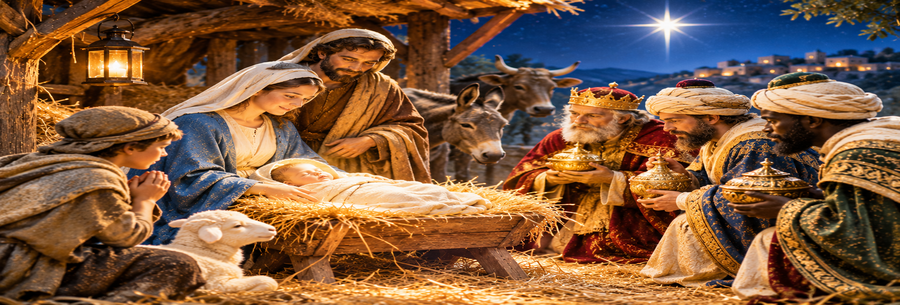
Discover the story of Jesus’ birth in the Bible, from the Annunciation to Bethlehem, from the shepherds to the Three Wise Men, and understand the deeper meaning of Christmas as told in the Gospels.
The Birth of Jesus in the Bible: The Christmas Story and Its Significance for Christians
Every year, on 25 December, Christians around the world celebrate Christmas, one of the most important festivals in the liturgical calendar. Behind the fairy lights, nativity scenes, carols and family traditions lies a fundamental event in the Christian faith: the birth of Jesus Christ in Bethlehem, as recounted in the Bible.
Over two thousand years ago, in a region then under the rule of the Roman Empire, a child was born into humble circumstances. His mother, Mary, wrapped him in swaddling clothes and laid him in a manger. Shepherds came to visit him after receiving an announcement from an angel. Later, wise men from the East set out to pay him homage.
For Christians, this child is not merely a historical figure. He is the Son of God, the Messiah foretold by the prophets, who came amongst mankind to bring them salvation.
The Gospels of Saint Matthew and Saint Luke recount the main events surrounding his birth. Their accounts, which differ but complement one another in Christian tradition, enable us to discover the mystery of the Nativity and to understand why Christmas holds such an important place in the life of the Church.
Why was Jesus born in Bethlehem? How did the Virgin Mary learn that she would become his mother? Why did the angels announce his birth to the shepherds? Who were the Magi who came from the East? And what does the biblical Christmas story teach us today?
To answer these questions, let us return to the texts of the Bible and follow the events leading up to the birth of the Saviour.
1. The birth of Jesus: which passages in the Bible tell the story of Christmas?
The birth of Jesus is mainly recounted in two books of the New Testament: the Gospel according to Saint Matthew and the Gospel according to Saint Luke.
These two accounts do not present exactly the same events or the same details. Each highlights a particular aspect of Christ’s coming.
The Gospel according to Saint Luke: from the Annunciation to the visit of the shepherds
The first two chapters of the Gospel according to Saint Luke recount, in particular, the announcement of the birth of John the Baptist, the Annunciation to Mary, the Visitation, the birth of Jesus in Bethlehem and the adoration of the shepherds.
Saint Luke places great emphasis on the Virgin Mary, her faith and her acceptance of the divine will.
He also describes the humble circumstances of Jesus’ birth and the joy of the shepherds as they discover the Saviour.
It is in this Gospel that the account traditionally read during the Christmas Eve Mass is found.
The Gospel according to Saint Matthew: Joseph, the star and the Magi
The first two chapters of the Gospel according to Saint Matthew present the genealogy of Jesus, the announcement made to Joseph, the birth of Christ, the visit of the Magi, the flight into Egypt and the return of the Holy Family.
St Matthew places particular emphasis on the fulfilment of the Scriptures and on Jesus’ place in the history of the people of Israel.
His account shows that Jesus is the long-awaited Messiah, descended from David.
And what about the Gospels of Mark and John?
The Gospel according to Saint Mark does not contain an account of Jesus’ childhood. It begins its narrative with the preaching of John the Baptist and the start of Christ’s public ministry.
Nor does the Gospel according to Saint John recount the birth in Bethlehem in the form of a historical narrative.
It does, however, present a fundamental theological reflection on the Incarnation, particularly in its prologue:
‘ And the Word became flesh and dwelt amongst us.’ (John 1:14)
This statement expresses the heart of the mystery of Christmas: the eternal Son of God took on our human nature.
2. Before the birth of Jesus: the prophets foretell the coming of the Messiah
To understand Christmas in the Bible, we must go back well before the birth of Jesus.
The Old Testament tells the story of the Covenant between God and the people of Israel.
Over the centuries, the prophets foretold God’s saving intervention and nurtured the hope of a Messiah.
In the Christian interpretation of Scripture, many of these texts find their fulfilment in Jesus Christ.
The prophet Isaiah foretells a great light
The Book of Isaiah contains a passage that is particularly significant in the Christmas liturgy.
The prophet foretells that a people plunged into darkness will see a great light.
He also speaks of the birth of a child associated with peace and kingship.
This passage, found in Isaiah 9, is traditionally read in the light of the birth of Christ.
For Christians, Jesus is the one who brings God’s light to the world and opens a path to peace and salvation.
The prophet Micah and the town of Bethlehem
The prophet Micah refers to Bethlehem as the place from which a leader destined to guide Israel will come.
This prophecy, found in Micah 5, occupies an important place in the Gospel according to Saint Matthew.
When the Magi arrive in Jerusalem and ask where the King of the Jews is to be born, the scribes specifically mention Bethlehem.
In the biblical narrative, this small town thus becomes the place where the messianic promises are fulfilled.
Why is Jesus called the Son of David?
In the Gospels, Jesus is presented as belonging to the lineage of King David.
This lineage has profound religious significance.
God had promised David that his descendants would occupy a special place in the history of salvation.
By presenting Jesus as a descendant of David, the Gospel writers emphasise that he is the Messiah awaited by Israel.
Bethlehem, a town associated with King David, thus takes on particular significance in the Christmas narrative.
3. The Annunciation: the angel Gabriel announces to Mary that she will be the mother of Jesus
The story of Jesus’ birth begins, in the Gospel according to Saint Luke, with an extraordinary encounter.
In the town of Nazareth, in Galilee, lived a young woman called Mary.
She was betrothed to Joseph, a man of the house of David.
One day, God sent the angel Gabriel to her.
The angel announced to Mary that she had found favour with God and that she would conceive a son.
This child was to be named Jesus.
The angel Gabriel’s message
The angel announced to Mary that she had found favour with God and that she would conceive a son.
This child was to be named Jesus.
The angel Gabriel’s message
The angel announced to Mary that she had found favour with God and that she would conceive a son.
This child was to be named Jesus.
The angel Gabriel’s message
The angel announced to Mary that she had found favour with God and that she would conceive a son.
This child was to be named Jesus.
The angel Gabriel’s message
The angel announced to Mary that she had found favour with God and that she would conceive a son.
This child was to be named Jesus.
The angel Gabriel’s message
The angel announced to Mary that she had found favour with God and that she would conceive a son.
This child was to be
The message from the angel Gabriel
The angel tells Mary that she has found favour with God and that she will conceive a son.
This child is to be named Jesus.
Gabriel also reveals to her that her son will be great and will be called the Son of the Most High.
Mary is troubled by this announcement.
She tries to understand how such an event could take place.
The angel explains to her that this conception will be the work of the Holy Spirit.
Mary’s ‘yes’: an act of faith and trust
Mary freely accepts the mission entrusted to her by God.
She replies:
‘Behold, I am the handmaid of the Lord; let it be done to me according to your word. ’ (Luke 1:38)
This response marks a pivotal moment in the history of salvation.
In the Catholic tradition, Mary’s consent is regarded as an act of faith, humility and total trust in God.
Mary does not yet know all the difficulties she will face.
Yet she agrees to welcome the Son of God and to take part in the mystery of the Incarnation.
Her attitude becomes a model for all Christians.
Why is the Annunciation important for Christmas?
The feast of Christmas celebrates the birth of Jesus, but the mystery of the Incarnation begins with his conception.
The Annunciation, celebrated on 25 March in the liturgical calendar, commemorates the moment when the Son of God took flesh in the womb of the Virgin Mary.
Nine months later, on 25 December, the Church celebrates his birth.
These two feasts are therefore deeply connected.
4. The Visitation: Mary meets her cousin Elizabeth
After the Annunciation, Mary goes to visit her relative Elizabeth, who is also expecting a child.
This child would be John the Baptist.
The Gospel according to Saint Luke recounts that, when Mary arrived and greeted Elizabeth, the child leapt for joy in his mother’s womb.
Elizabeth, filled with the Holy Spirit, recognises the special blessing bestowed upon Mary.
Mary proclaims the Magnificat
In response, Mary raises a magnificent prayer of praise to God: the Magnificat.
In it, she thanks the Lord for the wonders he has wrought and proclaims his mercy towards the humble.
This canticle now occupies an important place in the Church’s daily prayer, particularly during Vespers.
It expresses Mary’s joy at the fulfilment of God’s promises.
An encounter that already heralds the joy of Christmas
The Visitation shows that the coming of Jesus is a source of joy even before his birth.
It also reminds us of the importance of charity.
Mary, whilst expecting a child herself, sets out to visit Elizabeth.
She teaches us that true faith is also expressed through service and care for others.
5. Saint Joseph: the man chosen to protect Mary and Jesus
In the Gospel according to Saint Matthew, Saint Joseph plays a key role.
Joseph is presented as a righteous man, betrothed to Mary.
When he learns that she is expecting a child, he finds himself faced with a situation he does not understand.
He therefore considers parting from her discreetly.
But God intervenes.
The angel appears to Joseph in a dream
An angel of the Lord appears to Joseph whilst he is asleep.
He tells him not to be afraid to take Mary into his home.
He reveals to him that the child she is carrying is from the Holy Spirit.
The angel also asks him to name the child Jesus.
This name has a special significance, as it is associated with the salvation that God brings to his people.
Joseph’s silent obedience
Upon waking, Joseph does as the angel asked.
He takes Mary into his home and accepts the task of looking after her and the child.
The Gospel does not record any words spoken by Joseph.
Yet his actions bear witness to a deep faith.
He listens to God, trusts in him and acts with courage.
In Christian tradition, Saint Joseph is thus recognised as a model of fidelity, responsibility and family love.
6. The journey from Nazareth to Bethlehem: why did Mary and Joseph have to set out?
The Gospel according to Saint Luke places the birth of Jesus in the context of a census ordered by Emperor Augustus.
Joseph, a descendant of the house of David, travelled from Nazareth to Bethlehem in Judea.
Mary accompanies him whilst she is expecting her child.
Bethlehem, the city of David
Bethlehem is a small town situated south of Jerusalem.
It holds an important place in biblical history, as it is associated with King David.
In Saint Luke’s account, Joseph’s journey allows us to situate the birth of Jesus in this town.
For Christians, this birth in Bethlehem signifies the fulfilment of the messianic promises.
A journey in modest circumstances
The Bible does not provide a detailed description of Mary and Joseph’s journey.
In particular, it does not specify the means of transport used.
The depiction of Mary travelling on a donkey is part of Christian iconographic tradition, but it is not explicitly mentioned in the Gospels.
Above all, the biblical account invites us to contemplate the simplicity of the circumstances in which the Saviour came into the world.
We must also distinguish the text’s theological message from historical questions concerning the census and its chronology, which remain the subject of debate amongst specialists.
7. The birth of Jesus in Bethlehem: the Nativity story according to Saint Luke
The best-known account of the birth of Jesus is found in the Gospel according to Saint Luke, chapter 2.
Whilst Mary and Joseph are in Bethlehem, the time of the birth arrives.
Mary gives birth to her first-born son.
She wraps him in swaddling clothes and lays him in a manger, as there was no room for them in the inn.
These few lines, in all their simplicity, form the heart of the biblical Christmas story.
Why is Jesus lying in a manger?
A manger is a trough used to hold food for animals.
The fact that Jesus was laid there emphasises the humble circumstances of his birth.
The Bible does not describe the building in which he was born in detail.
Depictions of a stable or a cave have developed within Christian tradition.
The presence of the manger naturally helped to associate the Nativity with a place where animals were kept.
But the essence of the biblical message lies elsewhere.
The Son of God comes into the world in simplicity and poverty.
God’s greatness revealed in the fragility of a child
The birth of Jesus presents a striking contrast.
The One whom Christians recognise as the eternal Son of God appears in the form of a newborn baby.
He is dependent on his mother’s love and care.
He does not display his power through wealth, weapons or honours.
He presents himself in humility.
This birth reveals to us an essential dimension of the Christian faith: God chooses to draw near to humanity by fully sharing in its condition.
The poverty of Bethlehem and the message of Christmas
The manger in Bethlehem reminds us that a person’s dignity does not depend on their wealth.
The birth of Christ invites Christians to view the poor, the vulnerable and the marginalised in a different light.
It also teaches that the greatest expressions of love can occur in the simplest of circumstances.
At Christmas, the Church thus invites the faithful not to forget those who suffer, those who live in solitude and those who lack the necessities of life.
8. The announcement to the shepherds: the good news of Christmas for everyone
In the countryside around Bethlehem, shepherds spend the night in the fields tending their flocks.
Suddenly, an angel of the Lord appears to them.<
The glory of God envelops them in light.
The shepherds are seized with fear.
But the angel reassures them and announces great joy: a Saviour has just been born in the city of David.
Why were the shepherds the first to be told?
In Saint Luke’s account, the shepherds occupy a special place.
They were simple men, living by the labour of their hands.
The choice of these first recipients of the announcement has a profound spiritual significance.
It reminds us that the coming of Christ concerns all people, regardless of their wealth or social status.
The salvation announced by God is not reserved for the powerful.
It is offered to all humanity.
The angels’ song
After the announcement to the shepherds, a multitude of angels appeared and praised God.
Their song links divine glory with the peace offered to humankind.
This praise is the origin of the Gloria sung in the Catholic liturgy.
During Christmas Mass, this hymn takes on a particularly solemn character.
It reminds us that the birth of Jesus is a source of joy for heaven and earth.
9. The shepherds go to Bethlehem to worship the Baby Jesus
After hearing the angels’ announcement, the shepherds decide to go to Bethlehem.
They want to see the event that has just been announced to them.
They find Mary, Joseph and the newborn baby lying in a manger.
St Luke’s account specifies that they recount what had been revealed to them about the child.
All who hear them are amazed.
The shepherds’ faith: listening, believing and acting
The shepherds offer us an example of simple and spontaneous faith.
They listen to God’s message.
They place their trust in him.
Then they set off.
This course of action can be seen as a model for Christian life.
Faith does not consist merely in hearing the Word of God.
It also calls us to respond to it through our actions.
Mary treasured these events in her heart
The Gospel highlights a particular attitude of the Virgin Mary.
Whilst the shepherds recount the wonders that had been announced to them, Mary keeps these events and ponders them in her heart.
This attitude expresses the depth of her faith.
Mary does not seek to explain everything immediately.
She embraces the mystery and contemplates it in silence.
At Christmas, she invites us to do the same: to take the time to reflect on the birth of Jesus, beyond the hustle and bustle of the festivities.
10. The Star of Bethlehem and the visit of the Magi from the East
The Gospel according to Saint Matthew recounts that, after the birth of Jesus, the Magi from the East arrived in Jerusalem.
They declared that they had seen a star associated with the birth of the King of the Jews.
They wished to pay him homage.
King Herod, troubled by this news, consulted the chief priests and the experts in the Scriptures.
They tell him that the Messiah is to be born in Bethlehem.
Who were the Magi really?
The Gospel speaks of magi from the East.
It does not specify that they were kings.
Nor does it give their number or their names.
Christian tradition has gradually come to depict them as three kings, named Caspar, Melchior and Balthazar.
The number three is notably associated with the three gifts mentioned in the Gospel.
The Magi are generally understood to be scholars or wise men from eastern regions.
Their presence has universal significance.
They represent the nations that come to recognise Jesus as the Messiah.
What does the Star of Bethlehem represent?
The star guides the Magi to the place where Jesus is.
In Christian tradition, it symbolises the light that leads people to Christ.
It serves as a reminder that God reveals himself to those who sincerely seek him.
The exact nature of the star mentioned in the Gospel remains uncertain.
Various astronomical hypotheses have been put forward, but none of them allows the event described to be established with certainty.
The essence of the story lies in its religious significance: the Magi are led to the Saviour.
11. Gold, frankincense and myrrh: the significance of the Magi’s gifts
When the Magi find Jesus, they bow down before him and offer him their gifts.
The Gospel mentions three gifts: gold, frankincense and myrrh.
In Christian tradition, each has a symbolic meaning.
Gold: Jesus is king
Gold is a precious metal traditionally associated with royalty.
By offering gold to Jesus, the Magi symbolically recognise his royal dignity.
But Christ’s kingship is not one based on political domination.
It is linked to truth, justice and love.
Incense: Jesus is God
Incense has been used in religious practices since ancient times.
Its rising smoke evokes prayer and worship.
In the traditional Christian interpretation, the frankincense offered to Jesus recalls his divinity.
Myrrh: Jesus shares our human condition
Myrrh is an aromatic resin used in particular in perfumes and ancient funerary practices.
In Christian tradition, it symbolically heralds the Passion and death of Christ.
This gift reminds us that the Child of Bethlehem came to fulfil a mission of salvation that would be accomplished through the Cross and the Resurrection.
The visit of the Magi and the Epiphany
The Church particularly celebrates the manifestation of Christ to the nations on the feast of the Epiphany.
This feast extends the mystery of Christmas.
It reminds us that Jesus did not come for one people alone, but for all humanity.
12. King Herod and the Flight into Egypt: the first trials of the Holy Family
Saint Matthew’s account does not end with the visit of the Magi.
It also recounts the dangers faced by the Holy Family.
Herod, fearing the emergence of a rival, seeks to kill the child.
An angel warns Joseph in a dream and asks him to flee to Egypt with Mary and Jesus.
Joseph protects the Infant Jesus
Joseph obeys immediately.
He takes the child and his mother and sets off.
This flight reminds us that, from the very earliest years of his life, Jesus experienced insecurity and exile.
The Holy Family thus becomes, for Christians, a figure particularly close to the hearts of families who have been displaced, persecuted or forced to leave their country.
The Massacre of the Innocents
The Gospel according to Saint Matthew recounts that Herod ordered the killing of all the young boys in Bethlehem and the surrounding area.
This episode is known in Christian tradition as the Massacre of the Holy Innocents.
The Catholic Church commemorates the Holy Innocents on 28 December.
This account serves as a reminder of the violence to which the most vulnerable can fall victim.
It also calls on Christians to defend the dignity and lives of children.
The Return to Nazareth
After Herod’s death, Joseph receives another warning in a dream.
He returned with Mary and Jesus to the land of Israel.
The family finally settled in Nazareth.
It was in this town that Jesus grew up before beginning his public ministry.
13. The mystery of the Incarnation: why did God choose to become man?
The birth of Jesus cannot be understood solely as a family or historical event.
For Christians, it reveals one of the greatest mysteries of the faith: the Incarnation.
This term means that the eternal Son of God assumed a true human nature.
Jesus is recognised by the Church as true God and true man.
God comes to meet humanity
In the Christian faith, God does not remain distant from humankind.
He chooses to share in their existence.
In Jesus, he experiences birth, growth, work, fatigue, human relationships and suffering.
This closeness manifests his love.
Christmas thus reminds us that God is not indifferent to the human condition.
Jesus comes to bring salvation
The name ‘Jesus’ is linked to the mission of salvation entrusted to him by God.
In the Gospel according to Saint Matthew, the angel announces to Joseph that the child will save his people from their sins.
The birth of Christ is therefore intimately linked to his future mission.
The Child of Bethlehem is the one who will proclaim the Kingdom of God, call people to conversion and give his life for their salvation.
Emmanuel: God with us
In the Gospel according to Saint Matthew, Jesus is also associated with the name Emmanuel.
This name means ‘God with us’.
It beautifully expresses the mystery of Christmas.
God makes himself present amongst humankind.
He shares in their history and opens up a path for them to communion with him.
14. The birth of Jesus and the Christmas message of peace
The biblical account of Christmas is deeply marked by the proclamation of peace.
The angels proclaim the glory of God and the peace offered to humankind.
This peace is not limited to the absence of war or conflict.
In the Christian tradition, it also signifies reconciliation with God, with others and with oneself.
Peace begins in the heart
Christmas invites Christians to examine their relationships.
Are we able to forgive one another?
Are we capable of acknowledging our mistakes?
Do we pay enough attention to those around us?
The birth of Jesus reminds us that peace is built through concrete actions.
Solidarity with the most vulnerable
The fact that Jesus was born in humble circumstances gives the poor a special place in the spirituality of Christmas.
Christians are invited to remember those who are isolated, ill, displaced or facing hardship.
A visit, a shared meal, a gift or a word of comfort can become signs of Christ’s love.
Hope for the world
The message of Christmas remains relevant in a world marked by conflict and suffering.
The birth of Jesus proclaims that evil and darkness do not have the final say.
It heralds the possibility of a life renewed by God’s grace and love.
15. The birth of Jesus in the Bible and Christmas traditions
Many Christian traditions draw their inspiration from the biblical accounts of the Nativity.
It is, however, important to distinguish between what is explicitly recounted in the Gospels and what has gradually developed within popular piety.
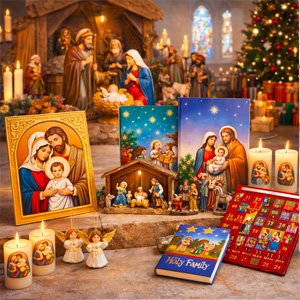
The nativity scene
The nativity scene depicts the birth of Jesus in Bethlehem.
It usually features Mary, Joseph, the Baby Jesus, the shepherds, the angels and the animals.
This depiction is inspired by the Gospels, whilst incorporating certain elements drawn from later traditions.
St Francis of Assisi played a particularly significant role in popularising it by organising a Nativity scene in Greccio in 1223.
The ox and the donkey
The ox and the donkey are almost always present in nativity scenes.
However, the Gospels do not explicitly mention them in the presence of the Baby Jesus.
Their inclusion stems notably from ancient traditions and symbolic interpretations of passages from the Old Testament, particularly Isaiah 1:3.
They have become familiar figures in Christian iconography.
The angels
Angels occupy a genuinely biblical place in the Christmas narrative.
Saint Luke recounts their appearance to the shepherds and their praise of God.
They symbolise the proclamation of the good news and the joy of heaven at the birth of the Saviour.
The star
The Star of Bethlehem is mentioned in the Gospel according to Saint Matthew.
It guides the Magi to Jesus.
It has become a very common symbol in Christian Christmas decorations.
The presents
The tradition of Christmas presents may evoke the gifts offered by the Magi to Jesus.
Above all, from a Christian perspective, it reminds us of the immense gift that God gave to humanity by sending his Son.
16. How can we read the story of Jesus’ birth as a family at Christmas?
The Christmas season is a special opportunity to rediscover the biblical texts as a family.
You do not need to have a deep understanding of theology to read them.
The most important thing is to take the time to listen to the Word of God and reflect on its message.
Biblical passages to explore
Here are several texts particularly suited to the Christmas season:
Luke 1:26–38: the Annunciation to the Virgin Mary.
Luke 1:39–56: the Visitation and the Magnificat.
Matthew 1:18–25: the announcement to Saint Joseph.
Luke 2:1–20: the birth of Jesus and the adoration of the shepherds.
Matthew 2:1–12: the visit of the Magi from the East.
Matthew 2:13–23: the flight into Egypt and the return of the Holy Family.
John 1:1–18: the Prologue of Saint John and the mystery of the Incarnation.
These passages allow us to follow the main events surrounding the birth of Jesus.
A moment of prayer before the nativity scene
On Christmas Eve, families can gather before the nativity scene.
An adult can read the Nativity story according to Saint Luke.
After the reading, everyone can take a few moments of silence.
The children can then place the Baby Jesus in the manger, in accordance with family tradition.
This simple gesture serves as a reminder that Christmas celebrates, above all, the birth of the Saviour.
17. A prayer to contemplate the birth of Jesus
Lord Jesus,
On this Christmas Day, we contemplate with wonder your birth in Bethlehem.
You, the eternal Son of God, chose to come amongst us in humility and simplicity.
We thank you for the immense love you have for humanity.
Together with the Virgin Mary, teach us to welcome your Word with trust.
Together with Saint Joseph, teach us faithfulness, courage and a sense of responsibility.
Together with the shepherds, grant us a simple heart, capable of recognising your presence.
Together with the Magi, guide our steps towards your light and help us to seek you with perseverance.
Bring peace to our families, comfort to those who suffer and hope to those who are going through trials.
May your birth renew our faith and teach us to love more deeply.
Remain with us, Lord Jesus, today and always.
Amen.
Conclusion: the birth of Jesus, the heart of the biblical message of Christmas
The birth of Jesus in the Bible is far more than an ancient story passed down from generation to generation.
For Christians, it represents the fulfilment of God’s promises and the manifestation of his love for humanity.
Through the Annunciation, Mary’s faith, Joseph’s obedience, the birth in Bethlehem, the announcement to the shepherds and the visit of the Magi, the Gospels invite us to contemplate the mystery of the Saviour who came amongst mankind.
Each character imparts a spiritual lesson to us.
Mary teaches us to trust in God.
Joseph shows us faithfulness and courage.
The shepherds teach us simplicity of heart.
The Magi invite us to seek the truth and to recognise the presence of God.
But at the centre of all these events is the Baby Jesus.
In the poverty of a manger, Christians recognise the Son of God, who came to share our human condition in order to open the way to salvation for us.
The message of Christmas thus spans the centuries without losing its power.
It reminds us that God draws near to humankind, that he loves each and every one of us, and that he calls us to live in peace, justice and charity.
As we re-read the Gospel accounts of the Nativity, we discover that the true greatness of Christmas lies neither in the lights, nor in the presents, nor in the festivities.
It lies in this extraordinary mystery: God chose to come amongst us in the form of a child.
And this truth, proclaimed for over two thousand years, remains at the heart of the Christian faith:
‘And the Word became flesh and dwelt amongst us.’ (John 1:14)