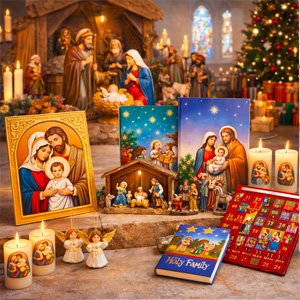
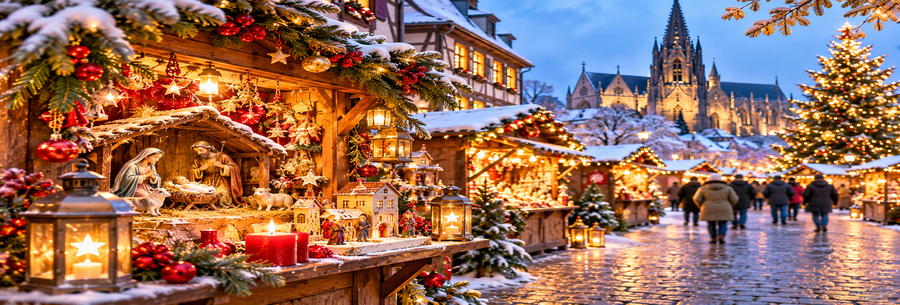
Discover the history of Christmas markets, their Christian origins, the most beautiful traditions in France, Alsace, Europe and around the world, as well as their connection to Advent and the Nativity.
Christmas markets in France and around the world: history, traditions and the magic of Advent
Every year, as December approaches, towns and villages are transformed. The streets are lit up, historic squares are filled with little wooden chalets, and the scents of cinnamon, gingerbread, roasted chestnuts and fir trees herald the arrival of the festive season.
Christmas markets are now among the most cherished traditions of the Advent season. In France, Germany, Austria and Italy, as well as in the United States, Canada and many other countries, they attract millions of visitors every year.
Behind this cosy atmosphere, however, lies an ancient history, deeply rooted in European traditions and the Christian calendar.
Originally, Christmas markets took place in the weeks leading up to the celebration of the birth of Jesus Christ. They allowed locals to stock up on provisions, handicrafts, candles and decorations in preparation for the festive season.
Over the centuries, these popular gatherings have become major cultural and tourist events. Some have retained a strong religious dimension, particularly through nativity scenes, traditional carols and Advent celebrations.
Christmas markets thus tell a story that brings together the Christian faith, family traditions, craftsmanship and the cultural heritage of different peoples.
From the famous Alsatian markets to the snow-covered villages of Central Europe, from Neapolitan nativity scenes to the illuminations of New York, let’s discover the origins and traditions of Christmas markets in France and around the world.
1. What are the origins of Christmas markets?
The history of Christmas markets dates back to the late Middle Ages, mainly in the German-speaking regions of Europe.
At that time, fairs and markets played a vital role in town life.
They enabled residents to buy food, clothing, tools and handcrafted goods.
As winter approached, certain markets took on particular significance.
Families would come to buy the provisions they needed to get through the cold season and prepare for major religious festivals.
The first winter markets
One of the oldest documented winter markets is that of Vienna, in Austria, where a trading privilege was granted in 1296 for the organisation of a market in December.
However, this was not yet a Christmas market in its current form.
Markets specifically associated with Christmas gradually developed across German-speaking regions.
The market in Dresden, Germany, whose tradition dates back to 1434, is one of the oldest documented Christmas markets.
Originally, it mainly enabled locals to buy meat and provisions ahead of the festive season.
The development of Advent markets
Over the centuries, the markets became more festive.
Craftspeople began to sell wooden toys, candles, figurines, decorations and items for Christmas celebrations.
Culinary specialities also took on an important role.
Locals came to buy gingerbread, dried fruit, pastries and other treats.
These gatherings gradually became places for people to meet and socialise.
A tradition linked to the Christian calendar
Christmas markets traditionally take place during Advent.
In the Christian faith, Advent is a period of preparation for the birth of Jesus Christ.
It comprises the four Sundays leading up to Christmas.
This period invites the faithful to prayer, repentance, charity and hope.
Christmas markets are not a religious practice in themselves, but their historical development is closely linked to this period in the Christian calendar.
They bear witness to the way in which religious festivals have influenced European folk traditions.
2. Why have Christmas markets become so popular?
The success of Christmas markets is down to several factors.
Firstly, they allow people to rediscover a special atmosphere, associated with childhood, family and festive memories.
The decorated chalets, the lights and the traditional specialities create a cosy atmosphere.
But their popularity can also be explained by their ability to showcase local traditions.
A meeting place for all generations
Christmas markets bring together families, friends and local residents.
For many, a visit to them is an annual tradition.
Grandparents take their grandchildren there.
Parents rediscover the traditions they experienced during their own childhood.
These shared moments help to pass on cultural and family heritage.
A showcase for craftspeople
Christmas markets also offer craftspeople the opportunity to showcase their work.
Visitors can discover wooden items, ceramics, candles, decorations, nativity figures and textile creations.
In some regions, these skills have been passed down through several generations.
The markets thus play a part in preserving ancient craft traditions.
An atmosphere of celebration and sharing
The Christmas period is associated with joy and generosity.
The markets help to create this atmosphere.
They offer a space where visitors can stroll, socialise and discover the traditions of different regions.
They also serve as a reminder of the importance of making time for others.
3. Strasbourg: one of the oldest and most famous Christmas markets in France
Strasbourg holds a special place in the history of Christmas markets.
The Alsatian city is often dubbed the ‘capital of Christmas’.
Its market, known as Christkindelsmärik, has a tradition dating back to 1570.
A history deeply rooted in Alsace
The name Christkindelsmärik means ‘market of the Christ Child’.
This name reflects the influence of Christian traditions on the market’s history.
Over the centuries, Strasbourg has maintained a special attachment to the Advent festivities.
Its historic centre, half-timbered houses and cathedral provide an exceptional setting.
The large Christmas tree on Place Kléber
One of the best-known symbols of Christmas in Strasbourg is the large Christmas tree erected on Place Kléber.
Every year, it becomes one of the city’s main decorative features.
The illuminations and market stalls scattered throughout the historic centre add to the festive atmosphere.
Alsatian culinary traditions
Strasbourg’s markets offer visitors the chance to discover traditional Christmas specialities.
These include bredele, small biscuits baked by Alsatian families during Advent.
Gingerbread, dried fruit and pastries also play an important role.
These recipes form part of the region’s heritage.
A Christian dimension that remains ever-present
Strasbourg’s Notre-Dame Cathedral serves as a reminder of the city’s religious history.
During Advent, churches host celebrations, concerts and times of prayer.
The tradition of nativity scenes also helps to rekindle the Christian meaning of Christmas.
4. Colmar: Christmas markets in the heart of a fairytale village
Colmar is another iconic Christmas destination in Alsace.
Its historic centre, canals and half-timbered houses create a particularly picturesque setting.
During Advent, several markets are traditionally set up in different neighbourhoods.
An authentic atmosphere
The old streets are decorated with garlands, fir branches and fairy lights.
The colourful façades of the houses add to the cosy atmosphere.
Each market has its own unique character.
Some specialise in handcrafted items, whilst others showcase regional specialities.
Alsatian heritage in the spotlight
Visitors can discover traditional decorations, figurines and items crafted by local artisans.
Gourmet products also play an important role.
Colmar’s markets thus offer a chance to rediscover family Christmas traditions in a remarkable historic setting.
5. Other major Christmas markets in France
Whilst Alsace remains the French region most closely associated with this tradition, many other towns now organise Christmas markets.
Reims: Christmas in the City of Coronations
Reims traditionally hosts a major Christmas market.
The city is particularly well known for its Notre-Dame Cathedral, where many kings of France were crowned.
The festivities feature illuminations, market stalls and regional specialities.
The cathedral also serves as a reminder of the city’s exceptional Christian heritage.
Metz: Christmas traditions in Lorraine
Metz has a festive tradition that is particularly cherished.
Its historic squares are adorned with markets and decorations.
The city showcases its architectural heritage and its culinary specialities.
Its cultural proximity to Germany and Luxembourg contributes to the identity of its markets.
Lille: Christmas in northern France
In Lille, the Christmas market is one of the most popular events in December.
Traditions from northern France blend with Belgian and Flemish influences.
Visitors can discover handcrafted goods, decorations and culinary specialities.
Paris: markets with a variety of atmospheres
The French capital traditionally hosts several Christmas markets.
Some focus on crafts, others on culinary specialities or family entertainment.
Paris also boasts a particularly rich religious heritage.
Churches host Advent celebrations, concerts and nativity scenes.
Lyon: Christmas and the tradition of lights
In Lyon, the month of December is particularly marked by the Festival of Lights.
This tradition has a historical link to devotion to the Virgin Mary.
On 8 December 1852, the people of Lyon lit their windows with small candles to mark the planned unveiling of a statue of Mary on Fourvière Hill.
This custom has gradually developed.
Today, the Festival of Lights has become a major cultural event.
Although it is not a Christmas market in the strict sense of the term, it contributes to the city’s special December atmosphere.
6. Christmas markets in Provence: santons, nativity scenes and Christian traditions
In Provence, Christmas celebrations have a very distinctive character.
Traditional markets are often associated with santon fairs, nativity scenes and handcrafted goods.
This region boasts a particularly rich Christian and folk heritage.
Marseille and its famous santon fair
The santon fair in Marseille is one of the oldest events of its kind.
Its history dates back to the early 19th century.
Santon makers showcase their creations there.
Visitors can discover the Nativity figures, as well as traditional Provençal trades.
The shepherd, the baker, the washerwoman, the miller and the Ravi are among the most popular figures.
Aubagne and the craftsmanship of the santon-makers
Aubagne is an important town in the history of ceramics and santons.
Many artisans continue to practise traditional manufacturing techniques.
The figurines are usually made from clay and then decorated by hand.
These creations help to preserve regional craftsmanship.
Aix-en-Provence and Christmas traditions
Aix-en-Provence also has a tradition of santon markets and fairs.
Visitors can discover nativity figures, decorations and Provençal specialities.
The thirteen Christmas desserts
In Provence, the Christmas meal is traditionally associated with thirteen desserts.
According to a widespread Christian interpretation, their number symbolises Jesus and his twelve apostles.
The selection varies depending on the family and the village.
These typically include dried fruit, dates, nougat and regional specialities.
This tradition highlights the importance of sharing and conviviality during the festive season.
7. Christmas markets in Germany: the cradle of a great European tradition
Germany is one of the countries most famous for its Christmas markets.
They are known as Weihnachtsmärkte or Christkindlmärkte.
Every year, many towns and cities organise markets during Advent.
Nuremberg and its Christkindlesmarkt
Nuremberg’s Christmas market is one of the best known in the country.
It is particularly famous for its chalets with red and white roofs.
The figure of the Christkind, associated with the Baby Jesus in local tradition, plays an important role in the opening ceremonies.
Visitors can sample Nuremberg’s famous gingerbread and browse the handicrafts.
Dresden and its Striezelmarkt
The Dresden market has a history dating back to 1434.
It takes its name from the Striezel, an old name for the traditional cake now known as Stollen.
This Christmas cake, made with dried fruit and covered in sugar, is one of Germany’s best-known specialities.
Cologne and its markets near the cathedral
Cologne hosts several Christmas markets.
The one near the cathedral boasts a particularly impressive setting.
The cathedral, a masterpiece of Gothic architecture, serves as a reminder of the historical importance of Christianity in the region.
Handcrafted German decorations
German markets are renowned for their wooden figurines, stars, angels and nutcrackers.
Certain regions, such as the Ore Mountains in Saxony, boast a long-standing tradition of woodcarving.
These items are often passed down from generation to generation.
8. Austria: Christmas markets blending music, faith and Alpine traditions
Austria has a long-standing tradition of Advent markets.
Its historic towns and Alpine landscapes help to create a particularly warm atmosphere.
Vienna and its Advent markets
Vienna hosts several Christmas markets.
One of the most famous is traditionally held in front of the town hall.
Visitors can discover decorations, handicrafts and Austrian specialities.
Vienna’s markets illustrate the importance of Advent traditions in the country’s culture.
Salzburg and the tradition of Christmas carols
Salzburg has a renowned Christmas market in its historic centre.
The region is also associated with the famous carol Silent Night, Holy Night.
This carol was first performed in 1818 in Oberndorf, near Salzburg.
It is now sung all over the world.
Its message of peace and contemplation remains deeply linked to the Christian celebration of Christmas.
Innsbruck and the Alpine markets
In Innsbruck, the Christmas markets take place against a mountainous backdrop.
The chalets, old houses and snow-capped peaks create a special atmosphere.
Tyrolean craft traditions play an important role here.
9. Italy: Christmas markets and the art of nativity scenes
In Italy, Christmas has a particularly strong family and religious dimension.
Christmas markets have developed particularly in the northern regions, where Austrian and Germanic influences are evident.
But Italy is also famous for its nativity scene traditions.
Bolzano and the markets of South Tyrol
Bolzano hosts an Alpine-inspired Christmas market.
The chalets sell decorations, wooden items and regional specialities.
Italian and Germanic traditions come together here.
Trento and Advent traditions
Trento also has a popular Christmas market.
The city showcases its architectural and artisanal heritage.
Visitors can discover the region’s traditional products.
Naples and Nativity figurines
In Naples, the Christmas period is particularly associated with the art of the Nativity scene.
San Gregorio Armeno Street is famous for its figurine workshops.
Artisans create Nativity figures and scenes from everyday life.
This Neapolitan tradition shares similarities with the santons of Provence.
It bears witness to the importance of depicting the birth of Jesus in Mediterranean Christian culture.
Rome and Vatican traditions
In Rome, the Christmas season has a special religious significance.
St Peter’s Square traditionally hosts a large nativity scene and a Christmas tree.
Christmas celebrations at the Vatican attract the faithful from all over the world.
The city thus offers visitors the chance to discover Christian traditions in an exceptional historical setting.
10. Christmas markets in other European countries
The tradition of Christmas markets has spread to many European countries.
Each region brings its own specialities and customs.
Prague, in the Czech Republic
Prague is famous for its markets set up in historic squares.
Old Town Square offers a particularly striking setting.
The stalls, the illuminations and the Gothic monuments all contribute to the festive atmosphere.
Budapest, in Hungary
Budapest hosts several Christmas markets.
Some are set up near St Stephen’s Basilica.
Visitors can discover Hungarian specialities and handcrafted items.
Brussels, Belgium
Brussels organises festivities known as Winter Delights.
Chalet-style stalls and illuminations can be found in various parts of the city centre.
The Grand-Place is one of the most iconic backdrops to these celebrations.
Basel, Switzerland
Basel has a renowned tradition of Christmas markets.
Its historic squares are adorned with chalets and decorations.
Visitors can discover Swiss specialities and handcrafted items.
Kraków, Poland
Kraków traditionally hosts a Christmas market on its large medieval square.
Religious Christmas traditions remain particularly important in Poland.
Nativity scenes, carols and family celebrations play a central role.
The city is also known for its traditional nativity scenes called szopki, inspired by Kraków’s architecture.
11. Christmas markets in Scandinavia: light and Nordic traditions
In the Nordic countries, the Christmas period has a special atmosphere.
The very short days lend symbolic importance to light.
Candles, lanterns and illuminations play a vital role.
Copenhagen, Denmark
Tivoli Gardens traditionally hosts Christmas festivities.
The illuminated decorations and chalets create a magical atmosphere.
Danish traditions place particular emphasis on conviviality and shared moments.
Stockholm, Sweden
Stockholm has several Christmas markets, particularly in its historic centre.
Handicrafts, Swedish specialities and traditional decorations play a prominent role there.
St Lucia’s Day
In Sweden and several other Nordic countries, 13 December is associated with St Lucia’s Day.
This tradition places particular emphasis on light.
Processions, carols and candles serve as a reminder of the importance of hope in the depths of winter.
Although its modern forms blend a number of cultural influences, this festival retains a link with the Christian figure of Saint Lucia.
12. Christmas markets in the United States: a European tradition that has gone global
Christmas markets have also become popular in the United States.
Some are directly inspired by German and Austrian traditions.
Others reflect American festive culture more closely.
New York and its winter markets
New York hosts several markets during the festive season.
Visitors can, in particular, explore the chalets in Bryant Park and the seasonal markets in Manhattan.
The illuminations, ice rinks and decorations all contribute to the festive atmosphere.
Chicago and its Christkindlmarket
Chicago has a Christmas market directly inspired by German traditions.
The Christkindlmarket showcases chalets, handicrafts and culinary specialities from Central Europe.
It illustrates how communities with European immigrant backgrounds have passed on their Christmas customs.
American Christmas traditions
In the United States, markets are often associated with large illuminated decorations, monumental Christmas trees and family-friendly entertainment.
The commercial aspect is sometimes very prominent.
However, Christian churches continue to celebrate Advent and Christmas through services, concerts and nativity plays.
13. Canada: Christmas markets in a wintry atmosphere
Canada has numerous Christmas markets, which are particularly popular in the weeks leading up to the festive season.
The snow-covered landscapes help to create an atmosphere reminiscent of European traditions.
Québec and its German Christmas market
The city of Québec hosts a Christmas market inspired by German traditions.
Its historic centre provides a particularly fitting setting for this event.
The chalet-style huts, decorations and culinary specialities attract many visitors.
Montréal and Christmas traditions
Montréal also organises markets and events during the festive season.
Visitors can discover handcrafted items, local produce and gourmet specialities.
Toronto and its festive markets
Toronto hosts several seasonal events.
The historic Distillery District, in particular, hosts Christmas festivities in a unique architectural setting.
Canadian markets illustrate the fusion of European traditions and North American culture.
14. Christmas markets in countries where December is summer
In the Southern Hemisphere, Christmas takes place during the summer.
Markets and festive traditions therefore take a different form to those in European countries.
Australia: Christmas in the sunshine
In Australia, Christmas celebrations take place during the hot season.
Markets may be held outdoors, sometimes in the evening.
Traditional decorations sit alongside summer activities.
Christmas meals are often held in gardens or near beaches.
New Zealand
In New Zealand, Christmas is also celebrated during the summer.
The markets showcase local crafts, regional produce and family traditions.
Christian celebrations remain important, despite a climate very different from that of Europe.
South America
In several South American countries, Christmas traditions are strongly influenced by Catholicism.
Nativity scenes occupy a prominent place in homes and churches.
Craft markets sell Christmas decorations and nativity figures.
In Mexico, Colombia, Peru and Brazil, customs vary from region to region.
Religious celebrations, carols and family gatherings are essential elements of the Christmas season.
15. Nativity scenes: an essential feature of many traditional markets
In several regions of Europe, Christmas markets are closely associated with the tradition of nativity scenes.
Their presence serves as a reminder of the festival’s Christian origins.
The nativity scene depicts the birth of Jesus
In the Gospel according to Saint Luke, Mary gives birth to Jesus in Bethlehem.
She wraps him in swaddling clothes and lays him in a manger.
Shepherds, warned by angels, come to visit him.
The nativity scene depicts this event.
St Francis of Assisi and the Greccio nativity scene
In 1223, St Francis of Assisi organised a Christmas celebration in Greccio, Italy, centred around a manger filled with hay, complete with an ox and a donkey.
He wished to help the faithful contemplate the simplicity of Jesus’ birth.
This initiative contributed to the development of depictions of the Nativity.
Regional traditions
In Provence, nativity scenes are made up of santons representing biblical figures and the villagers.
In Naples, craftsmen create particularly detailed nativity scenes.
In Poland, the nativity scenes in Kraków feature distinctive architecture.
These traditions show how each culture has adapted its own interpretation of the birth of Christ.
16. Culinary specialities at Christmas markets around the world
Christmas markets are also famous for their culinary specialities.
Every country has its own traditional recipes.
In France
In Alsace, bredele and gingerbread play an important role.
In Provence, the thirteen desserts are a particularly cherished family tradition.
In other regions, the markets offer pastries and local specialities.
In Germany
The Stollen, gingerbread and Christmas biscuits are among the best-known traditions.
Some recipes have been made for several centuries.
In Austria
Christmas biscuits, pastries and specialities made with dried fruit play an important role.
In Italy
The panettone and the pandoro are among the most famous Christmas desserts.
These traditions are particularly associated with the northern regions of Italy.
In Spain
turrón, a traditional almond-based sweet, is very common during the festive season.
polvorones and other treats complete the Christmas table.
In Poland
Christmas culinary traditions play a vital role in family life.
The Christmas Eve meal, known as Wigilia, has a strong symbolic and religious significance.
These specialities reflect the diversity of Christmas traditions around the world.
17. Why are Christmas markets associated with lights?
Today, illuminations are one of the most characteristic features of Christmas markets.
They decorate the streets, building façades, trees and stalls.
But light also has a profound Christian significance.
Jesus, the light of the world
In the Gospel according to Saint John, Jesus presents himself as the light of the world.
Christian tradition thus links the birth of Christ with the coming of a new light.
The prophet Isaiah also foretells that a people walking in darkness will see a great light.
Christians recognise this prophecy as a foretelling of the Messiah.
Light in the heart of winter
In the Northern Hemisphere, Christmas takes place during the shortest days of the year.
Candles and fairy lights bring warmth and comfort.
They can symbolise hope in the midst of darkness.
Advent candles
The Advent wreath traditionally features four candles.
Each Sunday, an additional candle is lit.
This growing light serves as a reminder that Christmas is drawing near.
It invites the faithful to prepare their hearts to welcome Jesus.
18. Christmas markets and the passing on of Christian traditions
Christmas markets are now largely open to everyone, regardless of religious beliefs.
However, their history remains linked to the Christian calendar.
They can provide an opportunity to rediscover the traditions of Advent and Christmas.
Explaining Christmas to children
A visit to a market can be an opportunity to tell children the story of the birth of Jesus.
Nativity scenes, angels, stars and decorations provide a way to introduce Christian symbols.
Parents can explain that Christmas celebrates the coming of the Saviour.
Discovering traditional carols
Many markets host choirs.
Christmas carols are an important part of Christian heritage.
They tell of the birth of Jesus, the joy of the shepherds and the peace announced by the angels.
Rediscovering the spirit of sharing
The Advent season invites Christians to practise charity.
Some events welcome charitable organisations or organise collections.
Visitors can thus combine their Christmas preparations with acts of solidarity.
19. How do you choose an authentic Christmas market?
Not all Christmas markets have the same atmosphere.
Some have become major tourist attractions, whilst others retain a more traditional feel.
Prioritise local crafts
Markets featuring craftspeople offer the chance to discover items made using regional skills.
Wooden decorations, ceramics, candles and nativity figures can make for meaningful gifts.
Discover regional specialities
Traditional markets often showcase local produce.
They offer the chance to discover recipes passed down through several generations.
Visit small villages
Large markets are famous for their illuminations and entertainment.
But small villages can offer a more intimate atmosphere.
Visitors sometimes discover particularly ancient traditions there.
Exploring religious heritage
In historic towns, a visit to a market can be combined with a visit to a church, a cathedral or a nativity scene.
This provides a better understanding of the region’s Christian history.
The dates, opening times and access conditions for the markets vary each year. It is therefore best to check with the organisers before planning a visit.
20. How can you experience Christmas markets in the Christian spirit of Advent?
Christmas markets can be an opportunity to enjoy some quality time with the family.
But they can also encourage us to rediscover the true meaning of this season.
Don’t forget the birth of Jesus
Amidst the decorations and shopping, it is important to remember that Christmas celebrates, above all, the Nativity of the Lord.
A visit to a nativity scene or a church can complement a stroll through the market.
Choose meaningful gifts
Giving a gift is a gesture of affection.
There’s no need to look for expensive items.
A simple gift, chosen with care, can express a great deal of love.
Supporting craftspeople
Buying a handcrafted item helps to support traditional skills.
It also helps to preserve local traditions.
Thinking of those who are isolated
The Christmas period can be difficult for people who are alone or in precarious circumstances.
Christians are encouraged to pay them special attention.
A gesture of generosity, a visit or a donation can lend a profoundly human dimension to this season.
Taking time to pray
Advent is a time of spiritual preparation.
Amidst the festivities, a few moments of silence and prayer allow us to return to what really matters.
21. A prayer to live out Christmas traditions in faith
Lord Jesus,
During this season of Advent, as our towns and villages are decked out in lights, we prepare our hearts to celebrate your birth.
Help us to rediscover the true meaning of Christmas.
May the lights that illuminate our streets remind us that you are the light of the world.
May the moments shared with our families teach us the joy of fellowship.
May the gifts we exchange be signs of love and generosity.
Teach us not to forget those who suffer, those who are alone and those who live in poverty.
Following the example of the Virgin Mary, grant us a heart open to your Word.
Following the example of Saint Joseph, teach us trust and faithfulness.
May the traditions of Christmas draw us closer to you and help us to pass on the faith to future generations.
And when Christmas Eve comes, grant that we may joyfully welcome the Baby Jesus, our Saviour.
Amen.
Conclusion: Christmas markets: a heritage of traditions, light and sharing
Christmas markets now play an important role in end-of-year traditions.
Originating in the German-speaking regions of Europe, they have gradually spread to France and many other countries around the world.
From Strasbourg to Colmar, from Nuremberg to Vienna, from Prague to Rome, from Quebec to New York, each city brings its own unique character to this tradition.
The markets offer visitors the chance to discover regional specialities, handcrafted items and customs passed down through several generations.
They also help to preserve a particularly rich cultural heritage.
But behind the fairy lights, the chalets and the decorations, it is important to remember the Christian origins of Christmas.
Advent is, above all, a time of preparation for the birth of Jesus Christ.
Nativity scenes remind us of the humility of Bethlehem.
Candles symbolise the light of the Saviour.
Traditional carols herald the joy of his coming.
And acts of generosity express love for one’s neighbour.
Christmas markets are thus much more than mere places of commerce: they can become spaces for meeting, passing on traditions and sharing, where popular traditions come together with the spirit of Christmas.
Every year, when the first lights are switched on in towns and villages, they invite us to rediscover that special joy which accompanies the anticipation of Christmas.
For beyond the decorations and festivities, the true message of Christmas remains that of the birth of Jesus Christ: a message of peace, hope and love intended for all humanity.