Find out how the Catholic Church celebrates Advent: Masses on the four Sundays, the Advent wreath, prayers, confession, liturgical traditions and preparations for the birth of Jesus.
How can we experience the season of Advent in church and prepare spiritually for Christmas?
Every year, as the first Christmas lights begin to illuminate towns and villages, the Catholic Church enters a particularly important period in its liturgical calendar: the season of Advent.
For four weeks, the faithful are invited to prepare to celebrate the birth of Jesus Christ. But Advent is not merely a time of festive anticipation. It is a genuine journey of faith, conversion, hope and prayer, experienced within the whole Christian community.
In church, this preparation takes on a special significance. The liturgical colours change, the biblical readings herald the coming of the Saviour, the candles on the Advent wreath are lit one by one, and the services invite the faithful to open their hearts to God.
Advent is a special time to rediscover the path to the Church, deepen one’s faith and prepare one’s heart for the coming of Christ.
How does the Catholic Church observe these four weeks? What is the significance of the liturgical traditions of Advent? How can the faithful participate fully in this spiritual preparation?
1. Advent: the start of a new liturgical year
Unlike the calendar year, which begins on 1 January, the Catholic Church’s liturgical year begins on the first Sunday of Advent.
This beginning has a profound significance: the whole of Christian life is centred on the mystery of Jesus Christ, from his birth to his death and Resurrection.
The word ‘Advent’ comes from the Latin adventus, which means ‘coming’ or ‘arrival’.
It refers to the time during which Christians prepare to welcome the Lord.
The Church invites us to contemplate two essential aspects of this waiting.
The first is the preparation for the celebration of Jesus’ birth in Bethlehem. The faithful remember the coming of the Son of God into our world, when he took on our human condition to bring salvation.
The second is the anticipation of Christ’s glorious return at the end of time.
Thus, Advent reminds us that the Christian life is a journey towards God, sustained by hope and vigilance.
Through celebrations, prayers and teachings, the Church encourages everyone to ask themselves a fundamental question: are we ready to welcome the Lord into our lives?
In 2026, the first Sunday of Advent will be celebrated on 29 November. The season of Advent will continue until the start of the Christmas celebrations on the evening of 24 December.
2. Why does the colour purple dominate in churches during Advent?
From the first Sunday of Advent, the faithful notice a change in the liturgical vestments.
The priest usually wears a purple chasuble, a colour traditionally associated with times of preparation and conversion.
In the Catholic liturgy, purple expresses, in particular, anticipation, penance and inner preparation.
During Advent, this colour reminds us that the birth of Christ should not only be celebrated outwardly, but also welcomed into our hearts.
It invites us to sobriety, contemplation and prayer.
However, unlike Lent, Advent is not primarily a time of penance. It has a distinctive character, marked by hope and the joy of the Saviour’s coming.
The pink of the third Sunday of Advent
The third Sunday of Advent is called Gaudete Sunday, a Latin word meaning ‘Rejoice’.
On this day, the priest may wear pink vestments instead of purple ones.
This colour expresses the joy that grows as Christmas approaches.
It reminds the faithful that Christian anticipation is not a time of sadness or anxiety, but one filled with hope.
The Lord is coming, and his coming is a source of profound joy for all humanity.
3. The Advent wreath in churches: four candles to mark the journey towards Christmas
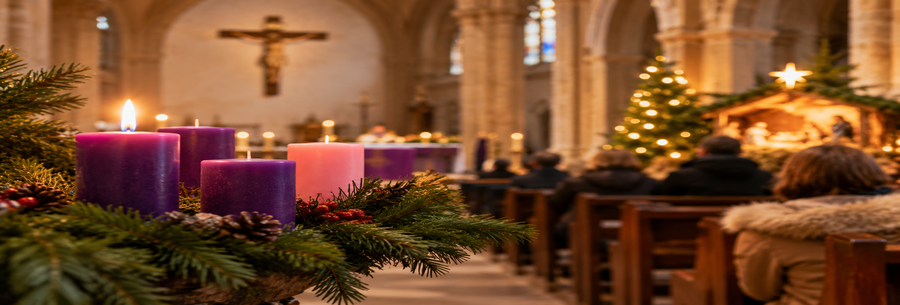
In many parishes, an Advent wreath is placed near the altar or in another prominent spot in the church.
Made of fir branches or evergreen foliage, it features four candles corresponding to the four Sundays of Advent.
Its circular shape evokes the eternity of God, whilst the evergreen branches symbolise life and hope.
The candles symbolise the light of Christ, who comes to enlighten the world.
Each Sunday, a new candle is lit, marking another step towards the celebration of Christmas.
The four Sundays of Advent
First Sunday: watching in hope
The first candle is lit.
The Church invites the faithful to remain vigilant and to prepare their hearts for the coming of the Lord.
This first stage reminds us that the Christian faith is based on a promise: God comes to meet his people.
Second Sunday: preparing the way for the Lord
The second candle is lit alongside the first.
The biblical readings particularly highlight the call to conversion and the figure of Saint John the Baptist.
The faithful are invited to change whatever in their lives distances them from God.
Third Sunday: Rejoicing in the Saviour’s nearness
The third candle is lit.
This is Gaudete Sunday, marked by joy.
The Church proclaims that the Lord’s coming is near and encourages Christians to renew their hope.
Fourth Sunday: welcoming the mystery of the Incarnation
The fourth candle is lit.
The readings direct our attention more towards the Virgin Mary, Saint Joseph and the events leading up to the birth of Jesus.
The faithful are invited to welcome Christ with the same trust as Mary and Joseph.
The Advent wreath is not a mandatory part of the Roman liturgy, but it is a widespread tradition that is particularly cherished in parishes.
4. The Masses for the four Sundays of Advent: a spiritual journey towards Christmas
Each Sunday of Advent holds a special place in the liturgical preparation for Christmas.
The biblical readings, prayers and hymns gradually guide the faithful towards the mystery of the Nativity.
First Sunday: staying alert and awaiting the Lord
The first Sunday of Advent calls Christians to vigilance.
In the Gospels, Jesus calls on his disciples to stay awake and be ready.
This vigilance does not mean living in fear, but learning to recognise God’s presence in our daily lives.
The Church reminds us that we can encounter the Lord through prayer, the sacraments, the Word of God and the people around us.
This first Sunday is an invitation to return to a more mindful spiritual life.
Second Sunday: listening to the call of Saint John the Baptist
Saint John the Baptist occupies a central place in the liturgy of Advent.
He is the one who announces the coming of the Messiah and calls on the people to prepare the way for the Lord.
His message remains deeply relevant today.
He calls on Christians to abandon what distances them from God, to acknowledge their mistakes and to rediscover the path to conversion.
In church, this Sunday’s readings encourage us to reflect on the way we live our lives.
Are we attentive enough to others? Do we know how to forgive? Do we give prayer its rightful place?
Advent thus becomes an opportunity to renew our Christian commitment.
Third Sunday: the joy of the Lord is near
The third Sunday is marked by a special joy.
The word ‘Gaudete’ comes from the invitation to rejoice which traditionally opens this Sunday’s liturgy.
Christian joy does not depend solely on external circumstances.
It springs from the certainty that God loves humankind and that he comes to bring them salvation.
Even in the face of difficulties, Christians are called to hold fast to this hope.
This celebration reminds us that Christmas is drawing near and that the light of Christ is stronger than the darkness.
Fourth Sunday: contemplating the faith of Mary and Joseph
The last Sunday of Advent brings us closer to the mystery of the birth of Jesus.
Depending on the liturgical year, the readings place particular emphasis on the Virgin Mary, Saint Joseph or the events that directly foreshadow the Nativity.
Mary teaches us trust and surrender to God’s will.
Joseph shows us the importance of obedience in faith, of faithfulness and of protecting those entrusted to our care.
Through their example, the Church invites us to prepare our hearts with humility.
5. Why is the Gloria not usually sung during Advent?
During Sunday Masses in Advent, the faithful may notice that the Gloria, usually sung or recited at many Sunday celebrations, is omitted.
This liturgical feature has an important significance.
The Church reserves the splendour of this hymn of praise for the celebration of Christmas, when the angels announce the birth of the Saviour.
Its absence during the Sundays of Advent helps to express the sense of anticipation.
When the Gloria is sung once more during the Christmas Mass, it takes on a particularly solemn and joyful character.
It should be noted, however, that the Gloria is still included in certain solemnities celebrated during Advent, notably the Feast of the Immaculate Conception.
The Alleluia, on the other hand, continues to be sung during Advent, unlike during Lent.
This distinction serves as a reminder that Advent is, above all, a time of joyful hope.
6. The place of the Virgin Mary in the Advent liturgy
The Virgin Mary occupies a central place in the Christian preparation for Christmas.
It was she who received the announcement from the angel Gabriel and agreed to become the mother of the Saviour.
Her attitude of faith, humility and openness serves as an example to all believers.
During Advent, the Church invites the faithful to reflect in particular on her role in the mystery of the Incarnation.
The Solemnity of the Immaculate Conception, 8 December
Every year, on 8 December, the Catholic Church celebrates the Solemnity of the Immaculate Conception of the Virgin Mary.
This feast reminds us that Mary, by a special grace of God and in view of the merits of Jesus Christ, was preserved from original sin from the very first moment of her conception.
This celebration therefore does not concern the conception of Jesus, but that of Mary herself.
In many parishes, a solemn Mass is celebrated on this occasion.
The faithful may also take part in times of Marian prayer, the recitation of the Rosary or processions, in accordance with local traditions.
This feast day provides a wonderful opportunity to entrust our families, our difficulties and our intentions to the Virgin Mary.
Mary, a model of Christian hope
In the Gospel account of the Annunciation, Mary welcomes the word of God with trust.
She accepts a mission that is beyond her human understanding.
Her attitude reminds us that faith sometimes means moving forward without fully knowing the path.
During Advent, Christians can ask Mary to help them welcome Jesus with an open heart.
7. Confession during Advent: preparing one’s heart for the coming of Christ
Advent is a particularly favourable time to receive the sacrament of penance and reconciliation.
Just as we prepare our homes for Christmas, the Church also invites us to prepare our souls.
Confession enables us to acknowledge our sins, receive God’s forgiveness and renew our relationship with him.
It is an act of trust in divine mercy.
Why go to confession before Christmas?
The birth of Jesus reveals God’s immense love for humanity.
Preparing for this feast therefore means seeking to welcome this love with a sincere heart.
The sacrament of reconciliation helps us to free ourselves from the burden of our faults and to rediscover inner peace.
It also encourages us to make amends, as far as possible, for any hurt we may have caused others.
In many parishes, additional confession times are offered before Christmas.
Some communities also organise penitential services featuring Bible readings, prayers and, depending on the arrangements, the opportunity to receive the sacrament individually.
For the faithful who have not gone to confession for a long time, Advent can be a wonderful opportunity to reconnect with this spiritual practice.
8. Times of prayer and Eucharistic adoration during Advent
In addition to Sunday Masses, many churches offer specific times of prayer during Advent.
These moments allow one to step away from the hustle and bustle of daily life and rediscover inner silence.
Adoration of the Blessed Sacrament
Eucharistic adoration involves spending time in contemplation before the Blessed Sacrament, in which Catholics recognise the real presence of Jesus Christ.
During Advent, this form of prayer takes on special significance.
The faithful are invited to contemplate Christ, who is already present amongst them, whilst preparing to celebrate his birth.
Adoration can be experienced in silence, with Bible readings, hymns or personal prayers.
It offers a special time to entrust one’s concerns, joys and hopes to the Lord.
Prayer vigils
Some parishes organise Advent vigils, often accompanied by hymns, Bible readings and meditations.
These celebrations enable the faithful to share in the anticipation of the Saviour’s coming.
They also provide an opportunity to rediscover the beauty of communal prayer.The Liturgy of the Hours
The official prayer of the Church, known as the Liturgy of the Hours, also accompanies this season.
It is a daily prayer that helps the faithful to deepen their relationship with God.
It is a time for reflection, prayer and communion with the Church.
It is a time for the faithful to pray together as a community.
It is a time for the faithful to pray together as a community.
It is a time for the faithful to pray together as a community.
It is a time for the faithful to pray together as a community.
It is a time for the faithful to pray together as a community.
It is a time for the faithful to pray together as a community.
It is a time for the faithful to pray together as a community.
It is a time for the faithful to pray together as a community.
It is a time for the faithful to pray together as a community.
It is a time for the faithful to pray together as a community.
It is a time for the faithful to pray together as a community.
It is
They also provide an opportunity to rediscover the beauty of communal prayer.
The Liturgy of the Hours
The Church’s official prayer, known as the Liturgy of the Hours, also accompanies the season of Advent.
Lauds, prayed in the morning, and Vespers, celebrated in the evening, include psalms, readings and antiphons specific to this season.
In some religious communities and parishes, the faithful can take part in these services.
In this way, they discover another way of sanctifying their day and uniting themselves with the prayer of the whole Church.
9. The ‘O’ Antiphons: a spiritual tradition of the final days of Advent
From 17 to 23 December, the liturgy of the Latin Church gives special prominence to the ‘O’ Antiphons ”.
These ancient prayers accompany the Magnificat during Vespers.
Each begins with an invocation addressed to Christ, using a title inspired by Scripture.
Among these invocations are:
O Wisdom.
O Adonai.
O Branch of Jesse.
O Key of David.
O East.
O King of the nations.
O Emmanuel.
These titles express different aspects of the Saviour’s mission.
They remind us that Jesus is the Wisdom of God, the long-awaited King, the light of the world and God present amongst mankind.
These final days of Advent possess a particular spiritual intensity.
The anticipation grows more urgent, and the entire liturgy seems to raise a single supplication to heaven: ‘Come, Lord!’
10. Dawn Masses and the Rorate tradition
In certain regions of Europe, an ancient liturgical tradition accompanies the season of Advent: the so-called Rorate Masses.
Their name comes from the opening words of a Latin hymn inspired by the prophet Isaiah: Rorate caeli desuper, which means ‘Heavens, pour down your dew from on high ”.
These votive Masses in honour of the Virgin Mary are traditionally celebrated early in the morning, sometimes before sunrise.
In some churches, they take place by candlelight.
This special atmosphere symbolically evokes humanity awaiting the light of Christ.
The dim light recalls the waiting for the Saviour, whilst the candle flames herald the light of Christmas.
This tradition remains alive in several countries, particularly in Central Europe.
It may also be offered in some French parishes.
Rorate Masses are a beautiful way to experience Advent in silence, contemplation and hope.
11. Setting up the nativity scene in churches
As Christmas approaches, churches gradually begin to display nativity scenes.
This tradition, deeply rooted in Christian life, allows us to contemplate the mystery of the birth of Jesus.
A tradition inherited from Saint Francis of Assisi
In 1223, in Greccio, Italy, St Francis of Assisi organised a re-enactment of the Nativity to help the faithful better understand the poverty and humility of Christ’s birth.
This initiative played a major role in the development of nativity scenes within the Christian tradition.
Today, they occupy an important place in many churches.
The nativity scene: a place of contemplation
During Advent, the figures in the nativity scene can be set up gradually.
Mary, Joseph, the shepherds and the animals take their places around the manger.
In some parishes, the Baby Jesus is not placed in the nativity scene until Christmas.
This gesture serves as a reminder that the entire Advent season is focused on his birth.
The faithful may come to reflect before the nativity scene, light a candle or offer up a prayer intention.
Children are often particularly moved by this depiction of the mystery of Christmas.
It enables them to discover the characters and events of the Nativity in a tangible way.
12. Solidarity and charity: living Advent within the parish community
Advent is not limited to liturgical celebrations.
It is also a call to live out Christian charity more fully.
In the Gospel, Jesus invites us to recognise his presence in the most vulnerable people.
Preparing for his coming therefore also means opening our hearts to others.
Charity initiatives organised by parishes
During Advent, many Christian communities organise food drives, clothing distributions, visits to isolated people, or initiatives aimed at families in need.
Some parishes also organise toy collections for disadvantaged children.
These initiatives enable the faithful to translate their faith into concrete actions.
They serve as a reminder that preparing for Christmas cannot be separated from love for one’s neighbour.
Special attention for those who are alone
The festive season can be difficult for those who are isolated, unwell or bereaved.
Advent is a special opportunity to show them that we care and to offer them a sense of fellowship.
A visit, a phone call or an invitation to share a meal can become true signs of Christ’s love.
Through these simple gestures, the parish community tangibly demonstrates its vocation to be a family open to all.
13. Advent hymns: a prayer in preparation for Christmas
Liturgical music plays an important role in the celebration of Advent.
The hymns chosen during this period express anticipation, hope and the desire to encounter the Lord.
Among the hymns traditionally associated with Advent are, in particular:
‘Come, O Divine Messiah’.
‘O Come, Emmanuel’.
‘Rorate caeli’.
‘Prepare the way of the Lord’.
These hymns invite the faithful to enter gradually into the mystery of Christmas.
They express the desire to see the Saviour come and recall the promises foretold by the prophets.
During Advent, the Church recommends a certain restraint in the use of musical instruments and in the floral decoration of the altar, so as to preserve the full joy of the Christmas celebration.
This liturgical restraint helps to lend greater force to the solemnity of the Nativity.
14. How can one participate fully in the life of one’s parish during Advent?
The season of Advent offers many opportunities to deepen one’s faith and become more involved in the life of the Church.
It is not necessary to take part in all the activities on offer.
The key is to choose a few commitments that will enable you to live this period with sincerity.
Some spiritual practices for the faithful
Attending Mass every Sunday
Sunday Mass is at the heart of Christian life.
During Advent, it enables us to gradually follow the path set out by the Church towards Christmas.
Receiving the sacrament of reconciliation
Taking the time to go to confession helps to prepare one’s heart inwardly for the coming of Christ.
Devote time to prayer
Taking part in a vigil, Eucharistic adoration or the recitation of the Rosary can enrich one’s spiritual life.
Reading the biblical texts for Advent
The readings provided by the liturgy help us to better understand the expectation of the Messiah and the mystery of the Incarnation.
Take part in charitable work
Serving the most vulnerable is a practical way of living out the Gospel.
Prepare for Christmas with the children of the parish
Families can help set up the nativity scene, in child-friendly celebrations or in the catechesis activities offered during Advent.
These various activities enable us to experience Advent not only as a time of personal preparation, but also as a communal experience.
15. Christmas Mass: the culmination of the Advent journey
After four weeks of anticipation and preparation, the Church enters into the celebration of the Nativity of the Lord.
The lights, the songs and the decorations then fully express the joy of Christmas.
The purple of Advent gives way to white or gold vestments, symbols of festivity and light.
The Gloria rings out once more, recalling the angels’ song announcing the birth of the Saviour.
The Midnight Mass
The Mass celebrated on the night of 24–25 December holds a particularly important place in Christian tradition.
The Gospel according to Saint Luke recounts the birth of Jesus in Bethlehem, the announcement made to the shepherds and the joy that accompanies this event.
The proclamation of the Saviour’s birth is the culmination of the entireAdvent waiting.
The faithful are invited to contemplate the mystery of a God who chooses to come amongst mankind in the humility of a newborn child.
The various Christmas Masses
The Catholic liturgy provides for several forms of Mass for the Solemnity of Christmas: the Mass on Christmas Eve, the Midnight Mass, the Dawn Mass and the Day Mass.
Each features specific readings and prayers that allow us to contemplate different aspects of the mystery of the Incarnation.
Through these celebrations, the Church proclaims that Jesus Christ is the light that has come to enlighten the world.
The long wait of Advent then gives way to the joy of his birth.
16. A prayer to live Advent fully with the whole Church
Lord Jesus,
In this blessed season of Advent, we prepare to celebrate your birth.
Open our hearts to your Word and teach us to recognise your presence in our lives.
Help us to rediscover the path of prayer, forgiveness and reconciliation.
May our churches be places of peace, welcome and fellowship.
Support our priests, our parish communities and all those who work in the service of your Church.
Together with the Virgin Mary and Saint Joseph, teach us to await your coming in faith and hope.
May the light of Christmas shine upon our families, comfort those who suffer and bring peace to our world.
Come, Lord Jesus, to renew our hearts and make your love grow amongst us.
Amen.
Conclusion: experiencing Advent in church, a journey of hope towards the light of Christmas
The season of Advent is a time of great spiritual richness for the whole Catholic Church.
Through Sunday Masses, Bible readings, the Advent wreath, prayers, the Sacrament of Reconciliation and acts of charity, the faithful are invited to prepare their hearts for the coming of the Saviour.
These four weeks remind us that Christmas is not merely a family tradition or a popular festival.
Above all, it is the celebration of an immense mystery: God became man to come to meet humanity and reveal his love to it.
To experience Advent in church is to be willing to slow down, to rediscover silence, to allow oneself to be touched by the Word of God, and to rediscover the joy of belonging to a Christian community.
It also means learning to recognise Christ in the people we meet, particularly the poorest, the most vulnerable and the most isolated.
Every candle lit, every prayer said and every act of charity brings us spiritually closer to Christmas Eve.
When the angels’ song finally rings out, announcing the birth of the Saviour, we will be able to welcome this joy with a renewed heart.
For Advent teaches us an essential truth: the most beautiful preparation for Christmas is not to be found in the decorations in our homes, but in the light that we allow to grow deep within our hearts.
And together with the whole Church, we can raise this prayer that has echoed through the centuries:
‘Come, Lord Jesus!’ (Revelation 22:20)