
Find out how to make the most of Advent as a family: prayers, Christian traditions, the Advent wreath, the Advent calendar, sharing and tips for preparing for Christmas in the faith.
How can we experience Advent as a family and prepare for Christmas in faith?
Every year, as Christmas approaches, the streets light up, houses are decked out in decorations and families begin to prepare for the festive season. Yet, behind the lights, the presents and the practical preparations lies a period of great spiritual richness: the season of Advent.
For Christians, Advent is much more than simply a countdown to Christmas. It is a time of waiting, hope, prayer and inner conversion. For four weeks, the Church invites us to prepare our hearts to welcome Jesus, the Saviour of the world.
But how can we fully experience this season within our families, amidst daily obligations, work, school and Christmas preparations? How can we convey the true meaning of this season to our children and make Advent a special time of sharing, faith and love?
Experiencing Advent as a family means learning to await the birth of Christ together, whilst making more room for God in our homes and in our lives.
1. Understanding the true meaning of Advent
The word ‘Advent’ comes from the Latin adventus, which means ‘coming’ or ‘arrival’. It refers to the period during which Christians prepare to celebrate the birth of Jesus Christ in Bethlehem.
Advent begins on the fourth Sunday before Christmas and also marks the start of a new liturgical year in the Catholic Church.
This period has a dual spiritual significance.
On the one hand, it invites us to remember Christ’s first coming, when God became man by being born humbly in a stable in Bethlehem.
On the other hand, it reminds us that Christians also await the glorious return of Christ at the end of time.
Between these two comings, Jesus is constantly present in our lives, particularly through prayer, the sacraments, the Word of God and the love we show to others.
Advent therefore invites us to ask ourselves: what place do we truly give to Jesus in our daily lives?
In a society where everything is moving ever faster, this season encourages us to slow down, to find silence and to rediscover the joy of simple things.
For families, it becomes a precious opportunity to grow closer to one another and to put what really matters back at the heart of our home.
2. Putting up an Advent wreath: a lovely family tradition
Among the most cherished Christian traditions, the Advent wreath holds a special place.
Made from fir branches or other evergreen plants, it symbolises life and hope. Its circular shape, with no beginning and no end, evokes God’s eternal love.
It traditionally features four candles, corresponding to the four Sundays of Advent.
Each Sunday, a new candle is lit, reminding us that the light of Christ is drawing ever nearer.
The meaning of the four Advent candles
The first candle: hope
Lit on the first Sunday of Advent, it reminds us of God’s promises and the expectation of the Messiah foretold by the prophets.
It is an opportunity to talk as a family about trust in God, even when we are going through difficulties.
The second candle: peace
It invites us to prepare the way of the Lord, as St John the Baptist proclaimed.
As a family, this week can be devoted to reconciliation, forgiveness and the pursuit of peace within our home.
The third candle: joy
The third Sunday of Advent is called Gaudete Sunday, which means ‘Rejoice’.
The joy of Christmas is drawing near. The Church invites us to rejoice in the Lord’s presence and in his love for each one of us.
The fourth candle: love
It accompanies the final days of preparation for Christmas and invites us to contemplate the immense love of God, who sends his Son to save humanity.
These meanings offer a lovely, educational way to experience the four weeks of Advent. However, they do not correspond to a universal and binding liturgical interpretation of the candles.
Making the lighting of the candles a time of prayer
Every Sunday, gather your family around the Advent wreath.
Switch off the television, put your phones aside and take a few minutes to be together.
After lighting the candle, you could read a short passage from the Gospel, say an Our Father or entrust each family member’s intentions to the Lord.
Even the youngest children can take part by sharing a prayer intention or singing a hymn.
This little ritual, repeated every Sunday, can become a precious memory that will stay with the children throughout their lives.
3. Create a Christian Advent calendar for children
The Advent calendar is a tradition particularly loved by children. But why not give it a spiritual dimension?
Instead of being limited to chocolates and little surprises, it can become a genuine journey of preparation for Christmas.
The idea is simple: suggest a small act, a prayer or a gesture of love each day.
24 small acts to prepare your heart for Christmas
Here are a few ideas to include in a family Advent calendar:
Say the Lord’s Prayer as a family.
Pay someone a sincere compliment.
Help with a household chore without being asked.
Light a candle and pray for those who are lonely.
Read the story of the Annunciation together.
Give a drawing to an elderly person.
Forgive someone who has hurt us.
Make a donation to a charity.
Pray a Hail Mary.
Give thanks to God for three lovely things that happened today.
Make a Christmas card for someone who is lonely.
Make an effort not to argue.
Read a passage from the Gospel of Saint Luke.
Spend a few minutes in silence before an image of Jesus.
Share a snack with someone.
Pray for those who are ill.
Make a Christian decoration for the Christmas tree.
Listen to a religious Christmas carol.
Give a toy in good condition to a child in need.
Pray for world peace.
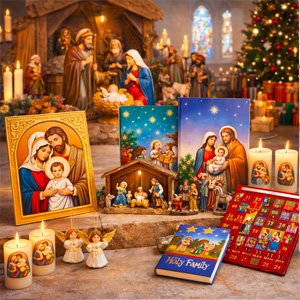
Set up the nativity scene as a family.
Thank someone who helps us in our daily lives.
Entrust a particular intention to Jesus.
Reflect quietly before the nativity scene and thank God for the birth of his Son.
These small gestures help children understand that preparing for Christmas is not just about receiving presents, but also about learning to give, to love and to share.
In this way, they discover that every good deed can become a tangible way of welcoming Jesus into their hearts.
4. Setting up the Christmas nativity scene as a family
The Christmas nativity scene is one of the most powerful symbols of the Nativity.
It reminds us that Jesus, the Son of God, was not born in a palace, but in the simplicity and poverty of a stable.
This humility teaches us that God seeks neither wealth nor outward appearances, but a heart open to his love.
A tradition inspired by Saint Francis of Assisi
In 1223, in Greccio, Italy, Saint Francis of Assisi organised a live re-enactment of the Nativity to enable the faithful to contemplate the birth of Christ more tangibly.
This initiative contributed to the development of the nativity scene tradition, which today holds an important place in many Christian homes.
Setting up the figures gradually
To make this tradition even more meaningful, you can set up the nativity scene gradually during Advent.
Start by setting out the stable, the animals and a few shepherds.
Then add Mary and Joseph, explaining to the children their journey to Bethlehem and their trust in God.
The Baby Jesus can be placed in the manger on the night of 24–25 December, symbolising his birth.
The Three Wise Men can be added to the nativity scene on Epiphany.
Each figure thus provides an opportunity to recount an episode from the Christmas story.
You could also suggest to the children that they place a small piece of straw in the manger each day when they do a good deed.
By Christmas, the manger will be ready to welcome the Baby Jesus, just as their hearts will have been prepared to receive his love.
5. Taking time to pray together during Advent
Prayer lies at the heart of spiritual preparation for Christmas.
However, amidst the sometimes hectic pace of family life, it is not always easy to find time for quiet reflection.
Advent offers us just the right opportunity to rediscover this essential practice.
There is no need to organise long prayers. A few minutes each day can be enough to create a genuine moment of family togetherness.
A simple prayer to say each evening
Before dinner or at bedtime, gather together for a few moments.
You could light a small candle, make the sign of the cross and say this prayer together:
Family prayer for Advent
Lord Jesus,
During this season of Advent, we prepare our hearts for your coming.
Teach us to live in peace, patience and love.
Help our family to remain united in times of joy as well as in times of difficulty.
Grant us generous hearts, attentive to the youngest and the most vulnerable.
May our home become a place of forgiveness, sharing and prayer.
Together with the Virgin Mary and Saint Joseph, we await your birth with trust and hope.
Come, Lord Jesus, dwell in our home and enlighten our lives.
Amen.
Choose a different intention each day
To involve the children more, you could suggest that each of them chooses a particular intention.
One evening, pray for the grandparents. Another evening, pray for the sick, families in difficulty or children suffering from war.
This practice helps to develop compassion and reminds us that Christian prayer is not limited to our personal needs.
It opens us up to others and teaches us to bring their joys and sufferings before God.
6. Rediscovering the Word of God as a family
During Advent, the Church offers us wonderful biblical texts that herald the coming of the Saviour.
Reading these passages as a family helps us to better understand the mystery of Christmas and to discover the essential role played by Mary, Joseph, the prophets and Saint John the Baptist in the history of salvation.
Among the passages particularly suited to this season, we might highlight:
Isaiah 9:1–6: the announcement of a child who will bring peace and light.
Luke 1:26–38: the Annunciation, when the angel Gabriel announces to Mary that she will become the mother of the Saviour.
Matthew 1:18–25: Saint Joseph’s dream and his acceptance of the mission entrusted to him by God.
Luke 1:39–56: Mary’s Visitation to her cousin Elizabeth.
Luke 2:1–20: the account of Jesus’ birth in Bethlehem, to be read especially at Christmas.
After the reading, take a few minutes to discuss it.
Ask the children what they understood, what moved them, or what they would like to ask Jesus.
There is no need for complicated answers. The main thing is to allow them to gradually discover the richness of the Christian faith.
7. Learning to wait: restoring meaning to patience
We live in a world where everything seems to have to be immediate.
Children, like adults, are used to getting what they want straight away.
Yet Advent teaches us a virtue that is sometimes forgotten: patience.
For several weeks, we await the birth of Jesus. This waiting is not empty: it is filled with hope, preparation and trust.
In the Gospel, Mary offers us a magnificent example of this inner attitude.
After receiving the announcement from the angel Gabriel, she awaits the birth of her child with faith, despite the uncertainties and difficulties.
She teaches us to trust in God, even when we do not yet fully understand his plans.
How can we teach children patience during Advent?
It is possible to turn this waiting period into a positive experience.
For example, you could save some decorations for the last few days before Christmas, wait until 24 December to place the Baby Jesus in the nativity scene, or prepare a new part of the celebration each week.
Explain to the children that joy is sometimes greater when it has been long awaited.
Advent thus teaches them that all important things require time, attention and perseverance.
8. Make Advent a time of generosity and sharing
Preparations for Christmas would not be complete without paying special attention to the most vulnerable.
Jesus was born into poverty. His birth reminds us that true wealth is not measured by what we possess, but by the love we are capable of giving.
Advent is therefore a special time to cultivate charity as a family.
Simple ways to help others
There are many ways to put generosity into practice during this period.
You can put together a food parcel for a charity, donate clothes in good condition, take part in a toy collection or visit someone who is isolated.
Children can also make Christmas cards for elderly people living in care homes.
These initiatives help them discover that Christmas is also a celebration of fellowship.
They teach them that a small gesture done with love can bring great comfort.
Learning to give without expecting anything in return
At a time when adverts and shop windows place particular emphasis on presents, it is important to remind children that happiness does not depend solely on what we receive.
Encourage them to choose a toy themselves that they would like to give away, or to set aside some of their pocket money for a good cause.
The aim is not to deprive them, but to help them discover the joy of giving.
True Christian generosity consists in giving from the heart, without seeking any reward.
9. Preparing oneself inwardly for Christmas through forgiveness and reconciliation
Advent is also a time of conversion.
Preparing one’s heart for the birth of Christ means acknowledging one’s mistakes, striving to improve and welcoming God’s mercy.
In family life, tensions and misunderstandings are sometimes inevitable.
Parents may lack patience, children may fall out, and certain hurts may linger for a long time.
Advent invites us to take a step towards reconciliation.
Asking for forgiveness, acknowledging one’s faults or renewing dialogue with someone who has drifted away are all concrete ways of preparing for the coming of Jesus.
Rediscovering the sacrament of reconciliation
For Catholics, the sacrament of penance and reconciliation is a particularly important step during Advent.
It enables us to receive God’s forgiveness and to renew our relationship with him.
Parents can accompany children who have already made their first confession, explaining to them that this sacrament is not a punishment, but an encounter with the Lord’s love and mercy.
Many parishes offer penitential services or opportunities for confession in the run-up to Christmas.
Taking part in this process can help the whole family to experience the feast of the Nativity with a freer and more peaceful heart.
10. Taking part in the life of the Church during Advent
Although family prayer plays an essential role, Advent is also experienced within the Christian community.
Attending Sunday Mass enables us to gradually follow the spiritual journey proposed by the Church.
Each Sunday has its own particular theme, reflected in the biblical readings, prayers and teachings.
The first two weeks highlight vigilance and the call to conversion, whilst the final days focus our attention more on the events immediately preceding the birth of Jesus.
Discovering your parish’s traditions
Depending on the region, some parishes organise prayer vigils, concerts of religious songs, nativity scene blessings or acts of solidarity.
These events can provide wonderful opportunities for family bonding.
They also help children to understand that they belong to a community of believers who are preparing together to welcome the Saviour.
Where possible, taking part in a celebration with grandparents or other family members can strengthen the passing on of the faith across generations.
11. Drawing inspiration from the Virgin Mary and Saint Joseph to live out Advent
Mary and Joseph occupy a central place in the mystery of Christmas.
Their attitude serves as a precious example for all Christian families.
The Virgin Mary, a model of trust and hope
When the angel Gabriel announced to her that she would become the mother of the Saviour, Mary accepted this mission with deep faith.
She does not know all the events that lie ahead, but she chooses to trust in God.
Her ‘yes’ becomes a model of openness and surrender to the divine will.
During Advent, families can turn to Mary to ask her to help them learn to welcome Jesus with the same trust.
The Solemnity of the Immaculate Conception, celebrated on 8 December, is a wonderful opportunity to dedicate a special time of prayer to her.
Saint Joseph, a model of faithfulness and protection
Saint Joseph, for his part, teaches us discretion, courage and a sense of responsibility.
Despite the difficulties, he welcomed Mary, protected the Child Jesus and faithfully fulfilled the mission entrusted to him by God.
His example can be a particular source of inspiration for parents in their role of guiding and protecting their children.
To pray to Saint Joseph during Advent is to ask him to watch over our home and to help us live with trust, simplicity and love.
12. Preparing for Christmas without letting material concerns take over
The run-up to Christmas can sometimes become a source of fatigue and stress.
Between shopping, organising meals, decorations and numerous obligations, we can sometimes lose sight of the deeper meaning of the festival.
Yet Christmas does not require a perfect home, an exceptional meal or a mountain of presents.
Above all, it invites us to welcome God’s presence into our lives.
Rediscovering the simplicity of Bethlehem
In Bethlehem, Mary and Joseph had neither wealth nor comfort.
Yet it was in this simplicity that one of the greatest mysteries of the Christian faith was fulfilled: God became man.
This reality reminds us that what truly matters is not found in outward appearances.
A family gathered round a nativity scene, a moment of shared prayer or a gesture of tenderness can have a far deeper meaning than even the most elaborate preparations.
It is therefore important not to try to do everything.
Choose a few traditions that suit your family and live them out with sincerity.
It is better to have a few moments of faith lived to the full than a multitude of activities carried out in a rush.
13. A simple programme for experiencing the four weeks of Advent as a family
To support families who wish to move gradually towards Christmas, here is a spiritual programme organised around the four weeks of Advent.
First week: opening your heart to hope
This first week can be devoted to trust in God.
Put up the Advent wreath, light the first candle and take the time to explain to the children why Christians await the coming of the Saviour.
Choose a family prayer intention and entrust it to the Lord throughout the week.
You can also start setting up the nativity scene.
Second week: building peace around us
The second week invites us to reflect on the place of peace in our lives.
Encourage every member of the family to make a gesture of reconciliation.
Take the time to talk calmly, listen to each other’s difficulties and ask for forgiveness where necessary.
You can also pray together for countries affected by war.
Week Three: sharing the joy of Christmas
As Christmas approaches, the Church invites us to embrace this joy more fully.
This week can be devoted to Christmas carols, making cards for loved ones and acts of generosity.
Organise a family gathering around the nativity scene or plan a charitable initiative together.
Remind the children that true Christian joy springs from God’s love and from happiness shared with others.
Fourth week: welcoming Jesus with love
The final days of Advent are particularly conducive to contemplation.
Take more time to contemplate the nativity scene, reread the Nativity story and pray with Mary and Joseph.
Avoid, as far as possible, overloading these days with material preparations.
On the evening of 24 December, gather round the nativity scene to thank God for the gift of his Son.
You can then attend Christmas Mass and place the Baby Jesus in the manger.
This simple gesture reminds us that Jesus is the true centre of the Christmas celebration.
14. How can we observe Advent when the children are young or the family is short of time?
Not all families have the same amount of time or the same opportunities.
Some have young children, whilst others have to cope with busy work schedules or difficult personal circumstances.
It is important to remember that observing Advent in a Christian way does not mean adding to one’s obligations.
The essential thing is to move towards Christmas with sincerity.
With very young children, a short prayer, a song or lighting a candle may be enough.
For families with older children, reading the Gospel, discussions about faith and acts of solidarity may take up more time.
Teenagers can be encouraged to choose a personal commitment for themselves: helping a charity, taking part in a celebration or setting aside a few minutes each day for prayer.
Even when schedules are hectic, it is possible to set aside a special moment every Sunday.
What matters is not the quantity of activities undertaken, but the quality of the attention given to God and to others.
Advent must not become an additional burden. It must remain a journey of peace, hope and joy.
15. Christmas Eve: welcoming the birth of the Saviour with joy
After several weeks of preparation, Christmas Eve finally arrives.
Families gather, churches welcome the faithful, and Christmas carols ring out.
This is the time to contemplate the mystery of the Incarnation: God chose to come amongst humankind in the form of a newborn baby.
This birth reveals to us a God who is close to us, humble and full of love.
Before the festivities begin, why not gather the whole family round the nativity scene?
Take a few moments to read the account of Jesus’ birth in the Gospel according to Saint Luke.
Give thanks to the Lord for the joys you have received throughout the year, entrust to him the difficulties you have faced, and ask him to watch over those dear to you.
You may also spare a special thought for those who will be spending Christmas in solitude, ill or in poverty.
The Christian joy of Christmas does not lie in forgetting the world’s suffering, but in believing that the light of Christ can reach every life.
Conclusion: making Advent a true journey of faith as a family
Experiencing Advent as a family is much more than simply preparing for a celebration.
It is embarking together on a spiritual journey that gradually leads us towards the joy of Christmas.
Through the Advent wreath, the nativity scene, daily prayers, Bible readings and acts of charity, every family can discover a simple yet profound way to prepare for the birth of Christ.
These traditions take on their full meaning when lived out in love, trust and simplicity.
They enable children to discover the Christian faith not only through words, but also through concrete actions and shared memories.
They also invite adults to rediscover a sense of wonder at the mystery of Christmas.
For beyond the decorations, meals and presents, Advent reminds us of an essential truth: the greatest Christmas gift is Jesus himself, given to the world out of love.
May these four weeks be an opportunity for every household to draw closer to God, to strengthen family ties and to foster peace.
And when Christmas Eve arrives, may everyone welcome the Baby Jesus with a renewed heart, filled with faith, hope and love.
‘Come, Lord Jesus!’ (Revelation 22:20)