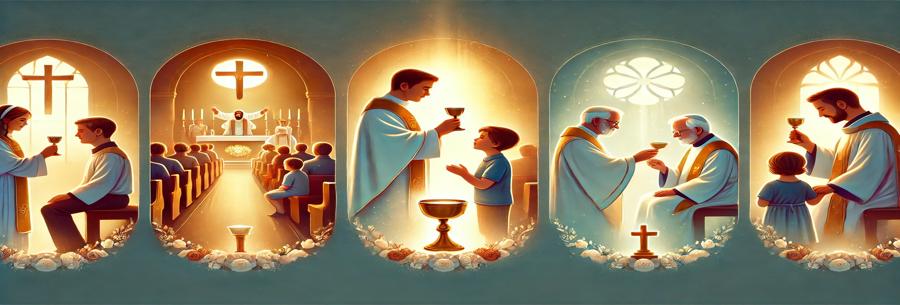
In the Catholic tradition, the three sacramental communions - First Communion, Frequent Communion and Eucharistic Communion during Viaticum - represent major moments in the spiritual journey of a faithful person. Each of these stages is deeply rooted in Eucharistic theology and reflects God's infinite grace and love for his people. Here is a detailed exploration of these three communions and their importance in the Catholic faith.
1. First Communion: An Initial Encounter with Jesus
a) What is First Communion?
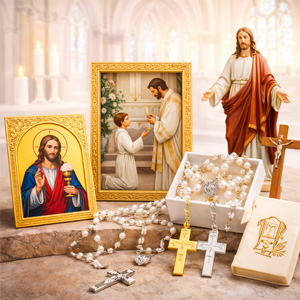
First Communion is the moment when a child, after spiritual and doctrinal preparation, receives the Body and Blood of Christ under the species of bread and wine for the first time. This sacrament marks a key stage in the child's integration into the sacramental life of the Church.
b) Spiritual importance
Union with Christ: The child enters into a deep communion with Jesus, welcoming his real presence in the Eucharist.
Introduction to sacramental life: First Communion opens the door to a life nourished by the Eucharist.
A stage of growth in faith: It marks the beginning of a conscious commitment to the Christian life.
c) Preparation
First Communion is preceded by a time of catechesis, where the child learns the basics of the Christian faith:
The meaning of the Eucharist, essential prayers such as the Our Father, active participation in the Mass.
. Frequent Communion: Continuous Spiritual Nourishment
a) What is frequent communion?
Frequent communion is the regular reception of the Eucharist, usually at Sunday Mass, but also, if possible, daily.
b) Spiritual importance
Feeding the soul:
The Eucharist is called the bread of life (John 6:35) and supports the faithful in their spiritual journey.
Strengthening faith:
Frequent communion helps believers grow in their faith and relationship with God.
Comfort in times of trial: It offers strength and consolation in times of difficulty.
c) Conditions for receiving communion
To receive the Eucharist frequently, a member of the faithful must:
Be in a state of grace, which implies the absence of unconfessed mortal sin.
Have observed the Eucharistic fast (at least one hour before communion).
Participate fully and actively in the liturgy.
d) Frequent communion in the Christian life
Frequent communion is a pillar of the spiritual life. It is encouraged by the Church as a means of remaining united to Christ and living in conformity with the Gospel.
3. Eucharistic Communion at Viaticum: A Preparation for Eternity
a) What is Viaticum?
Viaticum is the Eucharistic communion given to a person at the end of life. The word, which means provision for the journey in Latin, symbolises the Eucharist as a force to accompany the faithful in their passage to eternal life.
b) Spiritual significance
Ultimate union with Christ: Viaticum is regarded as the last sacramental communion, sealing the faithful's union with Jesus.
Strength for the passage: It brings comfort and inner peace to the one who is about to meet God.
Hope in the resurrection: It is a sign of faith in Christ's promise of eternal life.
c) The celebration of Viaticum
Viaticum is often preceded by the sacrament of reconciliation and, if possible, the anointing of the sick. These sacraments allow the faithful to prepare themselves spiritually and receive the grace necessary to face death with serenity.
4. The links between the three communions
a) A spiritual progression
The three communions form a coherent spiritual journey, accompanying the faithful throughout their lives:
First communion initiates the Eucharistic life.
Frequent communion nourishes the faith and sustains the spiritual life.
Viaticum completes the sacramental life, preparing for the encounter with God.
b) A sacramental unity
Each communion is an encounter with Christ in a particular form, but they are all united by the mystery of the Eucharist.
5. The common Eucharistic meaning
a) The real presence
In every communion, the faithful receive the Body and Blood of Christ, truly present under the Eucharistic species. This real presence is the heart of the Catholic Eucharistic faith
b) An act of faith, hope and charity
Communion is a response to Christ's invitation, "Do this in memory of me." (Luke 22:19). It expresses faith in his sacrifice, hope in eternal life, and charity towards God and others.
c) A participation in the community
Communion unites the faithful to the Christian community, the Mystical Body of Christ, and makes them participants in his mission in the world.
6. Conclusion: A life centred on the Eucharist
The three Catholic Communions - First Communion, frequent Communion and Viaticum - accompany believers throughout their lives. They are moments of grace, of encounter with God, and of spiritual growth. By living these stages to the full, the faithful discover the depth of God's love, the power of the Eucharist, and the joy of a life in communion with Christ. These sacraments remind us that the Eucharist is both a precious gift for today and a promise of eternity.