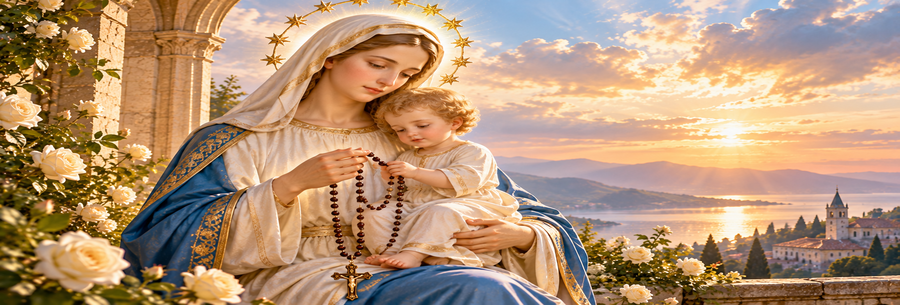
Every year on 7 October, the Catholic Church celebrates the Blessed Virgin Mary of the Rosary, more commonly known as Our Lady of the Rosary.
This Marian feast invites us to rediscover one of the best-known and most beloved prayers in the Catholic tradition: the Rosary.
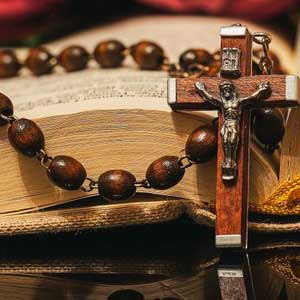
With a rosary in hand, Hail Marys repeated with confidence and, at the heart of this prayer, contemplation of the life of Jesus through the eyes of his Mother.
For praying the Rosary is not simply a matter of repeating words. It is a gradual journey into the great mysteries of Christ’s life, from the Annunciation through to his Passion and Resurrection, via his birth, his public life and the gift of the Holy Spirit.
But why does the Church particularly celebrate Our Lady of the Rosary on 7 October? Where does this feast day come from? What connection is there with the Battle of Lepanto? What is the origin of the Rosary and how can we pray it today?
Let’s set out to discover this beautiful Marian feast.
Why do we celebrate Our Lady of the Rosary on 7 October?
The history of this feast day is closely linked to a major event of the 16th century: the Battle of Lepanto, which took place on 7 October 1571.
At that time, Christian Europe and the Ottoman Empire were locked in conflict in the Mediterranean.
A Christian fleet, united under the Holy League, faced the Ottoman fleet near Lepanto, in the Gulf of Patras, in what is now Greece.
Pope Saint Pius V, who was particularly devoted to the Rosary, then asked the faithful to pray to the Virgin Mary and to recite the Rosary.
Rosary confraternities also organised prayers and processions.
The Holy League’s fleet won the battle on 7 October 1571.
Pius V attributed this victory to the intercession of the Virgin Mary and instituted a feast of thanksgiving under the title of Our Lady of Victory.
His successor, Pope Gregory XIII, subsequently gave this celebration the name Our Lady of the Rosary.
Over time, the feast day spread further throughout the Church until it became the Marian celebration we know today on 7 October.
It is important to understand the spiritual meaning that the Church now attaches to this feast: it does not celebrate war, but reminds us of trust in the prayer and intercession of the Virgin Mary.
What is the Rosary?
The word ‘Rosary’ evokes a crown of roses offered to the Virgin Mary.
In Christian tradition, every prayer recited with love is symbolically like a rose laid at Mary’s feet.
The Rosary is a meditative prayer centred on Christ.
This clarification is essential.
When we pray the Rosary, Mary does not replace Jesus. On the contrary, she accompanies us towards Him.
Through the various mysteries, we contemplate the life, Passion, death and Resurrection of Christ.
Mary is present as the one who welcomed Jesus, who accompanied him, and who still invites us today to turn our gaze towards him.
The Rosary could thus be described as a way of contemplating Jesus through the eyes of Mary.
What is the difference between the chaplet and the Rosary?
The words ‘chaplet’ and ‘Rosary’ are sometimes used as synonyms, but they do not refer to exactly the same thing.
The chaplet generally involves the recitation of five decades of Hail Marys, each preceded by an Our Father and accompanied by the meditation on a mystery from the life of Christ.
The Rosary, in its current form, comprises all four sets of mysteries:
the Joyful Mysteries;
the Luminous Mysteries;
the Sorrowful Mysteries;
the Glorious Mysteries.
This therefore amounts to twenty mysteries.
It is, of course, possible to pray just one Rosary a day.
What matters is not the number of prayers recited, but the faith, attention and trust with which we pray.
Did Saint Dominic receive the Rosary from the Virgin Mary?
A widespread tradition strongly associates the Rosary with Saint Dominic, founder of the Order of Preachers in the 13th century.
According to a pious tradition that has developed over the centuries, the Virgin Mary is said to have taught him or entrusted him with the Rosary as a spiritual weapon to foster the conversion of souls.
The history of the Rosary’s development, however, is a more gradual one.
The prayer developed during the Middle Ages from various practices of Marian devotion and the repetition of the Hail Mary.
The Dominicans subsequently played a significant role in spreading and structuring this devotion.
St Dominic therefore remains deeply associated with the Rosary in the Catholic tradition, even though the form we know today has evolved gradually over the centuries.
Why repeat ‘Hail Mary’ fifty times?
For someone discovering the Rosary for the first time, the repetition may seem surprising.
Why repeat the same prayer over and over again?
The repetition of the Hail Mary is not intended to mechanically multiply the words.
Rather, it creates a rhythm of prayer.
Like a breath.
Whilst the lips recite the words of the prayer, the mind and heart are invited to contemplate an episode from the life of Jesus.
The Rosary thus possesses something deeply soothing.
The repetition gradually slows down our thoughts.
It helps us to step away from the hustle and bustle of daily life.
It allows our mind to focus on God.
Sometimes, we begin a rosary with a heart full of worries and finish it with a greater sense of peace.
The problems have not necessarily disappeared.
But the way we bear them may have changed.
The Joyful Mysteries
The Joyful Mysteries lead us to the beginning of Jesus’ earthly life.
They include:
The Annunciation: the angel Gabriel announces to Mary that she will become the mother of the Saviour.
The Visitation: Mary visits her cousin Elizabeth.
The Nativity: Jesus is born in Bethlehem.
The Presentation of Jesus in the Temple: Mary and Joseph present the Child Jesus to the Lord.
The Finding of Jesus in the Temple: after three days of searching, Mary and Joseph find Jesus amongst the teachers of the Law.
These mysteries speak to us of trust, welcome, family, humility and openness to God’s will.
The Luminous Mysteries
The Luminous Mysteries were proposed to the whole Church by Saint John Paul II in 2002.
They focus in particular on the public life of Jesus:
The Baptism of Jesus in the Jordan.
The Wedding at Cana.
The proclamation of the Kingdom of God and the call to conversion.
The Transfiguration.
The Institution of the Eucharist.
Through these mysteries, we follow Christ in his mission and meditate on his teaching.
The Sorrowful Mysteries
The Sorrowful Mysteries lead us to the heart of Christ’s Passion:
Jesus’ Agony in Gethsemane.
The Scourging.
The Crowning with Thorns.
The Carrying of the Cross.
The Crucifixion and Death of Jesus.
These mysteries take on a special significance when we ourselves are going through a difficult time.
Illness, bereavement, loneliness, anxiety, family or work-related trials…
We can entrust all these sufferings to prayer and unite them with those of Christ.
Mary accompanies us then, just as she remained with Jesus right up to the foot of the Cross.
The Glorious Mysteries
The Glorious Mysteries lead us from the Resurrection to the glory of Heaven:
The Resurrection of Jesus.
The Ascension.
Pentecost.
The Assumption of the Virgin Mary.
The Coronation of Mary in Heaven.
These are the mysteries of hope.
They remind us that the Cross is not the end of the Christian story.
After the darkness of Good Friday comes the light of Easter.
For those going through a trial, this hope is essential:
suffering and death will not have the last word.
How do you pray the Rosary?
You don’t need to be an experienced pray-er to get started.
You can simply take your rosary and spend a few moments in silence.
Traditionally, you begin with the Sign of the Cross and the Creed.
Then come one Our Father, three Hail Marys and one Glory Be.
Next, the meditation on the five mysteries chosen for the day begins.
For each decade:
the mystery is announced;
the Our Father is recited;
ten Hail Marys are recited;
it ends with the Glory Be.
Some people then add the Fatima prayer:
‘O my Jesus, forgive us our sins, save us from the fires of hell, and lead all souls to Heaven, especially those who are most in need of Your mercy.’ ”
The most important thing, however, is to meditate on the mystery rather than simply reciting the prayers quickly.
Praying the Rosary for one’s family
The Rosary holds a special place in family prayer.
We can pray for our spouse.
For our children.
For our parents.
For someone who is ill.
For someone going through a difficult time.
For reconciliation.
For conversion.
For the departed.
When we no longer know how to help someone we love, we always have the option of entrusting them to God in prayer.
Praying the Rosary then becomes a true act of trust.
We humbly acknowledge that we cannot resolve everything on our own.
The Rosary in times of trial
There are times when we are at a loss for words.
We would like to pray but we no longer know what to say.
The Rosary can then become a precious resource.
We do not need to invent the words.
They are already there.
We can simply take up our rosary and begin.
A decade.
Then perhaps another.
And sometimes, simply a few Hail Marys.
Mary then becomes that maternal presence to whom we can entrust what we no longer know how to express.
October, the month of the Rosary
The feast day on 7 October is also part of a wider tradition: the month of October is particularly dedicated to the Rosary in Catholic devotion.
It is therefore a wonderful time to take up this prayer again if we have neglected it, or to discover it if we are not yet familiar with it.
Why not make a very simple resolution?
One decade a day.
It only takes a few minutes.
We can say it in the morning, in a church, whilst out for a walk, on public transport, or in the evening before going to sleep.
Gradually, this little habit can become a genuine encounter with God.
‘Holy Mary, Mother of God, pray for us’
At the heart of every Hail Mary, we make this request:
‘Holy Mary, Mother of God, pray for us sinners, now and at the hour of our death.’