Every year, on 6 October, the Catholic Church celebrates Saint Bruno, priest and founder of the Carthusian Order.
Born in the 11th century, Saint Bruno could have pursued a brilliant ecclesiastical career. A learned man, a renowned teacher and a sought-after counsellor, he nevertheless gradually chose to turn his back on honours in order to seek something far simpler and more radical: God in silence, solitude and prayer.
His name remains inextricably linked today with the Grande Chartreuse, founded in the mountains near Grenoble, and with the Carthusian Order, whose contemplative life is amongst the most demanding in the Catholic Church.
Almost a thousand years after his death, Saint Bruno still challenges us.
In a world where everything is accelerating, where noise accompanies us almost constantly and where our attention is ceaselessly demanded, his life poses a fundamental question:
Do we still know how to be still and listen to God?
Who was Saint Bruno?
Saint Bruno was born around 1030 in Cologne, in what is now Germany, probably into a well-to-do family.
From a very young age, he received a solid intellectual and religious education. In particular, he continued his studies in Reims, which was then one of the great intellectual centres of the Christian West.
Bruno quickly distinguished himself through his intelligence, his learning and his spiritual qualities.
He became a priest and went on to teach theology.
For nearly twenty years, he headed the school at Reims Cathedral and gained a remarkable reputation. Among his pupils was the man who would later become Pope Urban II.
Everything seemed to point to Bruno having a distinguished career within the Church.
But his heart gradually began to yearn for something else.
Leaving honours behind to seek God
Bruno discovered that the responsibilities, honours and affairs of the ecclesiastical world did not correspond to the deep longing growing within him.
He sought a life entirely turned towards God.
Not necessarily a life of action, but a life of contemplation.
A life in which silence allows one to listen.
A life in which solitude becomes a space for encountering God.
A life in which prayer is no longer just a moment in the day, but gradually becomes the centre of one’s entire existence.
Together with a few companions who shared the same desire, Bruno then sought a place where they could live out this vocation.
This search led them to the mountains of the Dauphiné.
The encounter with Saint Hugh of Grenoble
In 1084, Bruno and six companions came before Saint Hugh, Bishop of Grenoble.
According to tradition, Hugh had shortly before had a dream in which he saw seven stars pointing to a secluded spot in the mountains.
When Bruno and his six companions presented themselves before him, the bishop is said to have recognised in these seven men the fulfilment of his dream.
He then led them to a particularly wild and isolated spot in the Chartreuse mountains.
The site was austere.
The mountains were steep, the winters harsh and the isolation almost total.
But for Bruno and his companions, this place represented precisely what they were seeking:
a wilderness in which to encounter God.
It was there that the spiritual adventure began which would give rise to the Grande Chartreuse.
The founding of the Carthusian Order
Bruno does not seem to have sought to establish a large religious order.
His aim was much simpler: to live with a few brothers a life devoted to prayer and contemplation.
Yet this small community gradually became the origin of the Order of the Carthusians.
Carthusian life has a remarkable feature: it combines the solitude of the hermit with the fraternal life of the monk.
Traditionally, each monk has a personal space where he prays, studies, works and takes some of his meals in solitude.
But the monks also come together for certain liturgical services and communal moments.
Solitude is therefore not a rejection of others.
It is sought after to enable a deeper encounter with God.
Silence at the heart of Saint Bruno’s life
When one thinks of the Carthusians, one word immediately springs to mind:
silence.
But Christian silence is not simply the absence of words.
For Saint Bruno, silence creates a space within oneself where God can be heard.
We often live surrounded by noise.
External noise: conversations, television, music, notifications, news.
But also internal noise: worries, memories, plans, frustrations, fears.
Even when everything is silent around us, our mind can continue to race in all directions.
Saint Bruno’s spirituality therefore invites us to gradually rediscover the silence of the heart.
To be silent is not to create a void for the sake of a void.
It is making more room for God.
Solitude: fleeing the world or rediscovering what is essential?
Bruno’s decision to go into the mountains could be seen as a flight from the world.
Yet Christian solitude has a different meaning.
The monk does not leave the world because he despises it.
He withdraws from it in order to carry it more effectively in his prayer.
In the silence of his cell, the Carthusian monk prays not only for himself, but also for the Church and for the world.
This idea is fundamental.
A seemingly hidden life can be deeply spiritually fruitful.
St Bruno thus reminds us that our worth does not depend solely on what we produce, what we display or the recognition we receive.
A humble, silent life offered to God can be of immense value.
When the Pope summoned Bruno to Rome
Bruno’s solitude in the mountains did not, however, last as long as he would have wished.
In 1090, his former pupil, who had become Pope, Urban II, summoned him to Rome.
The Pope wished to benefit from his experience and advice.
For Bruno, this summons represented a real sacrifice.
He had to leave the solitude of the Carthusian monastery and return to the hustle and bustle of ecclesiastical affairs.
Out of obedience, he accepted.
But his desire for a contemplative life remained undiminished.
Urban II eventually realises that Bruno is not destined to live at the papal court for long.
He therefore allows him to return to a more secluded life.
A new life of solitude in Calabria
However, Bruno did not return to the Grande Chartreuse.
Circumstances led him to southern Italy, to Calabria.
He settled in a secluded spot called La Torre, near what is now Serra San Bruno.
There he founded a new community and finally rediscovered the life of silence, prayer and contemplation to which he had so deeply aspired.
It was there that he spent the final years of his life.
Saint Bruno died on 6 October 1101.
This date became the date of his liturgical feast day.
Why is Saint Bruno depicted with a skull?
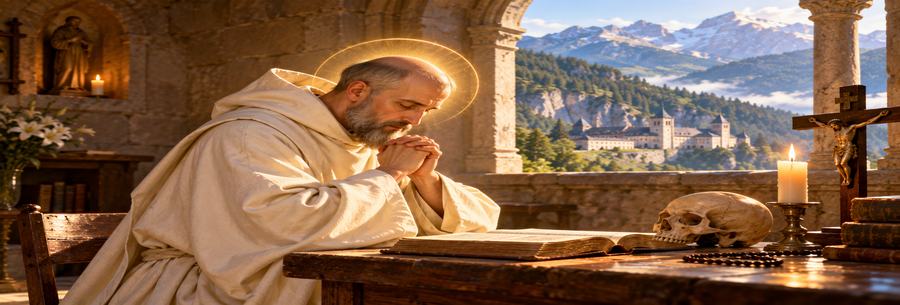
In Christian iconography, Saint Bruno is often depicted wearing the white habit of the Carthusians.
He may also be accompanied by a skull.
This symbol may seem sombre in our times, but it has an ancient spiritual significance.
The skull is a memento mori: a reminder that our earthly life is fleeting.
This is not a fascination with death.
It is an invitation to remember what truly matters.
Our wealth, our achievements, our possessions and our concerns will all eventually fade away.
The question then becomes:
What have we made of our lives?
Have we loved?
Have we forgiven?
Have we sought God?
Have we devoted enough time to what really matters?
What can Saint Bruno teach us today?
We are obviously not all called to become Carthusians.
But we can all learn something from their spirituality.
St Bruno invites us, first and foremost, to rediscover silence.
A few minutes may be enough.
Switch off the phone.
Turn off the television.
Sit before a cross or an image of Christ.
Ask for nothing straight away.
Simply stand before God.
Silence may seem uncomfortable at first.
Our thoughts surge forth.
Our worries return.
But gradually, this silence can become a true inner breath.
Rediscovering a ‘desert’ in our daily lives
We do not need to go to the Chartreuse Mountains to find a desert.
Our desert can be a small room in our home.
A prayer corner.
A church we step into for a few minutes.
A solitary walk.
A few moments before the house wakes up.
Or a few minutes in the evening when everything has quietened down again.
The key is to consciously create a space in which God can take his rightful place once more.
Saint Bruno teaches us that the spiritual life needs silence just as our bodies need rest.
Learning to listen before speaking
Our prayers are often filled with words.
We ask.
We give thanks.
We recite.
We entrust ourselves.
All these forms of prayer are precious.
But Saint Bruno reminds us of another dimension:
listening.
After speaking to God, can we remain in silence for a few moments?
Without seeking a spectacular answer.
Without necessarily expecting a sign.
Simply remaining in his presence.
Prayer then becomes less a succession of words than an encounter.
Saint Bruno and inner peace
The peace sought by Saint Bruno was not merely the outward tranquillity of the mountains.
True Christian peace springs from a heart that gradually learns to surrender itself to God.
We can be alone in a perfectly silent room and yet remain inwardly restless.
Conversely, we can go through a difficult period whilst retaining a deep sense of trust within us.
It is this peace that we can ask for through the intercession of Saint Bruno.
A peace that does not depend solely on circumstances.
A peace that comes from God.
How can we celebrate Saint Bruno on 6 October?
The feast of Saint Bruno can be an excellent opportunity to find a few moments of silence.
We can start by setting aside ten minutes without a mobile phone, without music and without distractions.
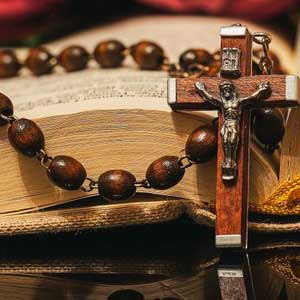
Place a cross, a Bible or a candle in front of us.
Slowly make the Sign of the Cross.
Then simply say:
‘Lord, here I am.’
We can then remain in silence for a few moments.
If thoughts come to distract us, there is no need to be discouraged. Let us gently return to God.
We can end this time of prayer by entrusting to the Lord a person, a difficulty or a particular intention.
In this way, without leaving our home, we can rediscover something of that ‘desert’ which Saint Bruno went to seek in the mountains.
? Prayer to Saint Bruno
Saint Bruno, man of silence and prayer,
you who left behind the honours of the world
to seek God in solitude,
teach us to rediscover what is essential.
When noise invades our lives,
lead us towards silence.
When our thoughts become too numerous,
help us to find peace.
When our worries prevent us from praying,
simply teach us to abide before God.
Saint Bruno,
you who found in solitude
not emptiness, but the presence of the Lord,
help us to set aside moments in our days
dedicated to God.
Teach us to listen before we speak,
to contemplate before we act
and to discern before we decide.
Help us not to constantly seek
honours, recognition or the goods of this world,
but to understand that our true wealth
lies in the love of God.
Today we entrust to you
our families,
our worries,
our decisions
and all the intentions we hold in our hearts.
Intercede especially for those who live in turmoil,
those who can no longer find peace,
those who feel lost
and those who are searching for their path.
May the Lord grant us, through your intercession,
a more peaceful heart,
a deeper faith
and ever-greater trust.
Saint Bruno,
lead us into silence
so that we may better hear the voice of God.
Saint Bruno, pray for us.
Amen. ?
Saint Bruno, a surprisingly modern message
Nearly a thousand years separate us from Saint Bruno.
And yet, his message seems perhaps even more necessary today than it was in the 11th century.
We have extraordinary means at our disposal for communicating, keeping informed and entertaining ourselves. But we sometimes find it increasingly difficult to spend a few minutes alone with ourselves… and with God.
Saint Bruno reminds us that we do not need to fill every silence.
Some answers emerge when we stop rushing.
Some wounds begin to heal when we allow ourselves to pause.
And certain encounters with God simply begin when we finally have the courage to be still.
So, on this 6 October, let us ask Saint Bruno to teach us how to rediscover this inner peace.
Even for just a few minutes.
Even in the midst of a busy day.
Let us be still.
And make room for God.
A happy Feast of Saint Bruno to you all!