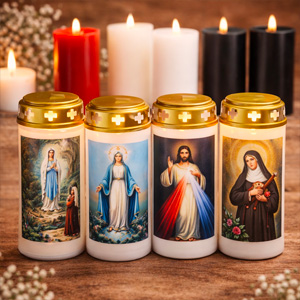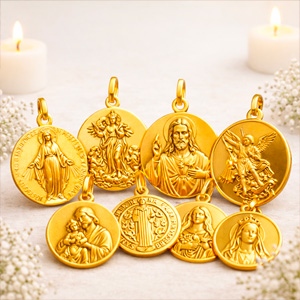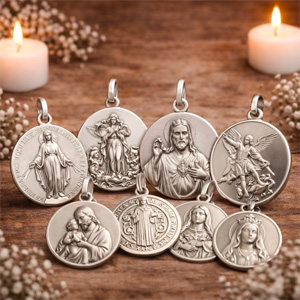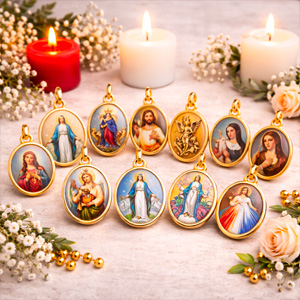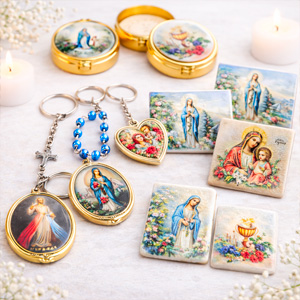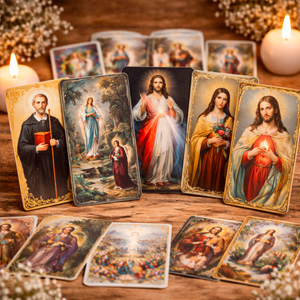
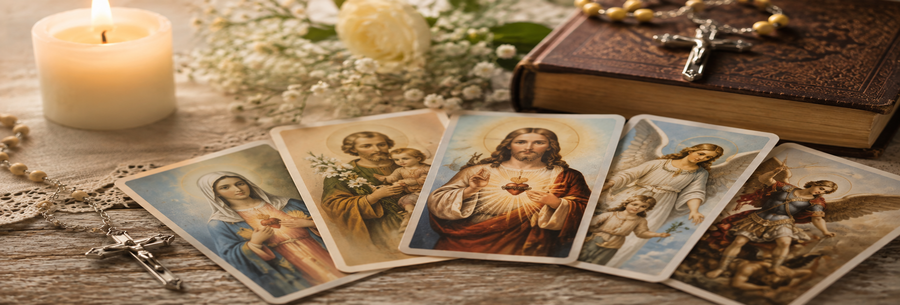
Small in size but often great in significance, the religious image has long been a part of the spiritual life of Christians.
Tucked into a wallet, placed on a bedside table, kept in a prayer book or given as a gift on the occasion of a baptism, a communion or a time of trial, it serves as a discreet reminder of faith and prayer.
But which devotional image should one choose? Should we opt for an image of the Virgin Mary, Jesus, Saint Michael the Archangel, Saint Rita or Saint Christopher?
Each depiction has its own history and may correspond to a particular devotion or intention.
Let’s find out how to choose a Catholic religious image depending on the person for whom it is intended and the prayer one wishes to entrust to it.
Why keep a religious image close to you?
A religious image is not a lucky charm.
In the Christian tradition, it is first and foremost a visible aid that helps to turn one’s thoughts towards God, the Virgin Mary or the saints.
Looking at an image of Christ can encourage us to take a few moments to pray. An image of the Virgin Mary can remind us to entrust a concern to her. The image of a saint can encourage us to ask for their intercession or simply to remember their example.
This also explains why many believers like to keep a small devotional image in their wallet or bag.
In the midst of a busy day, it can serve as a simple reminder: to take a few seconds to reflect and place one’s day in God’s hands.
An image of the Virgin Mary to entrust one’s family to
The Virgin Mary naturally occupies a special place in Catholic devotion.
A image of the Virgin Mary can be given as a gift on almost any occasion: a birth, a baptism, a First Communion, a wedding, during illness, at a time of bereavement, or simply to show one’s affection for someone.
Mary represents maternal presence, trust and surrender to God.
The wide variety of depictions also allows you to choose an image corresponding to a particular devotion.
Our Lady of Lourdes
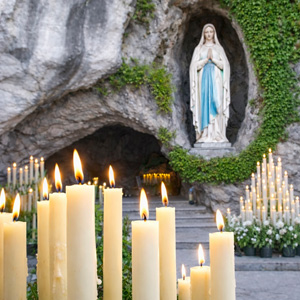
The image of Our Lady of Lourdes commemorates the apparitions of the Virgin Mary to Bernadette Soubirous in 1858 at the Grotto of Massabielle.
It is particularly cherished by those with a special attachment to the shrine at Lourdes and by those who wish to entrust to Mary someone who is ill or going through a difficult time.
An image of Lourdes can also be kept as a souvenir of a pilgrimage.
Our Lady of the Miraculous Medal
The depiction of the Virgin of the Miraculous Medal is linked to the apparitions on Rue du Bac in Paris in 1830 and to Saint Catherine Labouré.
Mary is usually depicted standing, with her arms outstretched and rays of light streaming from her hands.
This image evokes trust in the intercession of the Virgin Mary and in God’s grace.
Our Lady of Fátima
Our Lady of Fátima is associated with the Marian apparitions of 1917 in Portugal.
Her message is deeply linked to prayer, conversion and the Rosary.
An image of Our Lady of Fátima would therefore be particularly suitable for someone devoted to praying the Rosary.
Which image of Jesus should you choose?
There are, of course, numerous depictions of Jesus in Christian art and devotion.
Some emphasise in particular his love, his mercy or his Passion.
The Sacred Heart of Jesus
The image of the Sacred Heart of Jesus generally depicts Christ revealing his heart.
This depiction evokes Christ’s love for humanity and invites the believer to respond to that love through faith and prayer.
An image of the Sacred Heart can naturally find its place in a Christian home or be given as a gift to a family.
Merciful Jesus
The image of Merciful Jesus is linked to the devotion to Divine Mercy, which was spread in particular through Saint Faustina Kowalska.
It serves as a reminder of our trust in God’s mercy.
This image can be particularly meaningful for someone going through a period of doubt, who wishes to return to prayer, or who feels the need to entrust themselves more fully to God.
Christ on the Cross
The crucifix and depictions of Christ on the Cross occupy a central place in the Christian faith.
They serve as a reminder of the Passion, Christ’s sacrifice and his love for humanity, but also of the Resurrection, which gives the Cross its full meaning.
A small image of Christ on the Cross can, in particular, accompany prayer during Lent and Holy Week.
Saint Michael the Archangel, to ask for strength and protection
Recognisable by his sword and armour, Saint Michael the Archangel is one of the most powerful figures in Christian iconography.
In the Book of Revelation, Michael and his angels battle the Dragon.
He is therefore traditionally invoked in spiritual warfare and to seek protection against evil.
An image of Saint Michael can be given to someone going through a difficult time, to someone who feels the need to regain courage, or to a loved one for whom one wishes to offer a prayer.
It can also be placed in the home as a reminder to pray to Saint Michael the Archangel.
Saint Christopher for travellers
Saint Christopher is traditionally regarded as the patron saint of travellers.
Iconography generally depicts him carrying the Infant Jesus on his shoulders to help him cross a river.
This is why his image is often kept by people who travel regularly.
An image of Saint Christopher can therefore be given as a gift before a long journey, a move abroad, or simply to someone who spends a lot of time on the road.
Saint Rita for difficult situations
Saint Rita of Cascia is one of the saints most frequently invoked when a situation seems particularly difficult.
She is traditionally known as the saint of difficult or hopeless causes.
An image of Saint Rita can accompany the prayers of someone facing a family, romantic, professional or personal ordeal.
Giving it as a gift can also be a thoughtful way of telling someone: ‘I’m thinking of you and praying for you. ”
Saint Joseph for family and work
Husband of the Virgin Mary and foster father of Jesus, Saint Joseph is a symbol of faithfulness, humility and protection of the family.
He is also the patron saint of workers.
An image of Saint Joseph may therefore be particularly suitable for a father, for newlyweds or for someone facing difficulties at work.
It can also be placed in the home to entrust the whole family to his intercession.
Saint Benedict in the spiritual struggle
Saint Benedict of Nursia is one of the great figures of the Western monastic tradition.
His name is now particularly associated with the famous Medal of Saint Benedict, which features the Cross and various inscriptions relating to prayer against evil.
An image of Saint Benedict can serve as a companion for those who have a special devotion to him or who wish to seek his intercession in their spiritual life.
Saint Anthony of Padua for finding lost items
This is probably one of the best-known Christian folk traditions!
Saint Anthony of Padua is traditionally invoked to help find lost objects.
But to reduce Saint Anthony to this single tradition would be to overlook the importance of his spiritual life. A Franciscan and a great preacher, he is also depicted holding the Infant Jesus in his arms.
An image of Saint Anthony can therefore be given either in reference to this popular tradition or as an expression of personal devotion to the saint.
What religious image should you give as a christening gift?
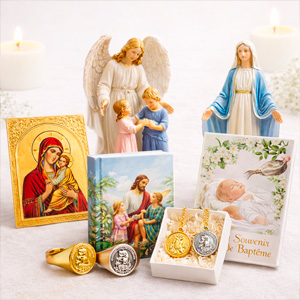
A christening is a wonderful occasion to give a religious image.
For a child, you could choose a depiction of:
- the Virgin Mary;
- the Guardian Angel;
- Jesus with children;
- the saint after whom the child is named;
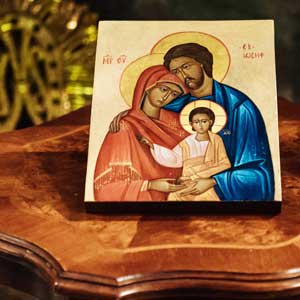
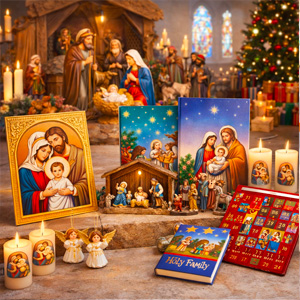
- the Holy Family.
The image can then be kept in a keepsake box alongside the medal, the candle and other mementos from the christening.
A short prayer or a few personal words written on the back will also help to turn this image into a true family keepsake.
Which picture should you choose for a First Communion?
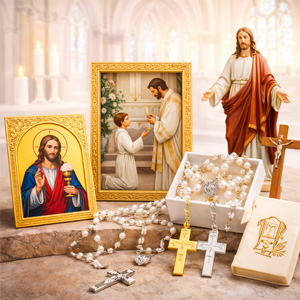
For a First Communion, depictions of Jesus, the chalice, the host or the Eucharist are particularly suitable.
There are also images accompanied by a prayer that the child can keep in their missal or First Communion book.
It is a simple keepsake that will remain associated with this important stage in their Christian life for many years to come.
A picture of the Guardian Angel for a child
The image of the Guardian Angel is one of the Christian images traditionally given to children.
It can be placed near the bed or kept in the bedroom.
In particular, it enables parents to gradually teach their child a short prayer to their Guardian Angel and to get them into the habit of ending their day with a few words addressed to God.
It makes a lovely little gift for a birth, a christening or a birthday.
A religious image to comfort someone who is unwell
When someone is unwell, finding the right gift or the right words isn’t always easy.
A religious image accompanied by a prayer can be a simple and discreet gesture.
A depiction of Our Lady of Lourdes is naturally very much appreciated in such circumstances, given the strong link between Lourdes, the sick and prayer.
One might also choose Saint Raphael the Archangel, traditionally associated with healing, or simply an image of Christ.
The image is, of course, not a cure and is no substitute for medical treatment. It symbolises a spiritual presence and a prayerful intention.
Can you write a prayer on the back of a devotional image?
Yes, and it is actually a lovely way to personalise a religious image given to someone.
A few words are enough:
‘May Our Lady be with you every day. ”
“I keep you in my prayers.”
“May Saint Michael give you strength and courage.”
“May the Lord watch over your family. ”
For a christening or First Communion, you can also include the date of the ceremony and the child’s first name.
The image then becomes both an object of devotion and a personal keepsake.
Where should a religious image be placed in the home?
There is no single correct place.
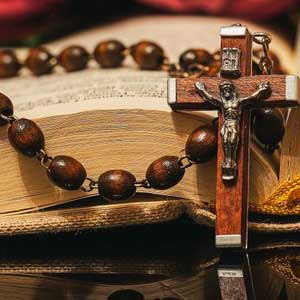
Some people set up a small prayer corner with a Bible, a crucifix, a statue, a rosary and a few religious images.
Others prefer simply to place an image of the Virgin Mary or Christ on a bedside table.
The key is not to accumulate religious images but to give them a genuine place in one’s spiritual life.
A single image before which one regularly takes a few minutes to pray can be more meaningful than a multitude of objects that one no longer looks at.
A religious image is not a good-luck charm
This distinction is important.
In the Catholic faith, an image of the Virgin Mary or a saint possesses no magical power.
A Christian does not worship the image.
When they reflect before an image of Mary or a saint, their prayer is addressed to the person depicted and asks for their intercession with God.
The image is therefore a means of remembrance, contemplation and prayer.
It helps us to remember God and those who have lived before us in the faith.
A small image for a great intention
There is no need to wait for a baptism, a First Communion or a religious feast day to give a devotional image.
It can simply accompany a moment in life.
A picture of Our Lady for a mother, Saint Christopher before a journey, Saint Joseph for a father, Saint Rita during a difficult time, or Saint Michael to ask for strength and protection...
Behind every image there may lie an intention.
And that is probably why these little religious images are passed down so easily through the generations.
Some remain for decades in a missal or a wallet. Others have a date, a first name or a few words written on the back by a loved one.
Beyond the image itself, they then become a memento of a prayer, an event or a person.
Choosing a religious image is, ultimately, choosing a presence that reminds us to turn our hearts towards God regularly.