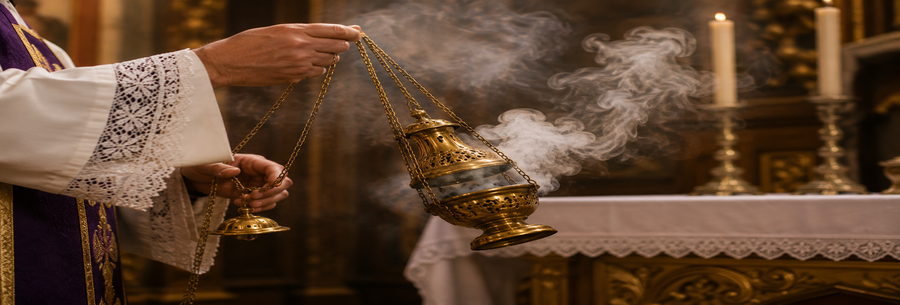
Incense has been part of Christian prayer since the early centuries of the Church. Its fragrance, rising towards heaven, symbolises the prayers of the faithful ascending to God, whilst its smoke serves as a reminder of the divine presence and the sanctity of the consecrated place.
Whether in church during Mass or at home during a time of prayer, using a thurible remains a beautiful way to live out one’s faith today. But how do you use a thurible correctly? Which incense should you choose? How do you light it safely? Here is a comprehensive guide to discovering or rediscovering this Christian tradition.
What is a thurible?
A thurible is a metal vessel designed to burn incense over glowing coals.
In the Catholic tradition, it is often suspended from chains so that it can be swung during liturgical ceremonies.
We generally distinguish between:
The thurible itself.
The incense holder, which contains the grains of incense.
The incense spoon used to place the incense on the embers.
The coals specially designed for incense.
Censers can be simple or richly decorated depending on whether they are used in the home or for liturgical purposes.
Why is incense used in the Christian religion?
The use of incense dates back to the Old Testament.
In the Temple of Jerusalem, the priests offered incense daily before God.
Psalm 140 beautifully expresses this symbolism:
‘Let my prayer rise before you like incense. ”
In the New Testament, the Magi offer the Child Jesus three gifts:
Gold for His kingship.
Incense for His divinity.
Myrrh, foreshadowing His Passion.
Even today, incense is used during major liturgical celebrations, blessings, processions, funerals and Eucharistic adoration.
What you’ll need
To use a traditional censer, you’ll need:
A censer.
Incense coals.
Coal tongs.
Incense grains.
A heat-resistant stand.
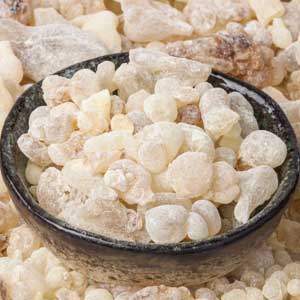
It is advisable to choose high-quality incense, made from natural resins such as:
Olibanum (traditional church incense).
Myrrh.
Benzoin.
Copal.
Fragrant liturgical blends.
How do you light the charcoal?
Lighting the charcoal is the most important step.
Place the charcoal in the censer or on a heat-resistant surface.
Using a lighter or a match, light the edge of the charcoal.
Self-lighting coals usually crackle for a few seconds.
Wait until the entire surface turns grey or whitish.
This step can take between five and ten minutes depending on the type of coal used.
Never place the incense on the charcoal until it is sufficiently hot.
Placing the incense
When the charcoal is ready, add a few grains of incense.
A small amount is sufficient.
As soon as it comes into contact with the embers, the incense begins to melt and release its fragrant smoke.
You can adjust the intensity of the fragrance by adding more or less incense.
It is better to add small amounts regularly rather than a large amount all at once.
Using the censer during prayer
At home, incense can accompany:
Reading the Bible.
The Rosary.
Adoration.
A novena.
Family prayer.
A blessing of the home.
Some families like to pass the censer around the different rooms of the house whilst reciting prayers to entrust their home to God’s protection.
This practice should always be experienced as an act of faith and prayer.
Incense in the liturgy
During Mass, the priest uses incense to honour what is consecrated to God.
The following may be incensed:
The altar.
The Gospel book.
The Cross.
The offerings.
The Blessed Sacrament.
The faithful.
The body of the deceased at funerals.
Incensing expresses respect, honour and veneration.
The various gestures of incensing
In the liturgy, the movements of the censer have a specific meaning.
Depending on the circumstances, the priest performs:
A single swing.
Two swings.
Three swings.
These gestures demonstrate the honour paid to sacred persons or objects.
Safety advice
Although using a censer is straightforward, certain precautions are essential.
Never leave a lit charcoal unattended.
Keep out of reach of children.
Use a heat-resistant surface.
Avoid draughts.
Wait until it has cooled completely before emptying the ashes.
Ensure the room is well ventilated.
These few precautions ensure you can enjoy incense safely.
Which incense should you choose?
Frankincense remains the most commonly used in churches.
Its resinous and slightly lemony scent is immediately associated with Christian prayer.
Myrrh brings a deeper, more meditative note.
Benzoin gives off a sweet, warm scent.
Many monastic or liturgical blends combine several resins to create a fragrance particularly suited to prayer.
Incense in spiritual life
Incense does not replace prayer.
It is simply its visible symbol.
Its smoke reminds us that our petitions, our praise and our thanksgiving rise up to God.
Its fragrance invites contemplation and helps to create an atmosphere conducive to meditation.
For centuries, Christians have used incense to mark important moments in their spiritual lives and to recall God’s presence amongst His people.
Using a censer is an ancient tradition that remains deeply relevant today. Whether during a liturgical celebration or in the silence of prayer at home, incense helps us to enter into an attitude of contemplation and worship.
Simple to use with a few precautions, the censer allows us to rediscover an age-old gesture that connects today’s Christians to the entire history of the Church.
With every fragrant wisp rising towards heaven, we can make the psalmist’s prayer our own:
“Let my prayer rise before you like incense, and my hands like the evening sacrifice. ” (Ps 140:2)