
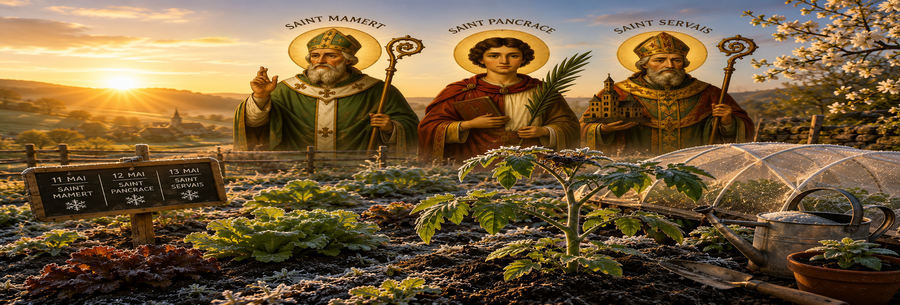
Every year in May, gardeners, farmers and gardening enthusiasts keep a close watch on a very special time of year: the Ice Saints. According to a very old folk belief, one should wait until the end of this period before planting the plants most sensitive to the cold. But where does this tradition come from? Who were these saints really? And do the Ice Saints still have any significance today?
A centuries-old tradition
The Ice Saints correspond to the feast days of three saints in the Christian calendar:
Saint Mamert: 11 May
Saint Pancras: 12 May
Saint Servatius: 13 May
Over the centuries, these three saints have become the traditional markers of the last spring frosts. As early as the Middle Ages, farmers had noticed that a sudden drop in temperatures could still occur at the beginning of May and destroy young crops. They therefore associated these cold spells with the days dedicated to these saints.
Folk sayings multiplied:
“Saint Servatius, Saint Pancras and Saint Mamert together bring a little winter.”
Or again:
“Before Saint Servatius, no summer; after Saint Servatius, no more frost.” ”
These proverbs long served as practical agricultural guides.
Who were the three Ice Saints?
Saint Mamert
Saint Mamert was bishop of Vienne, in Gaul, in the 5th century. He is best known for having established the Rogations, three days of prayer and processions intended to seek divine protection for the harvests and to ward off natural disasters. His memory has remained closely linked to the agricultural world.
Saint Pancras
Saint Pancras was a young Roman Christian who died a martyr at around the age of fourteen during the persecutions of Emperor Diocletian. Although he has no direct connection with agriculture, his feast day on 12 May has naturally integrated him into this popular tradition.
Saint Servatius
Bishop of Tongeren, in present-day Belgium, Saint Servatius was invoked to protect crops and livestock. His reputation as a protector against climatic disasters reinforced his association with late frosts.
Why do we talk about frosts at this time of year?
The explanation is partly meteorological.
In May, the days often become very mild, even warm. However, cold air masses from northern Europe can still occur. When the sky is clear at night, the heat stored in the ground escapes quickly, which encourages the formation of morning frosts.
For young tomato, courgette, cucumber, aubergine or pepper plants, a single night of frost can be fatal.
This is why older generations preferred to wait until mid-May before planting the most delicate crops.
The Ice Saints in different regions
Dates may vary depending on the region.
In certain areas of France or Europe, the following are added:
Saint Boniface: 14 May
Saint Sophie: 15 May
Saint Yves: 19 May
Saint Urbain: 25 May
Winegrowers and farmers often kept an eye on these additional dates before considering the risk of frost to be definitively over.
A tradition altered by the Church
Many are unaware that the Ice Saints disappeared from the official liturgical calendar during the reform of the Roman calendar in the 20th century.
The dates of 11, 12 and 13 May are now associated with other saints:
Saint Estelle
Saint Achilles
Saint Rolande
However, in popular culture, the names Mamert, Pancras and Servatius continue to be used by gardeners and in almanacs.
Are the Ice Saints still relevant today?
The answer is not so clear-cut.
According to a study published by Météo-France in 2026, the belief that the last frosts occur before 13 May is not always accurate. The data show that, over a long period of observation, frosts were still recorded after the Ice Saints in around two out of every three years.
However, the risk decreases significantly from mid-May onwards.
Global warming has also altered certain patterns:
late frosts are becoming less frequent overall;
springs often arrive earlier;
but late cold spells remain possible and can sometimes be destructive.
Thus, even in 2026, the Ice Saints period was marked by a veritable onslaught of polar air, with sub-zero temperatures observed in several regions of France.
What should we take away from this today?
The Ice Saints are not a meteorological law, but a precious legacy of peasant observation. For centuries, farmers have learnt to observe the sky, the winds and the temperatures to protect their crops.
Even though modern weather forecasts are now much more reliable, this tradition remains a symbol of folk wisdom and the close bond between humans, nature and the rhythm of the seasons.
Every year, when 11, 12 and 13 May roll around, the Ice Saints serve as a reminder that, in the heart of spring, winter can still make one last stand before finally giving way to the warmer days. ?❄️?