Saint Cecilia is one of the most beloved saints of the Christian tradition. A luminous figure of the early centuries, she embodies the gentle strength of faith, purity of heart and heroic courage in the face of oppression. Her name has been associated with sacred music since the Middle Ages, and countless composers, painters and poets have celebrated her as a symbol of divine harmony.
Yet behind the delicate image of the young virgin musician lies a powerful story, marked by faithfulness to the point of martyrdom. Here is the full story of her life, as handed down by Church tradition.
1. Origins: a young Roman woman devoted to God
Saint Cecilia was born in the IIᵉ century, in the heart of imperial Rome. Born into a noble Christian family, she received a refined education. From childhood, she devoted herself inwardly to God and took a vow of virginity. This radical choice was nourished by her constant prayer, her deep love for Christ, and a burning desire to live totally united with Him.
It is said that she always carried a small Gospel on her chest, which she read every day in secret, and that she accompanied her prayers with gentle, fervent songs. Already, tradition presents her as a musical soul, attuned to the rhythm of grace.
2. Her forced marriage to Valerian
Although Cécile had dedicated her life to God, her parents, unaware of her inner commitment, decided to marry her off to a young Roman nobleman named Valerian, from a pagan family.
On their wedding night, Cécile revealed to Valerian that an angel of God was watching over her and protecting her consecrated virginity. Moved by this mysterious declaration, Valérien agrees to listen to her faith. Cécile promises him that he will be able to see this angel if he himself agrees to receive baptism.
Valerian then meets Pope Urban I, who is hiding in the catacombs due to persecution. After a long conversation, Valerian receives baptism, followed shortly afterwards by his brother Tiburce, who in turn is converted when he sees Valerian's transformation.
3. The vision of the angel
According to tradition, when Valerian returns to Cécile after his baptism, an angel appears between them, dazzling with light, holding in his hands two crowns: one of lilies, the other of roses. He places them on the heads of Cecilia and Valerian, symbols of purity and spiritual love.
This episode is one of the most famous in the life of the saint. It expresses:
Cecilia's fidelity to her vow,
the inner beauty of her faith,
the heavenly approval of her mystical union with Christ.
4. Courage in the face of persecution
At this time, Christians were pursued by the prefect Almachus. Valerian and Tiburce were accused of giving Christian burials to the martyrs. They refused to sacrifice to pagan gods and were condemned to death.
Cecilia, far from letting herself be defeated, continued to proclaim Christ with astonishing boldness. She distributed her possessions to the poor, taught the faith, welcomed Christians into her home and transformed her residence into a veritable place of prayer.
5. Her heroic martyrdom
In her turn arrested, Cécile was condemned to die of asphyxiation in the burning baths of her house. But despite the flames and suffocating heat, she remains unharmed: this is the first miracle associated with her martyrdom.
Furious, the prefect orders her beheaded. The executioner struck her three times with his sword - the maximum allowed by law - but Cécile did not die immediately. Seriously wounded, she survived another three days, during which she continued to pray, sing and exhort the Christians.
During these three miraculous days:
she entrusted her possessions to the Church,
she asked for her house to become a place of worship,
she forgave her executioners,
and she again drew many pagans to the faith.
She finally dies in profound peace, her face turned towards God, her three fingers open to symbolise the Trinity, and one finger folded back to symbolise the unity of God.
6. Miracle after miracle: the trace of Saint Cecilia in history
a) The miraculous perfume of her tomb
When her body was laid to rest in the catacombs, a scent of roses filled the place. This fragrance was often mentioned in pilgrimage accounts.
b) Her body remained intact
In 1599, during the restoration of her basilica, Cardinal Sfondrati opened her tomb and discovered her incorrupt body, resting in the position in which she had breathed her last. This discovery provoked an immense surge of devotion.
c) Miracles obtained through her intercession
Since the first centuries, countless faithful have testified to favours:
healings,
conversions,
protections,
peace of heart,
musical or artistic inspirations.
7. Why is Saint Cecilia the patron saint of musicians?
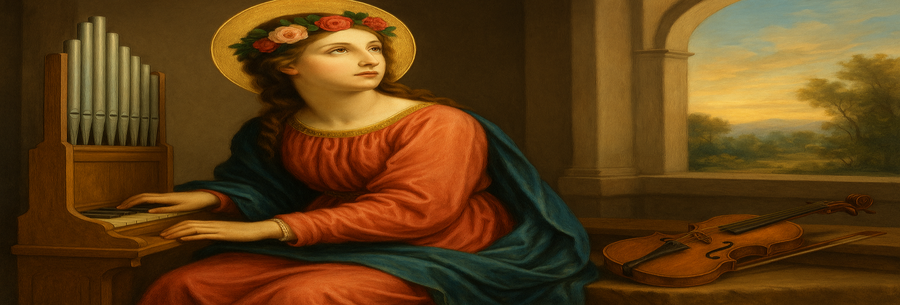
Tradition relates that at the time of her wedding, Cecilia sang in her heart to God. It is also said that she sang during her torture to keep up her courage. Very early on, artists depicted her:
playing the organ,
holding a violin,
accompanied by angel musicians.
From the Middle Ages onwards, she became the patron saint of musicians. The greatest composers - Purcell, Handel, Gounod, Charpentier - dedicated major works to her.
Her association with music expresses a profound truth:
Sainte Cécile embodies the soul that transforms all suffering into song, all life into praise.
Conclusion: a luminous model for today
Saint Cecilia is not just a figure of Christian antiquity:
she is a model for believers of all times.
She teaches us:
fidelity to God in the midst of trials,
the strength of a pure and courageous heart,
forgiveness even in the face of injustice,
the beauty of a life turned towards heaven,
and the spiritual power of music as the language of the soul.
In her, faith becomes melody, charity becomes harmony, and the whole of life becomes a song offered to God.