For many Christians, the words rosary and rosa ire seem to mean the same thing. In reality, they are intimately linked, but are not quite identical. The Rosary refers to the complete set of prayers, while the rosary is a part of it, a shorter, daily form of this great Marian devotion.
The rosary and the rosary: the same prayer, two complementary practices
The word rosary comes from the Latin rosarium, meaning "crown of roses": each prayer recited is like a rose offered to the Virgin Mary, a flower of love and faith woven around the mysteries of Christ's life. Originally, the Rosary comprised 150 Hail Marys, divided into three groups of 50 prayers, corresponding to the three series of mysteries: joyful, sorrowful and glorious.
Today, thanks to Saint John Paul II, a fourth series has been added: the luminous mysteries, meditating on the public life of Jesus. Thus, the complete Rosary now has 20 decades, or 200 Hail Marys.
By contrast, the Rosary corresponds to the recitation of a single series of five decades, i.e. five mysteries. Most of the faithful therefore pray one rosary a day, following the mysteries assigned to each day of the week. The complete Rosary can be prayed over several days, or on special spiritual occasions.
A deeply biblical and contemplative prayer
The Rosary is not a prayer of mechanical repetition, but an active meditation on the great events of Christ's life, experienced and contemplated through the eyes of the Virgin Mary. It is, in a way, a living summary of the whole Gospel.
Each Hail Mary takes us back to the greeting of the angel Gabriel in Nazareth: "Hail Mary, full of grace, the Lord is with you." By repeating these words, we allow God's love to grow within us, and we learn to welcome Christ as she did.
The mysteries of the Rosary
Each Rosary is organised around five mysteries, which we meditate on in silence or aloud.
The Joyful Mysteries (Monday and Saturday): they remind us of the beginnings of Christ's life - the Annunciation, the Visitation, the Nativity, the Presentation in the Temple and the Recovering of Jesus from among the doctors.
The Sorrowful Mysteries (Tuesday and Friday): they plunge us into Christ's Passion - the Agony in Gethsemane, the Flagellation, the Crowning with Thorns, the Carrying of the Cross and the Crucifixion.
The Glorious Mysteries (Wednesday and Sunday): these celebrate the victory of the Risen Christ - the Resurrection, the Ascension, Pentecost, the Assumption of Mary and her Coronation into Heaven.
The Luminous Mysteries (Thursday): added by Saint John Paul II, they meditate on the public life of Jesus - his Baptism in the Jordan, the Wedding at Cana, the Annunciation of the Kingdom, the Transfiguration and the Institution of the Eucharist.
These mysteries allow us to contemplate the entire history of salvation, from the coming of Christ to his triumph in glory.
How to pray the Rosary step by step
Praying the Rosary requires just a few minutes, a peaceful heart and a rosary in your hands. Here's the traditional structure:
Make the sign of the cross and recite the Creed (Symbol of the Apostles).
Say an Our Father.
Recite three Hail Marys to ask for the virtues of faith, hope and charity.
Say a Glory be to the Father.
Announce the first mystery (according to the day of the week), then recite:
an Our Father
ten Hail Marys, meditating on the mystery
a Glory to the Father
and possibly the Fatima prayer: "O my Jesus, forgive us our sins, preserve us from the fire of hell and lead to Heaven all souls, especially those most in need of your mercy. "
Recommence for the five mysteries of the day.
End the rosary with a prayer to Mary, such as the Salve Regina (Hail, Queen).
This prayer framework may seem simple, but it opens up an immense space for contemplation. By repeating the words of the Rosary, the mind calms, the heart lifts, and the presence of God becomes more intimate.
The spiritual fruits of the Rosary
Reciting the Rosary regularly profoundly transforms the inner life. This prayer educates one to patience, gentleness and peace of heart. It unites faith and daily life, action and contemplation.
Mary, through the Rosary, becomes a Mother and a friend who accompanies the believer step by step on the path to Christ. She teaches us to pray with confidence, to persevere in trials, to abandon ourselves to God's will.
The Rosary is also a prayer for protection and peace. At Fatima, in 1917, the Blessed Virgin asked us to recite the Rosary every day to obtain peace in the world. She promised that this simple but powerful prayer could change hearts and keep wars at bay.
Why pray with a rosary?
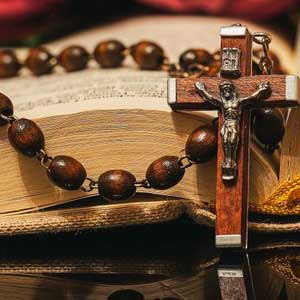
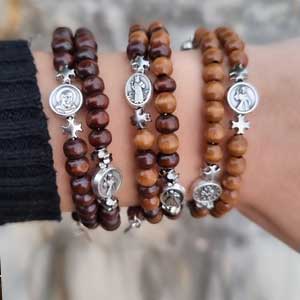
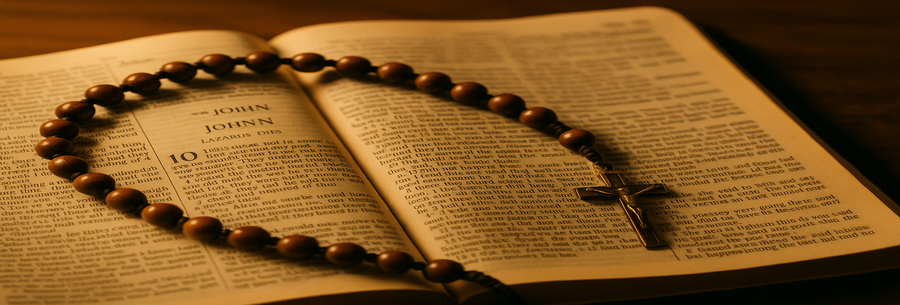
The rosary is not just a religious accessory: it is a spiritual tool that helps you pray with body and mind. Each bead, each gesture of the thumb on the bead is a concrete way of uniting oneself to prayer.
The regular movement soothes, encourages concentration and helps to anchor prayer in the rhythm of the breath and the heart.
What's more, praying with a blessed rosary is an act of faith. It reminds us of Mary's presence by our side and invites us to sanctify our daily time. Many of the faithful carry it with them as a sign of trust and protection.
A path of faith accessible to all
The Rosary is a universal prayer, both simple and profound, suitable for all souls: children, adults, religious, lay people or suffering people. It can be recited alone in silence, or in a group in a church, a shrine or even as a family.
Some people pray a whole rosary every day, others just a dozen. The important thing is not the quantity, but the love with which we pray. A single ten said with faith and recollection has as much value as a complete Rosary recited distractedly.
A prayer that unites heaven and earth
The Rosary and the Rosary are the two faces of the same prayer of love, a dialogue between the heart of man and that of God, through the Virgin Mary.
Through the Rosary, we learn to meditate on the life of Christ, to walk with Mary, and to make every moment an offering of peace and light.
The Rosary is not a prayer from the past: it is a present-day response to the needs of the world. In times of fatigue, doubt or fear, it reminds us that God is near, that Mary is watching, and that sincere prayer can transform everything.
"With the Rosary, the Christian puts himself in the school of Mary, to allow himself to be introduced into the contemplation of the beauty of Christ's face."
- Saint John Paul II