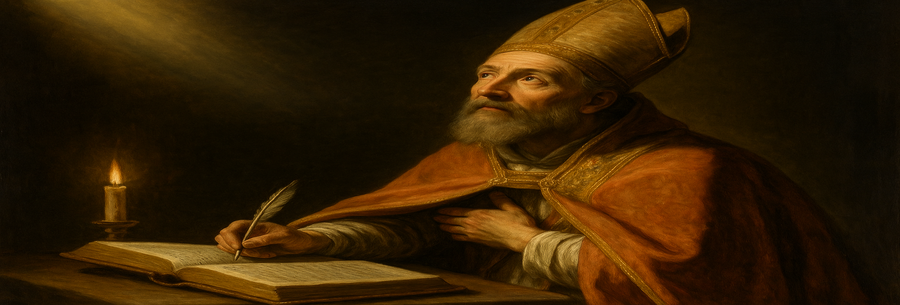
The spiritual legacy of Saint Augustine is immense and profoundly alive even today. His life, marked by the search for truth and a thirst for the absolute, makes him one of the greatest witnesses to the Christian faith. Throughout his life, Augustine sought to understand the meaning of life, the presence of God, the reason for evil and the path to inner peace. His journey, from tumultuous youth to sincere conversion, still inspires those who doubt, seek or struggle to believe.
Before becoming the great bishop of Hippo, Augustine was a tormented man. He knew the seductions of the world, the vanity of honours and the illusions of human wisdom. But behind his wanderings lay a heart in search of the infinite. It is this tension between man's weakness and God's call that structures all his thought. His famous phrase, taken from the Confessions, sums up his spiritual experience: "You have made us for yourself, Lord, and our heart is restless until it rests in you."
The conversion: from wandering to light
Augustine's conversion is one of the most moving episodes in spiritual literature. It was not a sudden event, but the fruit of a long inner struggle. In his Confessions, he describes with disarming sincerity his hesitations, temptations and tears before abandoning himself to God. This passage from darkness to light, from self-love to love of God, is the foundation of his entire spiritual legacy.
Augustine shows that faith is not a cold certainty, but a living encounter with the One who gives meaning to life. He teaches that conversion is an adventure of the heart, a dialogue between human freedom and divine grace. Man cannot save himself alone, but he can consent to be saved. In this cooperation between grace and will, he sees the key to salvation.
Grace, freedom and mercy
One of St Augustine's major contributions to Christian theology is his reflection on grace. He insists on the primacy of God's action in the human heart: all good, all spiritual progress, all conversion comes first of all from grace. But far from abolishing freedom, grace makes it possible. Without God, man can do nothing; with God, everything becomes possible.
This profoundly humble and trusting vision led Augustine to meditate at length on mercy. For him, God is a patient Father who never tires of forgiving. In the Confessions, he confides: "Late have I loved you, beauty so old and so new, late have I loved you!" These words, full of tenderness and regret, sum up his understanding of mercy: God waits for man, seeks him out, lifts him up, and never ceases to call him to return to Him.
The Church, a community of pilgrims
St Augustine not only sought God in the silence of his heart; he also served Him in community. As Bishop of Hippo, he lived among his people, preaching, teaching, accompanying and listening. For him, the Church is the place where God makes himself visible in charity and communion.
He often compares it to a spiritual city: The City of God. In this great work, he contrasts the "earthly city", marked by love of self to the point of contempt for God, with the "heavenly city", driven by love of God to the point of contempt for self. These two cities coexist in history, but their purpose is different: one passes away, the other remains. With this image, Augustine invites us to live already on earth as citizens of heaven.
The inner master
Another central aspect of the Augustinian legacy is the discovery of the "inner master". Augustine asserts that God dwells in the innermost depths of the human soul. He is not to be found primarily in the external world, but in the depths of the heart, where the voice of conscience resounds. "Do not go out of yourself, go into yourself; it is in the inner man that truth dwells."
This invitation to interiority runs through his entire spirituality. Augustine teaches that prayer, meditation and silence are not an escape from the world, but a return to what is essential. By turning inward, man discovers the discreet but constant presence of God, the source of peace and light.
A universal and lasting influence
St Augustine's spiritual legacy transcends the boundaries of time and tradition. His writings have shaped Christian theology, philosophy and mysticism. But more than that, they speak to every human soul. His struggle between flesh and spirit, his search for meaning, his late conversion - all these resonate with the universal experience of man in search.
His influence extends far beyond the Christian world. Thinkers, both believers and non-believers, have recognised in him a model of inner depth and intellectual honesty. His message remains astonishingly relevant today: modern man, often scattered and restless, finds in Augustine a call to refocus on what is essential, to listen to the voice of God in the silence of the heart.
A saint for our time
The legacy of Saint Augustine is a call to inner conversion, to mercy and peace of heart. He reminds us that happiness is not to be found in passing possessions, but in the love of God, the source of all true joy. His life proves that it is never too late to return to God, to change, to love.
In a world that is often turbulent and uncertain, Augustine invites us to seek the light that does not go out, to listen to the voice that whispers in the depths of the soul: "Return to me, for I loved you first."